

| Hea Kung Hur | 1 Article |
Purpose
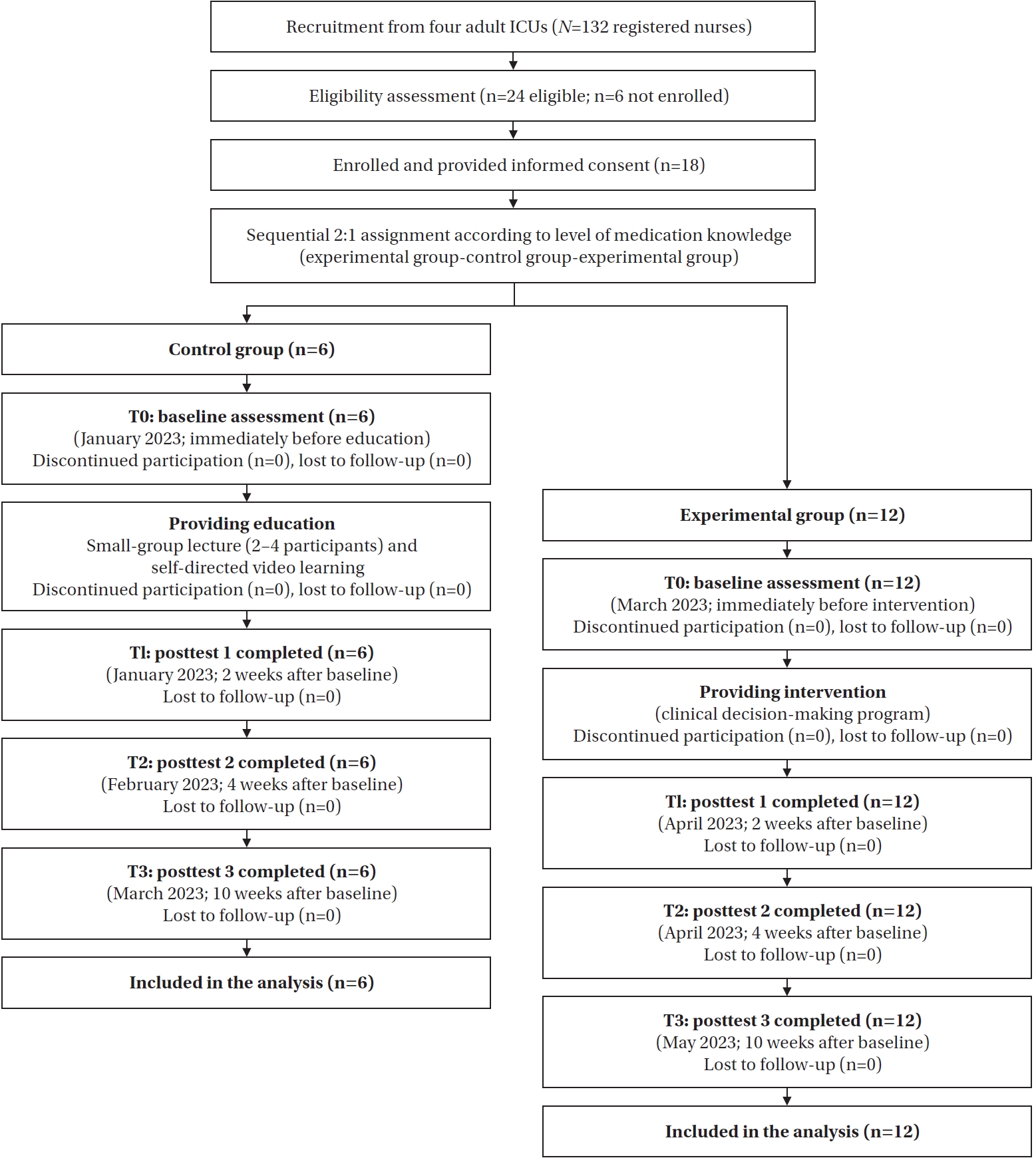
This study evaluated the immediate and sustained effects of a clinical decision-making program based on Simon’s decision-making model on medication safety competency among advanced-beginner nurses in intensive care units. Methods This nonequivalent control group pretest-posttest study used a time-lagged design and included 18 intensive care unit nurses at a tertiary hospital, with 12 assigned to the intervention group and six to the control group. The intervention group participated in a 2-week clinical decision-making program that integrated case-based learning and high-fidelity simulation, whereas the control group received lecture-based education. Clinical decision-making ability, medication safety competency, and safety motivation were measured at baseline and at 2 and 4 weeks after baseline. Near-miss medication error experiences were assessed at baseline and at 4 and 10 weeks. Data were analyzed using the independent t-test, Mann-Whitney U test, and linear mixed models. Results Clinical decision-making ability (F=3.94, p=.026), medication safety competency (F=4.97, p=.011), safety motivation (F=5.20, p=.009), and near-miss medication error experiences (F=14.28, p<.001) showed significant group-by-time interaction effects, indicating that outcome trajectories differed between the intervention and control groups. Conclusion These findings suggest that the program may be an educational strategy for strengthening nurses’ clinical decision-making during medication administration and improving medication and patient safety in intensive care unit settings.
|
|
 E-SUBMISSION