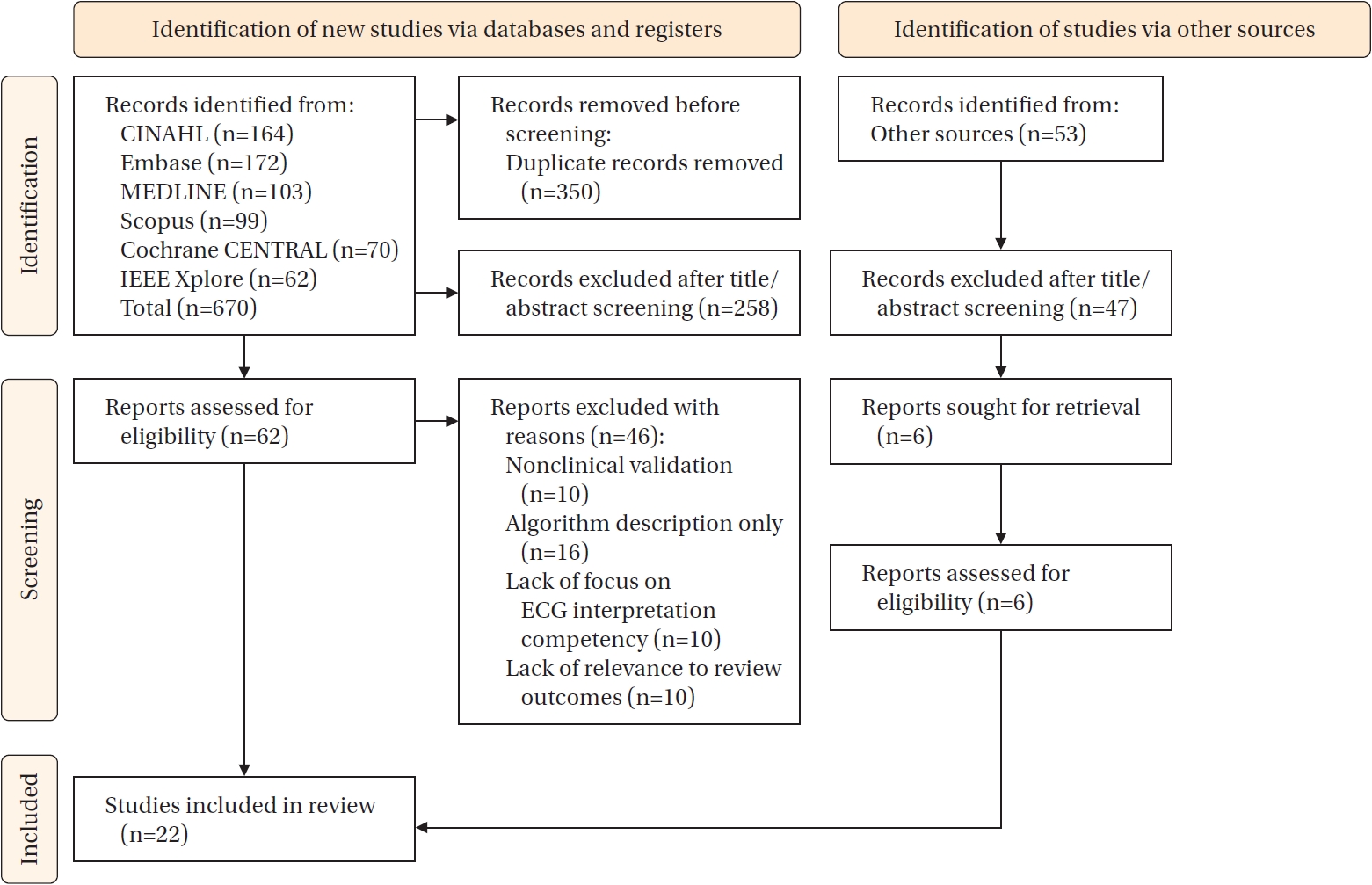
Purpose This systematic review aimed to evaluate electrocardiogram interpretation competency among emergency and critical care nurses and to examine the diagnostic performance, benefits, and limitations of computerized and artificial intelligence–based electrocardiogram interpretation systems.
Methods This systematic review was conducted in accordance with PRISMA 2020 guidelines and registered in the International Prospective Register of Systematic Reviews under registration number CRD420251169307. Six electronic databases and additional sources were searched for studies published between January 2020 and October 2025, with the final search conducted in October 2025. Studies were included if they involved registered nurses interpreting electrocardiograms in acute care settings or evaluated computerized electrocardiogram interpretation systems using adult datasets. Methodological quality was assessed using validated tools appropriate to study design, including the Joanna Briggs Institute critical appraisal tools, ROBINS-I, and QUADAS-2.
Results Mean electrocardiogram interpretation scores among nurses ranged from 43% to 68%, with fewer than 40% of participants meeting predefined competency thresholds. Performance was strongest for asystole recognition and weakest for tachyarrhythmias, myocardial ischemia, and conduction abnormalities. Artificial intelligence–based systems demonstrated high diagnostic accuracy, with area under the curve values ranging from 0.91 to 0.97 and sensitivity exceeding 94% across major diagnostic tasks.
Conclusion Emergency and critical care nurses demonstrated insufficient electrocardiogram interpretation competency in several safety-critical domains. Computerized and artificial intelligence–based systems showed high diagnostic accuracy and may serve as effective complementary tools when integrated with ongoing nurse education and appropriate clinical oversight.
Purpose This study examined the relationships among nurses’ readiness for artificial intelligence (AI), attitudes toward AI, and behavioral intention to use AI, focusing on clinical nurses in a tertiary hospital setting.
Methods A cross-sectional descriptive study was conducted using an online self-report survey of 218 clinical nurses recruited through convenience sampling from a tertiary hospital in South Korea. AI readiness was measured using the Medical Artificial Intelligence Readiness Scale, attitudes toward AI were assessed using the Korean version of the General Attitudes toward Artificial Intelligence Scale, and behavioral intention was measured using items adapted from the Unified Theory of Acceptance and Use of Technology. Open-ended responses were summarized descriptively to explore expected AI applications.
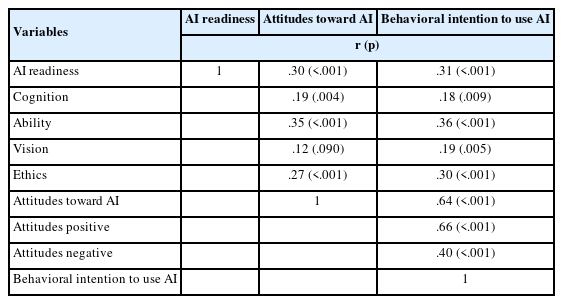
Results Clinical nurses demonstrated varying levels of AI readiness, attitudes toward AI, and behavioral intention to use AI, and these variables were positively correlated. Among AI readiness dimensions, ability and ethics tended to show stronger bivariate correlations with behavioral intention than vision. Hierarchical regression analysis indicated that attitudes toward AI were strongly associated with behavioral intention (β=.61, p<.001), whereas AI readiness factors showed weaker associations after attitudes were included. Open-ended responses suggested potential AI applications in both direct and indirect nursing care.
Conclusion Attitudes toward AI were strongly associated with nurses’ behavioral intention to use AI. AI readiness dimensions, particularly ability and ethics, were also associated with behavioral intention in correlation analyses, underscoring the importance of practical competence and ethical awareness. These findings provide empirical evidence to inform AI-related education, clinical integration, and organizational support strategies in nursing.
Citations
Citations to this article as recorded by
Nurses' knowledge, attitudes, literacy, anxiety, and readiness towards artificial intelligence in clinical practice: An international scoping review Aanuoluwapo Clement David-Olawade, Adewoyin A. Osonuga, David B. Olawade Applied Nursing Research.2026; 91: 152135. CrossRef
Purpose This study aimed to identify the components of artificial intelligence-based healthcare interventions and determine their effects on health behaviors and physiological, psychological, and cost-effectiveness outcomes among adults. Methods Nine core electronic databases were searched for articles published between January, 2009 and May, 2021 using terms related to artificial intelligence, healthcare, and randomized controlled trials. Qualitative synthesis was then performed. Results Of the 1,194 retrieved articles, 20 were selected for analysis. Many of the studies targeted adults who wanted to change their health behaviors, patients with diabetes, and those aged 20~50 years. The characteristics of the artificial intelligence-based healthcare interventions were analyzed in terms of the following components: external data, artificial intelligence technology, problem solving, and goals. Many interventions offered personalized suggestions by learning participant behavior patterns using machine learning technology and diet and physical activity data. The majority of interventions targeted health behaviors and physiological outcomes. These artificial intelligence-based healthcare interventions were effective in decreasing hospital visits and improving psychological outcomes and health behaviors. Conclusion Artificial intelligence-based healthcare interventions can be an important part of decreasing hospital visits and improving psychological outcomes and health behaviors among adults. The results suggest that there is a need to develop and apply appropriate artificial intelligence algorithms for patients with chronic diseases that require continuous management in Korea.
Citations
Citations to this article as recorded by
Current Status and Associated Factors of Artificial Intelligence-Based Personalized Learning for Health Management in Older Adults Seung Gyeong Jang Korean Journal of Geriatrics & Gerontology.2026; 27(1): 9. CrossRef
Keyword Network Analysis and Topic Modeling of News Articles Related to Artificial Intelligence and Nursing Ju-Young Ha, Hyo-Jin Park Journal of Korean Academy of Nursing.2023; 53(1): 55. CrossRef
The Development of Automated Personalized Self-Care (APSC) Program for Patients with Type 2 Diabetes Mellitus Gaeun Park, Haejung Lee, Ah Reum Khang Journal of Korean Academy of Nursing.2022; 52(5): 535. CrossRef



 E-SUBMISSION
 First
First Prev
Prev