Purpose This study examined the associations between sociodemographic characteristics, knowledge, self-efficacy, social support, comorbidities, and self-care quality among CAPD patients in Central Java, Indonesia.
Methods This cross-sectional study included CAPD patients recruited from two tertiary referral hospitals in Central Java (Dr. Kariadi Hospital and Dr. Moewardi Hospital). Data were collected from April to May 2025, with a total sample of 72 patients. The study instruments comprised the Self-care Scale for Peritoneal Dialysis Patients, a knowledge questionnaire, the Duke-UNC Functional Social Support Questionnaire, and the General Self-Efficacy Scale. Data analysis was performed using the chi-square test, Spearman’s rank correlation, and univariate logistic regression.
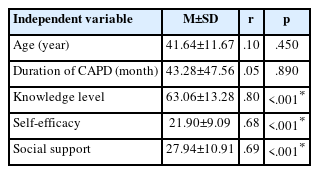
Results Univariate logistic regression analysis demonstrated that the presence of comorbidities was associated with significantly lower odds of good self-care quality (odds ratio [OR], 0.05; 95% confidence interval [CI], 0.01–0.18; p<.001). Higher levels of knowledge (OR, 1.45; 95% CI, 1.19–1.78; p<.001), self-efficacy (OR, 1.27; 95% CI, 1.14–1.42; p<.001), and social support (OR, 1.38; 95% CI, 1.16–1.64; p<.001) were significantly associated with better self-care quality. Sociodemographic factors showed no statistically significant associations with self-care quality (all p>.05).
Conclusion Among CAPD patients in Central Java, higher levels of knowledge, self-efficacy, and social support were associated with better self-care quality, whereas the presence of comorbidities was associated with factors hindering optimal self-care. Sociodemographic variables did not demonstrate clear associations with self-care quality, which may be partly attributable to limited statistical power in this sample.


 E-SUBMISSION
 First
First Prev
Prev