Purpose This systematic review aimed to evaluate electrocardiogram interpretation competency among emergency and critical care nurses and to examine the diagnostic performance, benefits, and limitations of computerized and artificial intelligence–based electrocardiogram interpretation systems.
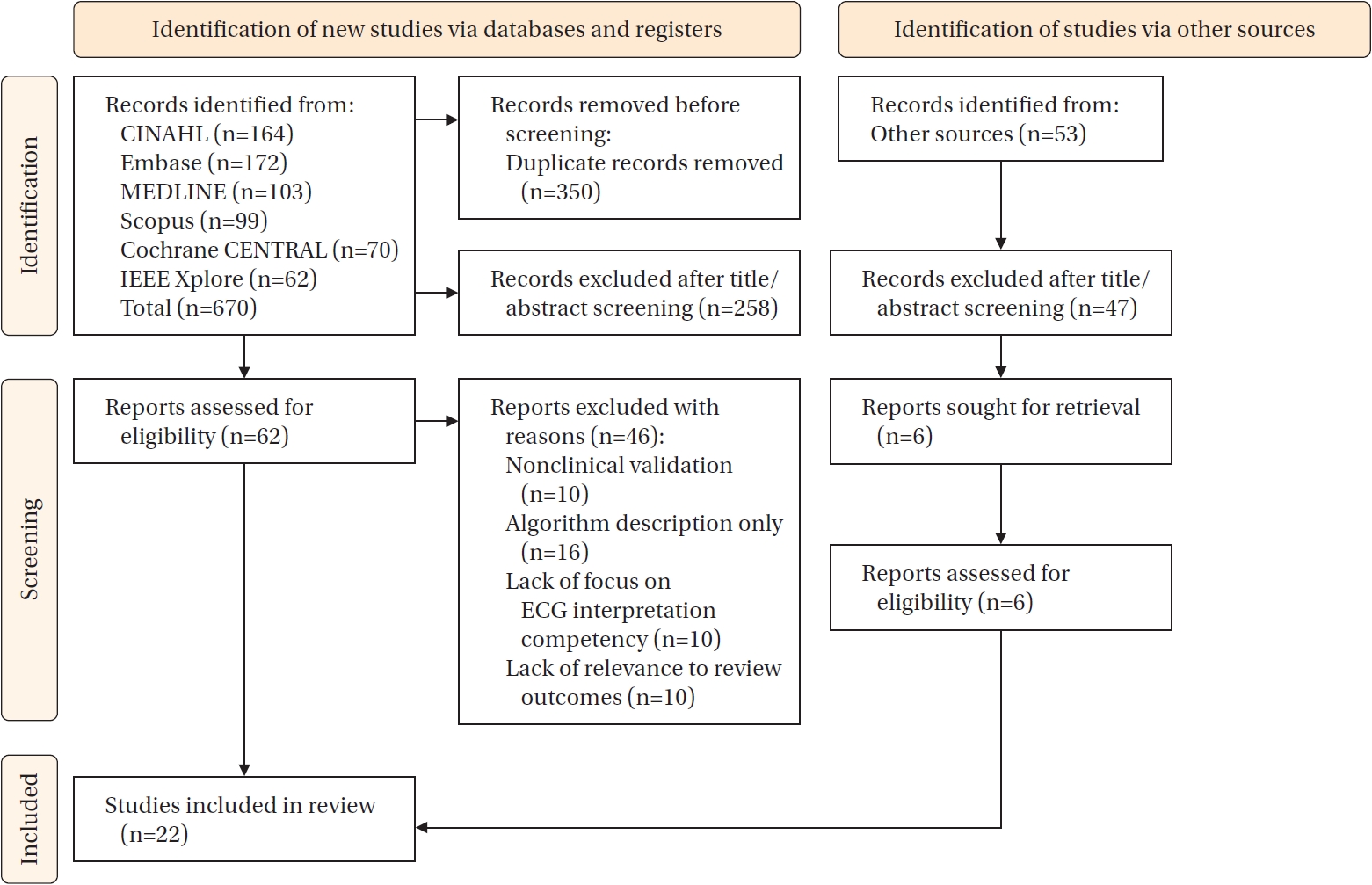
Methods This systematic review was conducted in accordance with PRISMA 2020 guidelines and registered in the International Prospective Register of Systematic Reviews under registration number CRD420251169307. Six electronic databases and additional sources were searched for studies published between January 2020 and October 2025, with the final search conducted in October 2025. Studies were included if they involved registered nurses interpreting electrocardiograms in acute care settings or evaluated computerized electrocardiogram interpretation systems using adult datasets. Methodological quality was assessed using validated tools appropriate to study design, including the Joanna Briggs Institute critical appraisal tools, ROBINS-I, and QUADAS-2.
Results Mean electrocardiogram interpretation scores among nurses ranged from 43% to 68%, with fewer than 40% of participants meeting predefined competency thresholds. Performance was strongest for asystole recognition and weakest for tachyarrhythmias, myocardial ischemia, and conduction abnormalities. Artificial intelligence–based systems demonstrated high diagnostic accuracy, with area under the curve values ranging from 0.91 to 0.97 and sensitivity exceeding 94% across major diagnostic tasks.
Conclusion Emergency and critical care nurses demonstrated insufficient electrocardiogram interpretation competency in several safety-critical domains. Computerized and artificial intelligence–based systems showed high diagnostic accuracy and may serve as effective complementary tools when integrated with ongoing nurse education and appropriate clinical oversight.
Purpose This study aimed to identify the characteristics and efficacy of Intermittent Pneumatic Compression (IPC) interventions for preventing Venous Thromboembolism (VTE) in critically ill patients.
Methods: The CENTRAL, Embase, OVID, CINAHL, KMbase, KoreaMed, and KoreaScience databases were searched from January 7 to 11, 2023. The search included all records from the inception of each database up to January 2023, with publication language restrictions to English and Korean. Three reviewers independently carried out the entire process, which included data search, quality assessment, and data extraction.
Results: Out of 1066 articles, six Randomized Controlled Trials (RCTs) were included. One of the four studies that reported on the incidence of DVT, and one of the six studies that measured the incidence of Pulmonary Embolism (PE), found that IPC alone was effective in reducing the incidence of DVT and PE. One of the four studies that reported on VTE incidence demonstrated a significant reduction in VTE incidence with a triple intervention of IPC, anticoagulants, and elastic compression stockings compared to a combined intervention of anticoagulants and graduated compression stockings. Four studies that reported data on the incidence of bleeding reported no effect on reducing bleeding.
Conclusion: Our findings suggest that IPC interventions may reduce the incidence of DVT as a preventive strategy in critically ill patients. Further RCTs are necessary to evaluate the effect of IPC interventions on DVT prevention in this patient population and to provide robust evidence for critical care nursing.
Citations
Citations to this article as recorded by
Biometric-based design and visualized evaluation systems for multimodal pneumatic compression therapeutic modalities Yu Shi, Ziyan Liu, Yongyan Liang, Zhi Yang, Ruixin Liang, Chongyang Ye Expert Systems with Applications.2026; 310: 131348. CrossRef
The silent legacy of venous thromboembolism: why rehabilitation is the missing link D. V. Blinov, A. G. Solopova, V. O. Bitsadze, J. Kh. Khizroeva, M. V. Tretyakova, N. R. Gashimova, K. N. Grigoreva, P. S. Kiykova, A. R. Khisamieva, A. R. Oskolkova, A. V. Vorobev, P. L. Khazan, A. N. Mnatsakanyan, E. I. Rumyantseva, Ok N. Li, N. V. Lomak Obstetrics, Gynecology and Reproduction.2026; 20(2): 281. CrossRef
PURPOSE This study was conducted to develop Web-based multimedia contents for supporting student nurses' clinical practice on critical care, and to evaluate learners' responses. METHODS Based on the steps of Assessment, Design, Development, Implementation, & Evaluation(ADDIE) model, a total of 13 self-directed learning modules including live lectures and real video clips were developed through faculty collaboration of nine nursing colleges in Gwangju and Chonnam province. The finally developed multimedia contents were published on the Web of the learning management system at a local e-learning center. RESULTS The Web contents were evaluated after self-learning by 81 junior college nursing students who were encouraged to study it at their own pace during their two-week clinical practice at a medical or surgical intensive care unit of a university hospital and two hospitals. The knowledge (t = -27.66, p < .001) and self-evaluated clinical performance level(t = 7.54, p < .001) were significantly increased after learning of the Web contents and clinical practice, and satisfaction level that measured post-test only was 4.0 out of 5 point. CONCLUSION The use of Web contents for critical care need to be extended as a complimentary material in a class room lecture or clinical practice of students to increase their self-learning ability and understandings of clinical knowledge and situation.
PURPOSE This descriptive study was conducted to project the number of critical care APNs needed in critical care units in an acute care hospital setting, up to the year 2020. METHOD Necessary data and information were collected from various funded reports, professional literature, web-sites and personal visits to national and private institutions. The demand of critical care APNs were projected based on two critical care APNs per critical care units. RESULT The projected number of critical APNs for the critical care units in acute care hospital settings as follows: 1) The total projected number of critical care APNs needed for critical care units were 1,270 in 2001. 2) By the year 2020, total number of projected critical care APNs needed in critical care units will be 1,080-1,700. CONCLUSION In order to match the supply to the need, the professional organization should direct their efforts toward enacting legislation. Educational systems should identify strategies in initiation of critical care APN programs in masters level as well as standardizing curriculums across the programs.



 E-SUBMISSION
 First
First Prev
Prev