Purpose This review presents a comprehensive overview of the utilization of educational technology for formative assessment in nursing education and proposes directions for its future application.
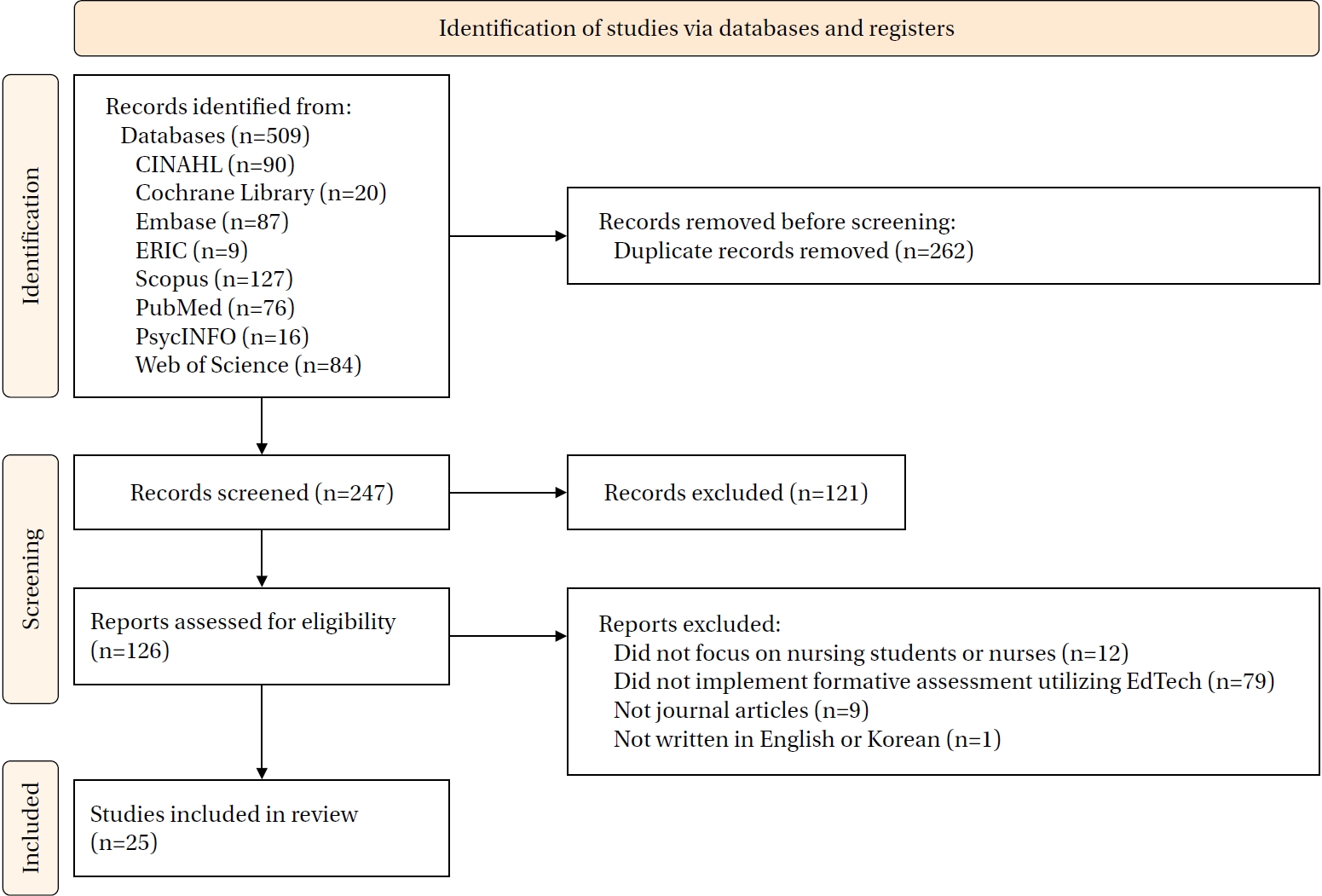
Methods Arksey and O'Malley’s scoping review design was adopted. A total of 509 articles were retrieved in February 2025 from the Cumulative Index to Nursing and Allied Health Literature, the Cochrane Library, Embase, Education Resources Information Center, Scopus, PubMed, PsycINFO, and Web of Science databases.
Results Twenty-five articles that conducted formative assessments utilizing educational technology among nursing students and nurses were analyzed. The analysis identified three key themes: educational technology, formative assessment, and educational feedback. Online platforms were the most frequently employed educational technology, while mobile applications have gained prominence since 2020. Formative assessment primarily evaluated knowledge in theoretical courses but has increasingly been used to evaluate skills in practicum settings since 2020. Immediate constructive feedback was provided by educators, peer learners, and non-human agents. Since 2020, feedback delivery has increasingly been automated through non-human agents, including artificial intelligence-based non-human agents.
Conclusion This review, which focused on the implementation of educational technology-based formative assessment in nursing education, highlights the increasing adoption of non-human agents for delivering educational feedback in practicum courses. To strengthen educators’ competency in providing immediate and constructive educational feedback, sustained support from policymakers and educational institutions is required.
Citations
Citations to this article as recorded by
Academic Performance in Nursing Education Through Digital Competencies and AI Integration: A Systematic Review Lorena Espina-Romero, Jorge Izaguirre Olmedo, Angélica Ochoa-Díaz, Omar El Kadi Janbeih, Karla Rojas Jimenez, Hugo Benzaquen Hinope Encyclopedia.2026; 6(7): 143. CrossRef
Purpose This study aimed to review the effectiveness of delirium education programs for nurses in acute hospitals. Methods The inclusion criteria were studies on delirium education programs for nurses published in English and Korean from 2012 to 2022. A literature search was conducted in the RISS, KISS, DBpia, PubMed, CINAHL, PsycINFO, and Web of Science databases using the key words of "delirium", "nurse", and "education". Qualitative appraisal of studies was conducted using the revised Cochrane risk-of-bias tool for randomized trials (RoB 2) and the Risk of Bias in Non-randomized Studies of Interventions (ROBINS-I) tool translated by National Evidence-based Healthcare Collaborating Agency (NECA). For meta-analysis, the effect size of the intervention was calculated as standardized mean difference. Results Eighteen studies were selected for the systematic review. While the contents of the education programs were similar, the teaching methods were different. Interventions implemented included traditional learning, e-learning, and blended learning. Teaching methods of delirium education programs for nurses included lecture, discussion, practice, simulation, role-play, and coaching. The systematic review found that delirium education programs for nurses effectively increased post-intervention outcomes in 17 studies. Delirium education programs for nurses have benefits regarding delirium knowledge and performance. In four studies, delirium education program interventions improved delirium nursing performance (95% CI: 0.48~2.44, p=.003). Conclusion These results demonstrate the need for a standardized delirium education program. It is recommended that further studies evaluating the patient outcome effects of delirium education programs should be conducted.
Citations
Citations to this article as recorded by
Physical Restraint Education Programs for Intensive Care Unit Nurses : A Scoping Review Hyemin Kim, Miyoung Kim Journal of Korean Critical Care Nursing.2026; 19(2): 95. CrossRef
Development and Preliminary Effectiveness of a Delirium Training Program for Rehabilitation Hospital Nurses Bo Ra Kwak, Jun Hyeok Lee, Hyenam Hwang, Eunyoung Jeon The Korean Journal of Rehabilitation Nursing.2026; 29(1): 47. CrossRef
The influence of delirium knowledge, critical thinking disposition, and compassion competence on delirium nursing performance in general hospital clinical nurses: A cross-sectional descriptive study Hyang Sook Lee, Jeong Eun Yang Journal of Korean Gerontological Nursing.2025; 27(1): 95. CrossRef
Educational programs to improve nursing competency of patient- and family-centered care in intensive care units: A systematic review Youngshin Joo, Eugene Han, Yeonsoo Jang Nurse Education Today.2025; 151: 106699. CrossRef
Performance, Knowledge, and Barrier Awareness of Medical Staff Regarding the Prevention and Management of Pain, Agitation/Sedation, Delirium, Immobility, and Sleep Disruption in Adult Critical Care Patients: A Cross-Sectional Study Hyo-Geun Song, Duckhee Chae, Sung-Hee Yoo Korean Journal of Adult Nursing.2023; 35(4): 379. CrossRef



 E-SUBMISSION
 First
First Prev
Prev