Purpose While capability and opportunity factors in dementia prevention have been extensively studied, the motivational mechanisms that translate these resources into behavior remain relatively underexplored. This study examined the mediating effect of self-efficacy on the relationships between instrumental activities of daily living (IADL), social networks, and dementia-prevention behaviors among community-dwelling older adults, guided by the capability, opportunity, motivation-behavior (COM-B) theoretical framework.
Methods A cross-sectional study was conducted with 205 community-dwelling adults aged 65 years and older residing in Gyeongsangnam Province, South Korea. Data were collected between July and September 2024 using validated instruments, including the Korean Instrumental Activities of Daily Living, Social Network Measurement Scale, General Self-Efficacy Scale, and Korean Health Behavior for Dementia Prevention Scale. Mediation analysis was performed using Hayes’ PROCESS macro (model 4) with bootstrap resampling (5,000 iterations) to estimate indirect effects, while controlling for demographic and health-related covariates.
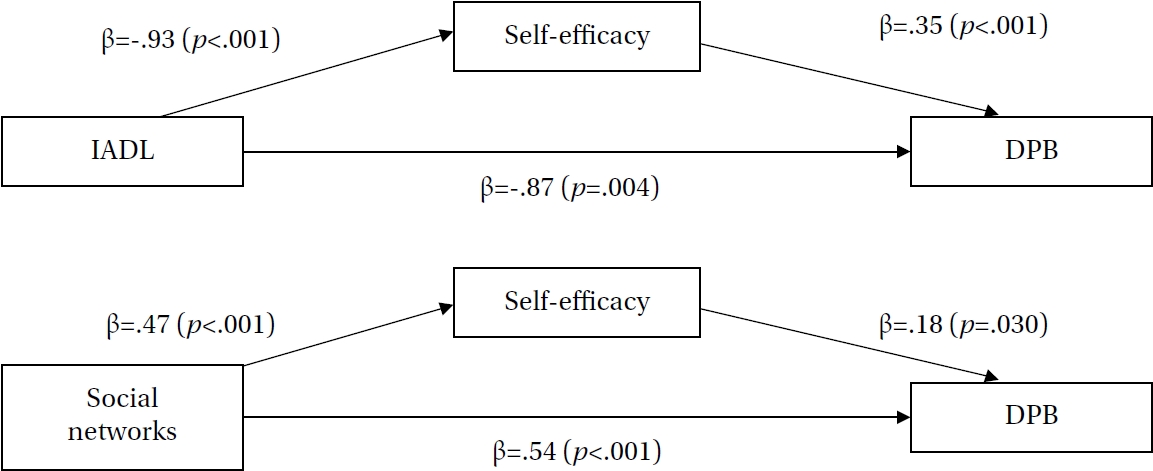
Results Self-efficacy significantly mediated both the IADL–dementia-prevention behavior relationship (indirect effect, −0.33; 95% confidence interval [CI], −0.61 to −0.12) and the social network– dementia-prevention behavior relationship (indirect effect, 0.08; 95% CI, 0.002 to 0.19). The mediation models explained 40.7% and 48.5% of the variance in dementia-prevention behaviors, respectively. Bootstrap CIs confirmed significant partial mediation effects in both pathways.
Conclusion These findings provide empirical support for the COM-B model’s theoretical proposition that motivation serves as a critical bridge linking capability and opportunity factors to actual behavior. Nursing interventions should therefore integrate self-efficacy–enhancement strategies alongside traditional capability-building and opportunity-provision approaches to maximize the effectiveness of dementia-prevention programs for older adults.
Purpose The aim of this study was to identify the effects of stigma, social support, and resilience on post-traumatic growth in patients with stroke and to provide foundational data for developing nursing interventions that can effectively promote post-traumatic growth in this population.
Methods This cross-sectional study employed a questionnaire-based survey. The participants were 150 patients who attended the neurology outpatient clinic three months after a stroke diagnosis. Data were collected between February and April 2024 using a structured self-report questionnaire. Analyses included descriptive statistics, reliability analysis, inferential statistics(independent t-test, one-way ANOVA, and Scheffé's test), and hierarchical multiple regression using SPSS/WIN 27.0.
Results The mean post-traumatic growth score was 2.52±1.05 out of 5. Significant factors affecting post-traumatic growth were age, education, religion, the presence of a housemate, income, time since stroke onset, stroke type, and stroke recurrence. Post-traumatic growth was positively correlated with social support (r=.44, p<.001) and resilience (r=.53, p<.001), but not significantly correlated with stigma. Regression analysis identified resilience (β=.37, p<.001), religion (β=.29, p<.001), and stroke type (β=.23, p=.033) as significant predictors, explaining 44.2% of the variance in post-traumatic growth (F=9.45, p<.001).
Conclusion Developing and implementing nursing interventions to increase resilience may be crucial for promoting post-traumatic growth in patients with stroke. Further research is needed to design and evaluate these interventions.


 E-SUBMISSION
 First
First Prev
Prev