Purpose This review presents a comprehensive overview of the utilization of educational technology for formative assessment in nursing education and proposes directions for its future application.
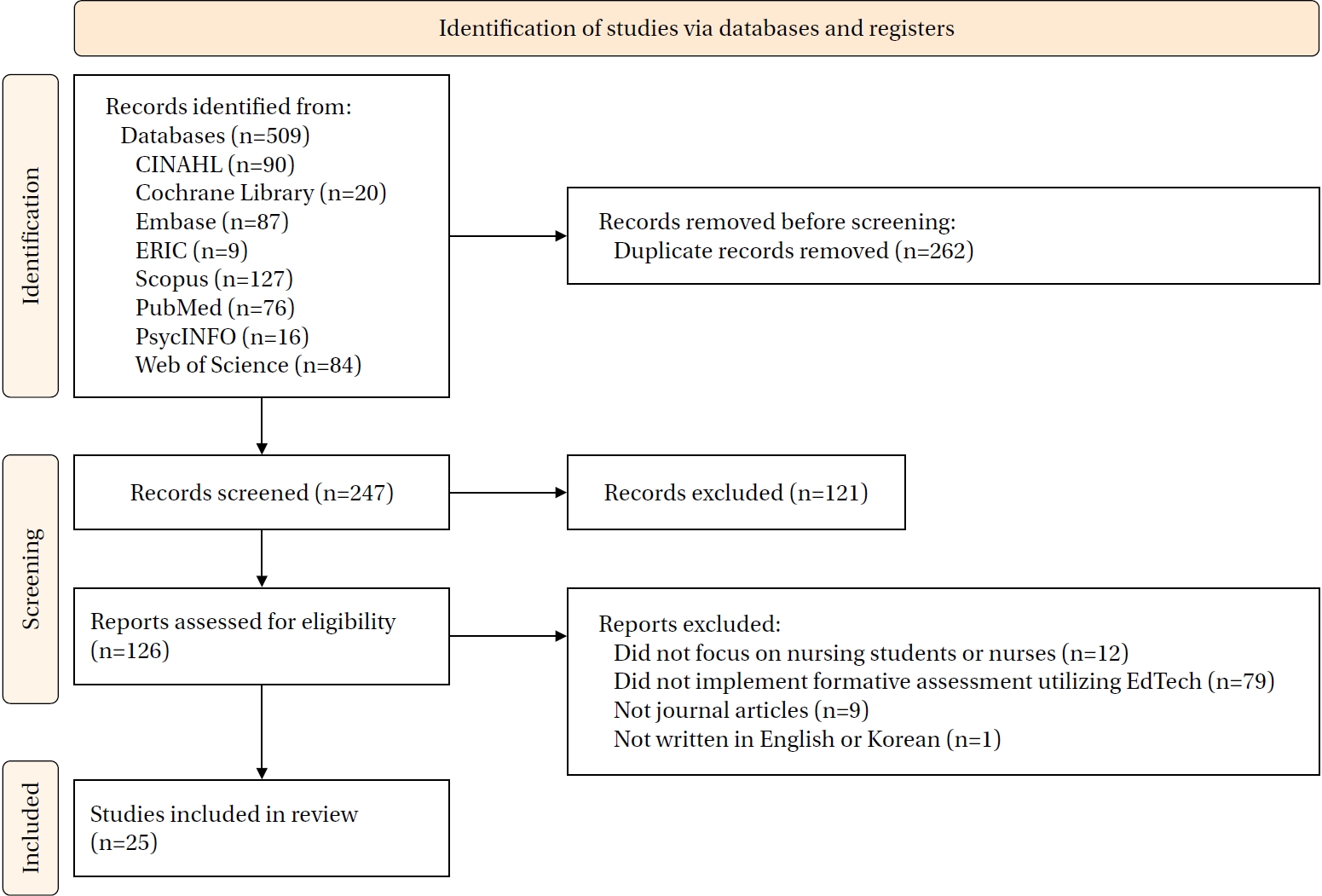
Methods Arksey and O'Malley’s scoping review design was adopted. A total of 509 articles were retrieved in February 2025 from the Cumulative Index to Nursing and Allied Health Literature, the Cochrane Library, Embase, Education Resources Information Center, Scopus, PubMed, PsycINFO, and Web of Science databases.
Results Twenty-five articles that conducted formative assessments utilizing educational technology among nursing students and nurses were analyzed. The analysis identified three key themes: educational technology, formative assessment, and educational feedback. Online platforms were the most frequently employed educational technology, while mobile applications have gained prominence since 2020. Formative assessment primarily evaluated knowledge in theoretical courses but has increasingly been used to evaluate skills in practicum settings since 2020. Immediate constructive feedback was provided by educators, peer learners, and non-human agents. Since 2020, feedback delivery has increasingly been automated through non-human agents, including artificial intelligence-based non-human agents.
Conclusion This review, which focused on the implementation of educational technology-based formative assessment in nursing education, highlights the increasing adoption of non-human agents for delivering educational feedback in practicum courses. To strengthen educators’ competency in providing immediate and constructive educational feedback, sustained support from policymakers and educational institutions is required.
Citations
Citations to this article as recorded by
Academic Performance in Nursing Education Through Digital Competencies and AI Integration: A Systematic Review Lorena Espina-Romero, Jorge Izaguirre Olmedo, Angélica Ochoa-Díaz, Omar El Kadi Janbeih, Karla Rojas Jimenez, Hugo Benzaquen Hinope Encyclopedia.2026; 6(7): 143. CrossRef
Purpose The aim of this study was to systematically review the literature on the effects of mobile health applications in older adults with dementia or Mild Cognitive Impairment (MCI) and to quantify the effect size of these interventions through meta-analysis. Methods A systematic review and meta-analysis was conducted, with a total of seven databases searched on April 18, 2023. The risk of bias was evaluated using the Revised Cochrane Risk of Bias and the Risk of Bias in Non-randomized Studies of Interventions tools. Effect sizes were calculated using Hedges’ g within a random effects model, and subgroup analyses were also performed. Results A total of 10 studies were included in the systematic review, and six studies were included in the meta-analysis. Intervention groups exhibited a statistically significant improvement in cognitive function (Hedges’ g=0.33, 95% Confidence Interval [CI]=0.09~0.56, p=.007). Subgroup analyses revealed that older adults with MCI (Hedges’ g=0.41, 95% CI=0.12~0.69, p=.006) and interventions lasting more than 4 weeks (Hedges’ g=0.47, 95% CI=0.09~0.85, p=.016) demonstrated a significant cognitive improvement. Conclusion The results of this study indicate that mobile health applications may represent a suitable approach for improving cognitive function in older adults with MCI, emphasizing the need for at least a four-week intervention. These findings underscore the potential of mobile health interventions as a practical option for cognitive improvement in the early stages of cognitive decline.
Citations
Citations to this article as recorded by
Patient Engagement in Mobile Health for Community‐Dwelling Older Adults: A Systematic Review Yun‐Hee Kim, Yi Kyung Ha International Journal of Older People Nursing.2026;[Epub] CrossRef
An umbrella review and meta-meta-analysis on the effectiveness of digital health interventions for cognitive function improvement in the elderly Yi Deng, Minqi Wang, Can Li, Hong Wu European Geriatric Medicine.2025; 16(5): 1599. CrossRef
Digital assistive technologies for community-dwelling people with dementia: A systematic review of systematic reviews by the INTERDEM AI & assistive technology taskforce David Neal, Michael P Craven, Jane Cross, Shirley Evans, Christopher Fox, Laila Oksnebjerg, Isabel Alexandre, Aidin Aryankhesal, Arlene Astell, Ahmet Begde, Annabel Ditton, Thomas Engelsma, Rikke Gregersen, Pascale Heins, Eef Hogervorst, Aysegul Humeyra K DIGITAL HEALTH.2025;[Epub] CrossRef
Terrapino: a mobile application for Alzheimer’s risk assessment and cognitive health promotion Ross Andel, Katerina Sheardova, Jan Pavlik, Martin Vališ, Jana Amlerova, Jakub Hort Frontiers in Digital Health.2025;[Epub] CrossRef



 E-SUBMISSION
 First
First Prev
Prev