
• KSAN
  • Contact us
  • E-Submission
ABOUT
BROWSE ARTICLES
EDITORIAL POLICY
FOR CONTRIBUTORS

Page Path

95
results for

"NIC"

Filter

Article category

Keywords

Publication year

Authors

Funded articles

"NIC"

Original Articles

Purpose
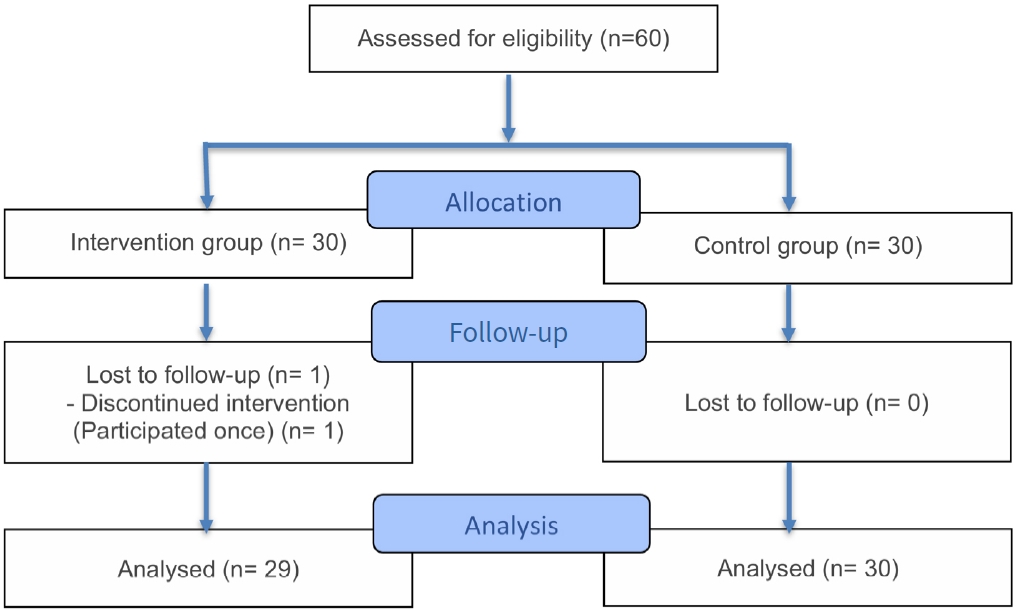
This study aimed to develop and evaluate the effectiveness of a therapeutic communication program based on King’s goal attainment theory, specifically designed for nurses providing care to patients with hematological oncology in a tertiary hospital setting. Methods: A non-equivalent control group design was employed, involving 59 nurses (intervention group: 29, control group: 30) with experience in hematological cancer care. The therapeutic communication program, developed according to the theoretical constructs of King’s theory, consisted of eight weekly sessions. Outcome variables included problem-solving ability, communication self-efficacy, and interaction satisfaction. The effects of the intervention were analyzed using the independent- and paired-samples t-test as well as a Wilcoxon signed-rank test. Results: In between-group comparisons of pre–post changes, communication self-efficacy increased significantly more in the intervention group than in the control group (p=.027). However, no significant between-group differences were found for problem-solving ability or interaction satisfaction. These findings suggest that the program effectively enhances therapeutic communication competencies among nurses in hematological oncology wards. Conclusion: The therapeutic communication program significantly improved problem-solving ability, communication self-efficacy, and interaction satisfaction among nurses in the intervention group within the hematological oncology ward. This theory-based intervention provides an evidence-based framework for strengthening clinical nursing practice and education.
  • 345 View
  • 30 Download
Stigma and Self-Management in Patients Undergoing Hemodialysis: A Cross-Sectional Study
Seulgi Ryu, Yeon-Hwan Park
Korean J Adult Nurs 2025;37(4):425-435.   Published online November 14, 2025
DOI: https://doi.org/10.7475/kjan.2025.0606
Purpose
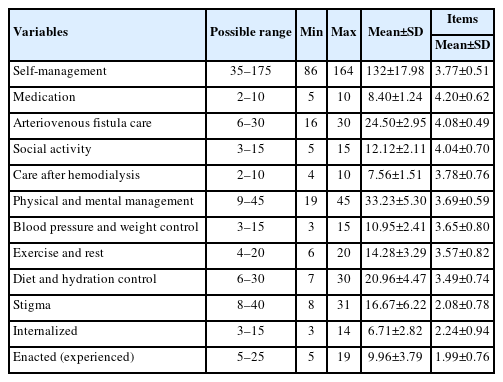
This study aimed to examine the relationship between stigma and self-management among patients undergoing hemodialysis and to identify the key factors influencing their self-management practices. Methods: A convenience sample of 139 hemodialysis patients, aged 18 years or older with an arteriovenous fistula, was recruited from online websites designed for patients undergoing hemodialysis in South Korea. Data were collected using a self-reported questionnaire that assessed demographic and clinical characteristics, self-management behavior, and stigma. Data analysis included descriptive statistics, the independent t-test, one-way analysis of variance, Pearson r correlations, and hierarchical regression analysis to evaluate the influence of stigma on self-management. Results: Hierarchical regression analysis showed that demographic and clinical characteristics accounted for 25.1% of the variance in self-management, and the inclusion of stigma increased the explained variance to 31.4%. Significant predictors included the number of hemodialysis sessions per week (≥3) (β=–.38, p<.001), stigma (β=–.27, p<.001), monthly household income (≥4 million won) (β=.24, p=.014), and marital status (single) (β=–.18, p=.028). Conclusion: The findings highlight the substantial impact of stigma and treatment burden on self-management, while socioeconomic status and marital support serve as protective factors. Targeted interventions that reduce stigma and strengthen support systems are warranted.
  • 668 View
  • 20 Download
Factors Influencing Nurses’ Person-Centered Care: A Cross-sectional Descriptive Study
Heesun Jang, Young A Kim
Korean J Adult Nurs 2025;37(3):344-353.   Published online August 29, 2025
DOI: https://doi.org/10.7475/kjan.2025.0509
Purpose
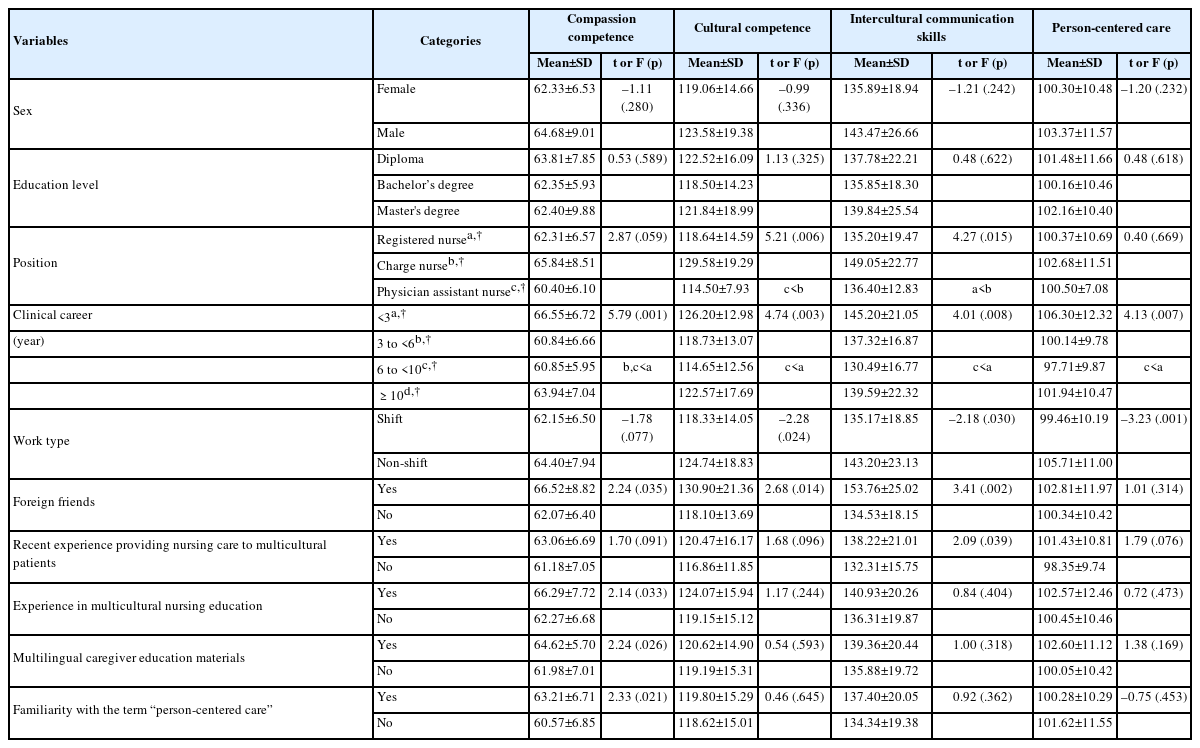
Person-centered care is essential to improving patient outcomes, yet the factors that influence it require further investigation. This study examines the relationships among nurses’ compassion competence, cultural competence, intercultural communication skills, and person-centered care, and it identifies key predictors of person-centered care. Methods: A descriptive survey was conducted among 191 nurses from two general hospitals using convenience sampling between April 1 and April 22, 2024. Data collection included measures of compassion competence, cultural competence, intercultural communication skills, and person-centered care. Statistical analyses involved descriptive statistics, the independent t-test, analysis of variance, Pearson’s correlation coefficient, and stepwise multiple regression. Results: Of the 191 participants, 172 (90.1%) were females and 19 (9.9%) were males, with an average clinical experience of 8.89 years. Person-centered care showed significant positive correlations with compassion competence (r=.58, p<.001), cultural competence (r=.62, p<.001), and intercultural communication skills (r=.63, p<.001). Key predictors of person-centered care included intercultural communication skills (β=.29, p=.001), compassion competence (β=.27, p<.001), cultural competence (β=.20, p=.024), and non-shift work status (β=.12, p=.031). The model explained 47.9% of the variance in person-centered care (F=44.76, p<.001). Conclusion: In this study, person-centered care among nurses was influenced by compassion competence, cultural competence, intercultural communication skills, and work type. Further research is warranted on the delivery of person-centered care among nurses who provide care to patients from diverse cultural backgrounds.
  • 3,737 View
  • 78 Download
Purpose
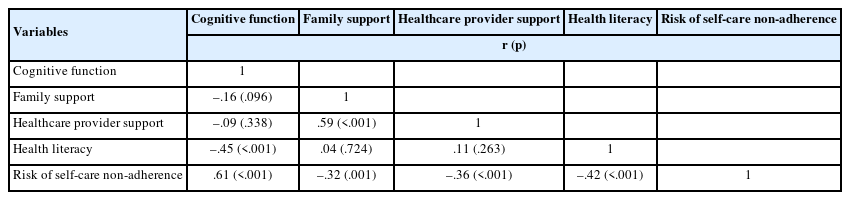
This study examined the effects of cognitive function, health literacy, and social support influence the risk of self-care non-adherence among older adults with chronic kidney disease. Methods: A cross-sectional survey was conducted using structured questionnaires. The study included 105 older adults (≥65 years) in the pre-dialysis stage, all of whom were receiving regular follow-up at a nephrology outpatient clinic in Jeonju, Jeollabuk-do, Korea. Data were collected through one-on-one interviews from April to May 2024 and analyzed using SPSS version 26.0. Predictive factors were assessed using hierarchical multiple regression analysis. Results: The risk of self-care non-adherence was significantly correlated with cognitive impairment (r=.61, p<.001), lower social support from healthcare providers (r=–.36, p<.001), and reduced health literacy (r=–.42, p<.001). Multiple regression analysis indicated that decreased physical activity (β=.25, p=.002), greater cognitive impairment (β=.29, p<.001), and lower support from healthcare providers (β=–.26, p=.008) were significant predictors of increased risk of self-care non-adherence. The model explained 46% of the variance in the risk of self-care non-adherence. In contrast, family support and health literacy were not significant predictors. Conclusion: To reduce the risk of self-care non-adherence in older adults with chronic kidney disease, routine cognitive screening and tailored education for those with cognitive impairment should be implemented in outpatient care. Promoting physical activity and strengthening support from healthcare providers are also key strategies to improve adherence in this population.
  • 1,756 View
  • 40 Download
Nursing Competence in Coping with Clinical Deterioration: An Evolutionary Concept Analysis
Ui Rim Song
Korean J Adult Nurs 2025;37(3):215-230.   Published online August 29, 2025
DOI: https://doi.org/10.7475/kjan.2025.0409
Purpose
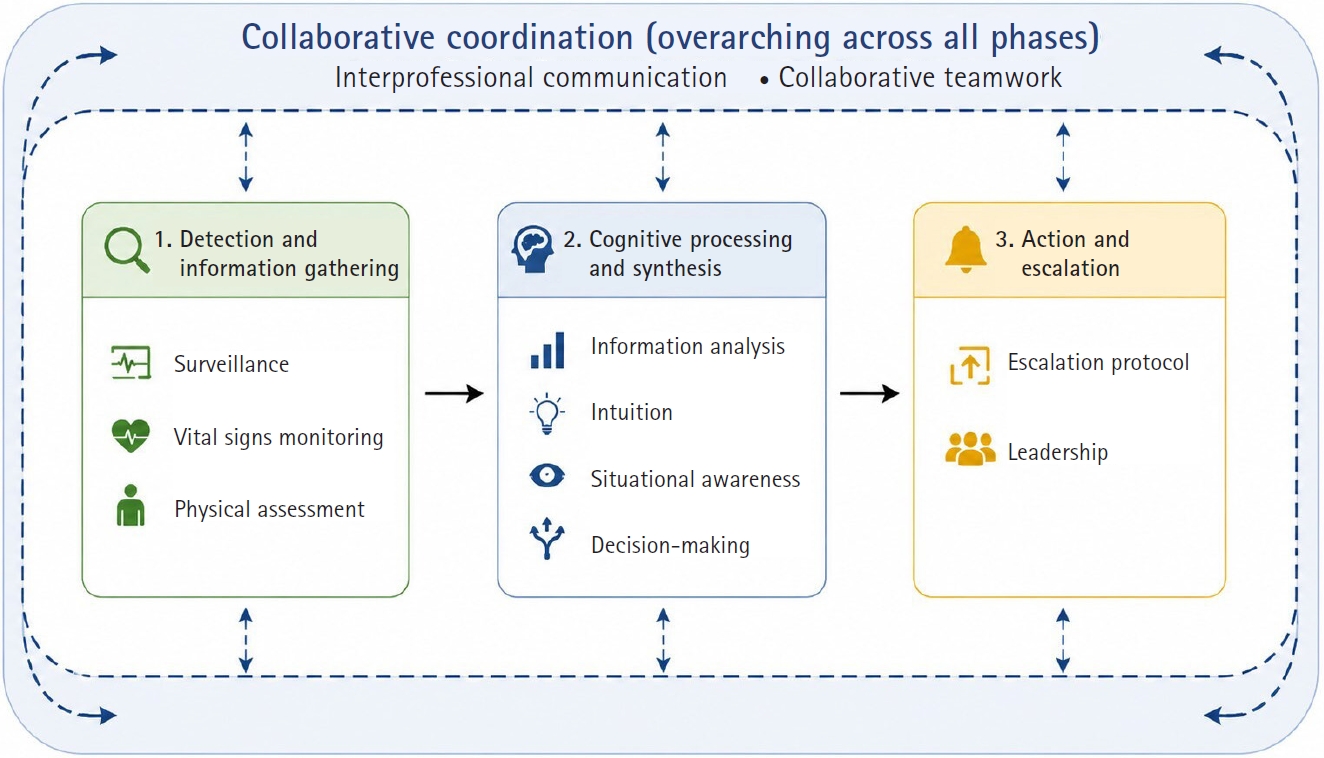
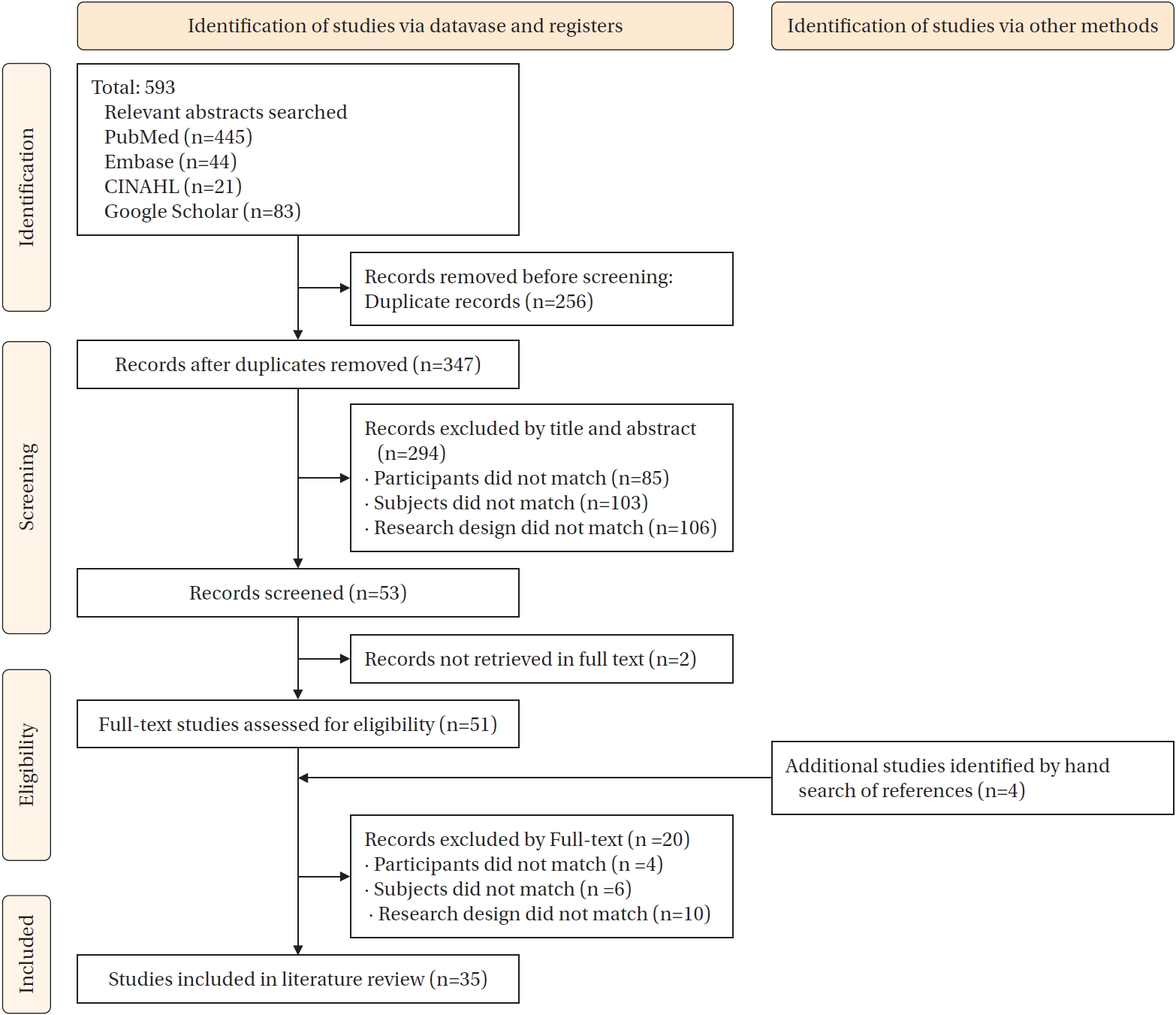
This study aimed to clarify the concept of nursing competence in coping with clinical deterioration by employing Rodgers’ evolutionary concept analysis, which reflects both sociocultural and temporal dimensions. Methods: A six-step concept analysis was conducted following Rodgers’ methodology. A systematic literature review was performed using PubMed, Embase, CINAHL, and Google Scholar, yielding 35 relevant studies published between 2000 and 2025. Data extraction followed the Joanna Briggs Institute template, and quality was appraised using the STROBE checklist. Results: Four key attributes of nursing competence were identified: technical skills in patient monitoring, situational awareness and clinical intuition, decision-making regarding escalation of care, and communication and teamwork to ensure timely intervention. Antecedents included formal education, clinical experience, and institutional support. Consequences encompassed enhanced patient safety, increased nurse confidence, and greater professional autonomy. The concept was demonstrated to be dynamic and influenced by healthcare policies, such as the implementation of rapid response systems. Conclusion: Nursing competence in managing clinical deterioration is a multidimensional and evolving concept that is essential for patient safety. Clarification of this concept can inform the development of assessment tools and simulation-based education. Further research should explore its application across diverse healthcare contexts and address challenges related to escalation of care.
  • 4,951 View
  • 96 Download
Experiences of Nurse Managers in Clinical Nursing Education during Emerging Infectious Disease Outbreaks: A Qualitative Study
Soojin Chung, Ju-Young Park, Jeongim Lee
Korean J Adult Nurs 2025;37(3):276-286.   Published online August 29, 2025
DOI: https://doi.org/10.7475/kjan.2025.0321
Purpose
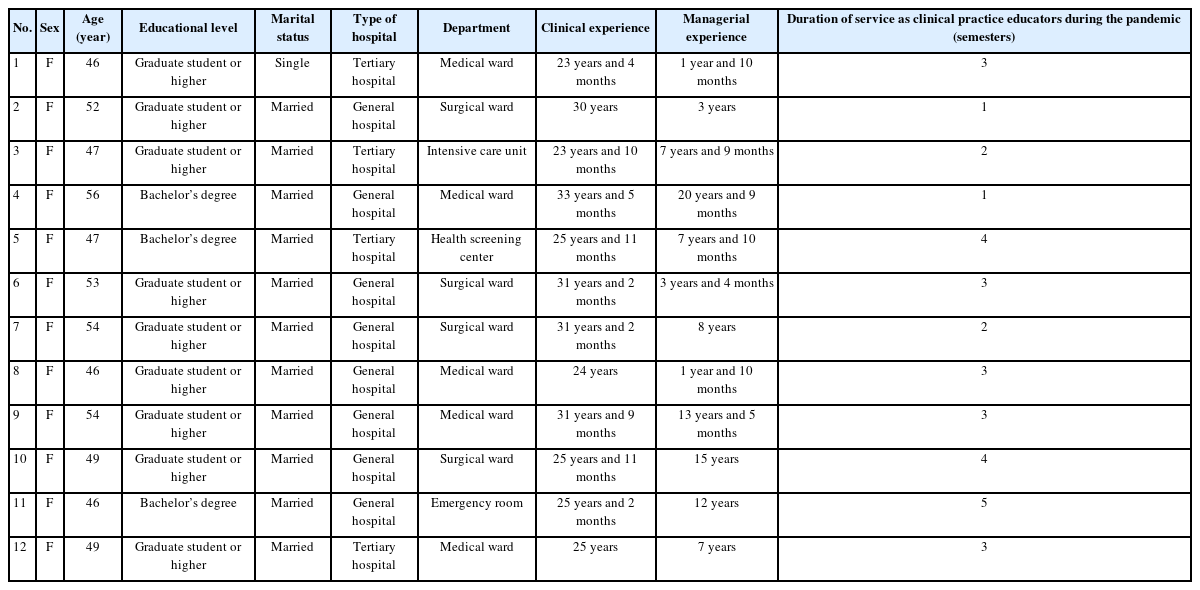
The purpose of this study was to examine the experiences of nurse managers in clinical nursing education during an emerging infectious disease outbreak. Methods: Individual semi-structured interviews were conducted with 12 nurse managers from seven general or tertiary hospitals, each with 300 or more beds, in South Korea. Data were collected between February 17 and June 10, 2023, and analyzed using qualitative content analysis. Results: Four themes and 11 subthemes were identified. Nurse managers faced significant challenges in departmental management during the infectious disease outbreak, encountered a wide range of student attitudes toward learning, adapted their teaching methods flexibly in response to changing infectious disease conditions, and ultimately found meaning in the irreplaceable value of clinical practice education. Conclusion: During the emerging infectious disease outbreak, nurse managers not only encountered substantial difficulties but also experienced professional growth as clinical nursing educators. To enhance clinical nursing education in such challenging environments, it is essential to minimize uncertainty caused by infectious diseases and foster positive perceptions among nursing students regarding clinical practice education under restrictive circumstances. Institutional support is also necessary to reduce the work burden on nurse managers.
  • 1,129 View
  • 24 Download
Self-Rated Health among People with Chronic Kidney Disease: A Secondary Data Analysis
Jena Lee, Soo Kyung Park
Korean J Adult Nurs 2025;37(3):245-256.   Published online August 29, 2025
DOI: https://doi.org/10.7475/kjan.2025.0308
Purpose
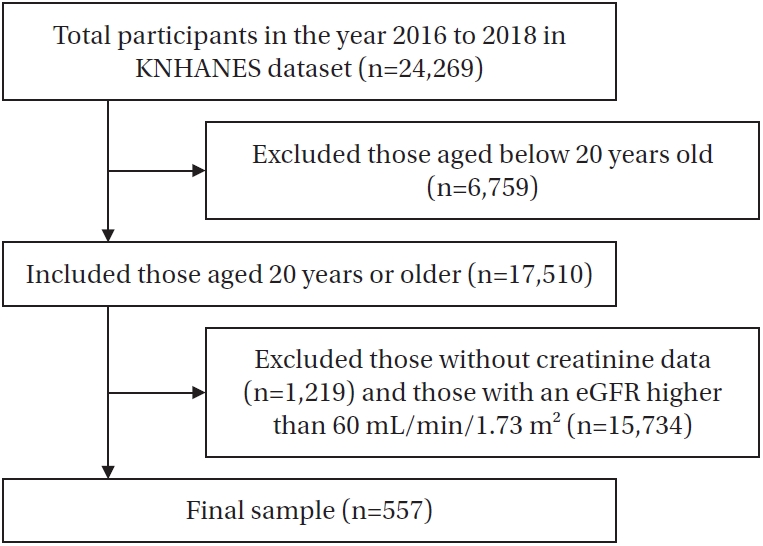
Self-rated health in individuals with chronic diseases is influenced by various factors, including dietary adherence and physical activity. However, limited research has investigated how these factors relate to self-rated health among people with chronic kidney disease. Therefore, this study aimed to describe self-rated health and identify its associated factors in this population. Methods: This cross-sectional, secondary data analysis utilized datasets from the seventh Korea National Health and Nutrition Examination Survey, which were collected between 2016 and 2018. A total of 557 participants (mean age=74.8 years) with a glomerular filtration rate of <60 mL/min/1.73 m² were included. Data from health interviews and examinations were analyzed to assess self-rated health, dietary adherence, and physical activity. Descriptive and inferential statistical methods were employed for analysis. Results: Among the 557 participants, 42.6% rated their health as poor. Factors such as sex, age, income, smoking history, anxiety/depression, number of comorbidities, glomerular filtration rate, and physical activity were significantly associated with self-rated health. In contrast, dietary adherence did not exhibit a significant association. Conclusion: Understanding the factors associated with self-rated health can inform the development of nursing interventions aimed at improving self-rated health among patients with chronic kidney disease.
  • 1,877 View
  • 39 Download
Purpose
Over 10% of intensive care unit (ICU) patients die; however, research aimed at assessing and improving the quality of their deaths remains scarce. This study investigated the impact of communication among healthcare professionals and person-centered care provided by ICU nurses on the quality of dying and death (QODD) experienced by ICU patients.
Methods
We measured general characteristics of ICU nurses, interprofessional communication, and person-centered care, and identified their impact on the quality of death for patients who died in the ICU. Participants consisted of 103 ICU nurses employed at two tertiary hospitals in South Korea. Data were collected between January and May 2023. Descriptive statistics, the t-test, analysis of variance, the Mann-Whitney U test, Pearson correlation coefficients, and multiple linear regression analyses were conducted using SPSS version 23.0.
Results
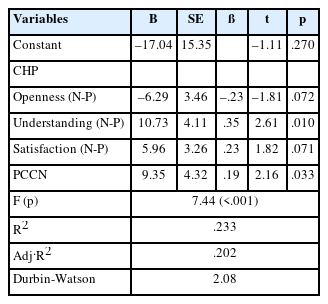
The mean QODD score was 44.73±21.26. QODD was positively correlated with openness (nurse-physician), understanding (nurse-physician), satisfaction (nurse-physician), and person-centered care. Factors significantly influencing QODD included nurse-physician communication, specifically understanding (β=.35, p=.010), and person-centered care (β=.19, p=.033), explaining 20.2% of the total variance (F=7.44, p<.001).
Conclusion
Improved communication among healthcare professionals and enhanced person-centered care are essential for improving the QODD for ICU patients. To achieve this, educational initiatives focusing on end-of-life care and communication training programs for healthcare professionals should be implemented.

Citations

Citations to this article as recorded by  
  • Intensive care nurses’ perceptions of good death and end-of-life care attitudes and behaviors: a descriptive and correlational quantitative study
    Rumeysa Bayram, Belkız Kiziltan
    BMC Palliative Care.2025;[Epub]     CrossRef
  • 3,554 View
  • 65 Download
  • 1 Crossref

Review Article

Purpose
This study was a scoping review aimed at evaluating Simulation-Based Education for recognizing and responding to deteriorating patients within Korean nursing school curricula, and at developing educational strategies for these competencies.
Methods
A literature search was conducted from April 1 to April 30, 2024. The review followed the scoping review framework by Arksey and O’Malley and the manual by the Joanna Briggs Institute. Relevant studies were identified through databases such as the Korean Medical Database, Korean Studies Information Service System, DataBase Periodical Information Academic, Research Information Sharing Service, ScienceOn, and the Cumulative Index to Nursing and Allied Health Literature.
Results
Eleven studies published from 2010 to 2019 were reviewed. The simulations typically included several lectures and practice sessions on advanced cardiopulmonary life support before the simulation exercises, which were then repeated. Cardiac arrest was frequently used as a scenario subject. The learning outcomes focused on the cognitive and psychomotor domains, as well as self-efficacy.
Conclusion
Although simulation for recognizing and responding to deteriorating patients was available in Korean nursing school curricula, it was infrequently incorporated as a regular part of the training. Future initiatives should include adding educational content to enhance nursing students' competencies in recognizing and responding to deteriorating patient simulations. Subsequent studies should assess the effectiveness of these educational methods.
  • 2,315 View
  • 54 Download
  • 0 Scopus

Original Articles

Development of a Pressure Injury Machine Learning Prediction Model and Integration into Clinical Practice: A Prediction Model Development and Validation Study
Ju Hee Lee, Jae Yong Yu, So Yun Shim, Kyung Mi Yeom, Hyun A Ha, Se Yong Jekal, Ki Tae Moon, Joo Hee Park, Sook Hyun Park, Jeong Hee Hong, Mi Ra Song, Won Chul Cha
Korean J Adult Nurs 2024;36(3):191-202.   Published online August 31, 2024
DOI: https://doi.org/10.7475/kjan.2024.36.3.191
Purpose
The purposes of this study were to develop a prediction model for pressure injury using a machine learning algorithm and to integrate it into clinical practice.
Methods
This was a retrospective study of tertiary hospitals in Seoul, Korea. It analyzed patients in 12 departments where many pressure injuries occurred, including 8 general wards and 4 intensive care units from January 2018 to May 2022. In total, 182 variables were included in the model development. A pressure injury prediction model was developed using the gradient boosting algorithm, logistic regression, and decision tree methods, and it was compared to the Braden scale.
Results
Among the 1,389,660 general ward cases, there were 451 cases of pressure injuries, and among 139,897 intensive care unit cases, there were 297 cases of pressure injuries. Among the tested prediction models, the gradient boosting algorithm showed the highest predictive performance. The area under the receiver operating characteristic curve of the gradient boosting algorithm's pressure injury prediction model in the general ward and intensive care unit was 0.86 (95% confidence interval, 0.83~0.89) and 0.83 (95% confidence interval, 0.79~0.87), respectively. This model was integrated into the electronic health record system to show each patient's probability for pressure injury occurrence, and the risk factors calculated every hour.
Conclusion
The prediction model developed using the gradient boosting algorithm exhibited higher performance than the Braden scale. A clinical decision support system that automatically assesses pressure injury risk allows nurses to focus on patients at high risk for pressure injuries without increasing their workload.

Citations

Citations to this article as recorded by  
  • Machine Learning Applications in Nursing-Affiliated Research: A Systematic Review
    Eun Joo Kim, Seong Kwang Kim
    Korean Journal of Adult Nursing.2025; 37(3): 189.     CrossRef
  • Data Analytics and Administrative Decision‐Making in Nursing Management: A Systematic Review
    Nathidathip Darach, Min Su Kim, Wasinee Wisesrith, Eileen G. Collins, Majd Mrayyan
    Journal of Nursing Management.2025;[Epub]     CrossRef
  • 3,337 View
  • 85 Download
  • 2 Crossref
  • 0 Scopus
Development of a Conceptual Framework for Non-Adherence to Self-Management in Patients with Chronic Obstructive Pulmonary Disease: An Exploratory Study
Ja Yun Choi, Eui Jeong Ryu, So Young Yun, Sehyun Cho
Korean J Adult Nurs 2024;36(2):126-135.   Published online May 31, 2024
DOI: https://doi.org/10.7475/kjan.2024.36.2.126
Purpose
This study was conducted to develop a conceptual framework for understanding non-adherence to self-management among patients with Chronic Obstructive Pulmonary Disease (COPD). This was accomplished through a literature review, in-depth interviews with patients, and a survey of healthcare professionals featuring semi-structured open-ended questions.
Methods
First, a systematic literature review was conducted across five databases. Next, 25 patients with COPD participated in detailed interviews that included seven semi-structured questions. Subsequently, 15 healthcare professionals completed a survey about factor categories and specific factors associated with non-adherence to COPD self-management. Categories and factors identified at least once across these three methods were documented. Finally, two researchers conducted preliminary mapping of the relationships between factor categories and individual factors, which was assessed for face validity by a third researcher. All processes were conducted from March 28, 2022, and January 30, 2023.
Results
The research revealed eight factor categories and 53 individual factors associated with non-adherence to COPD self-management. The categories encompassed personal, socioeconomic, disease-related, functional, treatment- related, health system-related, and environmental characteristics. The literature review, patient interviews, and survey of healthcare professionals yielded 35, 19, and 44 factors, respectively. Twelve factors were identified using all three sources. All processes were conducted from March 28, 2022, and January 30, 2023.
Conclusion
In this study, quantitative and qualitative methods were employed to develop a conceptual framework for non-adherence to COPD self-management. The findings indicate that effective self-management of this condition requires not only patient effort but also adaptations to complex treatment regimens, societal perceptions, and workplace environments.

Citations

Citations to this article as recorded by  
  • Development of a deep learning model to predict smoking status in patients with chronic obstructive pulmonary disease: A secondary analysis of cross-sectional national survey
    Sudarshan Pant, Hyung Jeong Yang, Sehyun Cho, EuiJeong Ryu, Ja Yun Choi
    DIGITAL HEALTH.2025;[Epub]     CrossRef
  • Enhancing deep learning models for predicting smoking Status using clinical data in patients with chronic obstructive pulmonary disease
    Sehyun Cho, Hyeonseok Jin, Kyungbaek Kim, Sola Cho, Ja Yun Choi
    DIGITAL HEALTH.2025;[Epub]     CrossRef
  • Factors Associated with Non-Adherence to Self-Management Among Patients with Chronic Obstructive Pulmonary Disease: A Survey Using the Delphi Technique and Analytic Hierarchy Process
    Ja Yun Choi, Eui Jeong Ryu
    International Journal of Chronic Obstructive Pulmonary Disease.2024; Volume 19: 1247.     CrossRef
  • 1,699 View
  • 29 Download
  • 3 Crossref
  • 2 Scopus
Purpose
The triage process in the emergency department is a complex decision-making task influenced by individual competence and a multitude of factors. Unlike patient-related factors, nurse-related factors can be improved through education. This study sought to determine the impact of grit, self-leadership, and communication skills of emergency department nurses on their triage competency.
Methods
We surveyed a convenience sample of 152 emergency department nurses to evaluate their grit, self-leadership, communication skills, and triage competency. The differences in these skills and competencies were analyzed according to the participants' general characteristics using the independent t-test and one-way analysis of variance. Hierarchical regression analysis was performed to identify the factors influencing nurses' triage competency.
Results
Triage experience, self-leadership, and communication skills influenced triage competency. Although triage competency can be positively impacted by knowledge gained from experience, expert assessment was identified as the least developed category of triage competency.
Conclusion
To improve nurses' triage competency, it is necessary to implement educational programs that utilize various methods to address self-leadership and communication skills. Moreover, reflective methods can be employed to help develop self-leadership, thereby improving triage competency. These findings can contribute to improving the work culture and the development of educational programs. Specifically, these programs should treat nurses' mistakes during work as learning opportunities rather than failures, thereby significantly advancing their competency.

Citations

Citations to this article as recorded by  
  • The Association Between Self‐Esteem, Assertiveness, and Professional Competence Among Palestinian Newly Graduated Emergency and Critical Care Nurses
    Malakeh Z. Malak, Ahamd Ayed, Anas Shehadeh, Moath Abu Ejheisheh, Ahmad Batran
    International Nursing Review.2025;[Epub]     CrossRef
  • Experiences of Emergency Nurses Providing End‐of‐Life Care During the COVID‐19 Pandemic
    Alysha Cowley, Julia Morphet, Kimberley Crawford
    Journal of Advanced Nursing.2025; 81(9): 6036.     CrossRef
  • Factors influencing triage competence in emergency nurses: The role of resilience, social support, and work-related factors
    JianMei Chen, JiaHui Ma, Ao Zhao, XueHuan Huang
    International Emergency Nursing.2025; 83: 101681.     CrossRef
  • 2,407 View
  • 47 Download
  • 3 Crossref
  • 3 Scopus
Validity and Reliability of Translated Version of the Chronic Hepatitis B Self-Management Scale
Eun Vi Kim, Heeyoung Oh
Korean J Adult Nurs 2022;34(6):555-564.   Published online December 31, 2022
DOI: https://doi.org/10.7475/kjan.2022.34.6.555
Purpose
This study aimed to evaluate the validity and reliability of the revised Korean version of the Chronic Hepatitis B Self-Management Scale-K16 (CHBSMS-K16). Methods Using the convenience sampling method, the data of chronic hepatitis B patients (N=200) were collected from August to October 2021. The participants were recruited from two hospitals in D metropolitan city and 3 internet cafes for hepatitis patients. The data were analyzed using SPSS 26.0 and AMOS programs. The content, structure, item-convergent/discriminant, and convergent validities and internal consistency were evaluated. Results Based on the statistical analysis, 9 items from the original version were excluded-resulting in 4 subscales with a total of 16 items. The confirmatory factor analysis demonstrated adequate model fit indices. The items convergence and discrimination validity were verified using extracted mean variance (.46~.65) and composition reliability (.81~.88). The convergent validity was satisfactory, as demonstrated by its correlation with the New General Self Efficacy scale (r=.63, p<.001). The Cronbach’s α for the overall scale was .88, and that of the four subscales ranged from .63 to .74. Conclusion The CHBSMS-K16 is a valid and reliable instrument. Therefore, this tool can be used to measure the level of self-management of Korean patients with chronic hepatitis B. Additionally, this scale can be used in clinical settings as well as in educational and research settings.
  • 542 View
  • 11 Download
  • 0 Scopus
Validation of the Korean Version of the Chronic Kidney Disease Self-Care Scale
Yon Hee Seo, Hye-Young Jang, Jung-Won Ahn
Korean J Adult Nurs 2022;34(4):360-368.   Published online August 31, 2022
DOI: https://doi.org/10.7475/kjan.2022.34.4.360
Purpose
The treatment of chronic kidney disease aims to delay dialysis and prevent progression to end-stage health complications. This study aimed to validate the Korean version of the Chronic Kidney Disease Self-Care (CKDSC-K) scale, which is used to measure self-care behaviors in patients with chronic kidney disease. Methods Data from 285 participants were collected between August and November 2020. Validity was assessed in terms of content, construct, and concurrence through the content validity index and exploratory and confirmatory factor analyses. The reliability of the CKDSC-K was examined using internal consistency. Results The final instrument consisted of 15 items across five factors (medication adherence, diet control, exercise, smoking behaviors, and blood pressure monitoring). The content validity index of the CKDSC-K was ≥.80. Confirmatory factor analysis indicated that factor loadings for the five factors ranged from .41 to .99, which explains the total variance of 75.3%. The internal reliability of the instrument was .81. Conclusion The CKDSC-K scale has demonstrated acceptable reliability and validity and can be utilized to assess self-care behaviours in patients with chronic kidney disease. Additional research is recommended to expand the psychometric evaluation of the CKDSC-K.

Citations

Citations to this article as recorded by  
  • LITERASI KESEHATAN BERHUBUNGAN DENGAN SELF CARE MANAGEMENT PASIEN PENYAKIT GINJAL KRONIK YANG MENJALANI HEMODIALISIS
    Ferlan Ansye Pondaag, Dina Mariana, Musfirah Ahmad
    JURNAL KEPERAWATAN TROPIS PAPUA.2024; 7(1): 8.     CrossRef
  • 1,227 View
  • 22 Download
  • 1 Crossref
  • 1 Scopus
The Role Experience of Clinical Practice Nurses in a University Hospital
Sosun Kim, Mi Jung Ryu, Ain Kim
Korean J Adult Nurs 2022;34(1):15-26.   Published online February 28, 2022
DOI: https://doi.org/10.7475/kjan.2022.34.1.15
Purpose
The purpose of this study was to describe clinical practice nurse’s role experience working in a university hospital. Clinical practice nurses are a mix of certified and non-certified nurses. They perform some of the duties of physicians in addition to the work they do as nurses. In the future, such nurses may become advanced practice registered nurses. Methods Focus group interviews were conducted with three groups, each consisting of eight participants. The interview lasted two and a half hours per group. Data were analyzed using a thematic analysis method. Results The analysis yielded four categories and 14 themes. The four categories were “seeking an escape from the repeated routines as a nurse”, “pioneering and developing new roles as a clinical practice nurse”, “confusion about professional identity due to ambiguity in role boundaries”, and “securing oneself as a team member and establishing a role as a clinical practice nurse”. Conclusion The scope of advanced practice registered nurses’ roles was meant to have been established in 2020, but this was not achieved. Thus, studying the role experience of clinical practice nurses and their experiences is worthwhile and the results can inform legislation. The results of the study will also help establish a customized curriculum for advanced practice nurses and ultimately improve the quality of nursing services for patients.

Citations

Citations to this article as recorded by  
  • Exploring the Difficulties and Educational Needs of Surgical Unit Nurses in Caring for Surgical Patients: A Qualitative Content Analysis
    Ki Nam Kwon, Seon Young Hwang
    Journal of Korean Academy of Fundamentals of Nursing.2025; 32(1): 24.     CrossRef
  • A study on the job performance, importance, and educational needs of clinical practice nurses in tertiary hospitals
    Hyemi Lee, Youngmee Ahn, Min Sohn, Minhee Suh
    The Journal of Korean Academic Society of Nursing Education.2025; 31(3): 315.     CrossRef
  • The Influence of Clinical Practice Nurses' Self-Leadership, Role Conflict, and Practice Environment on Patient Safety Competency
    Jeong Hwa Heo, Ji Hyun Sung
    Journal of Korean Academy of Nursing Administration.2025; 31(4): 458.     CrossRef
  • Role Conflict of Physician Assistants with Nursing Licenses in Korea
    Byeongkwan Kim, Wonhee Jung
    Journal of Korean Academy of Nursing Administration.2024; 30(2): 141.     CrossRef
  • 1,962 View
  • 64 Download
  • 4 Crossref
  • 2 Scopus
Purpose
This study was conducted to identify the factors affecting the performance of person-centered care among Intensive Care Unit (ICU) nurses from an ecological perspective.
Methods
The participants were 172 ICU nurses working in eight hospitals in B city. Data were collected from July to August, 2020. The questionnaire consisted of measuring tools for general characteristics, performance of person-centered care, compassion satisfaction, communication competence, and teamwork. The SPSS/25.0 program was used to analyze the data using hierarchical multiple regression.
Results
According to the hierarchical multiple regression analysis, total nursing experience, compassion satisfaction, communication competence, and team work accounted for 44.1% of the variance in performance of person-centered care among ICU nurses (p<.001).
Conclusion
Enhancing compassion satisfaction, communication competence, and teamwork can help increase the performance of ICU nurses’ person-centered care. In addition, in order to improve the performance of person-centered care among ICU nurses, it is necessary to investigate and explore the factors hindering the performance of person-centered care among ICU nurses with more than 5 years of experience. Therefore, multidimensional efforts are needed to develop educational programs to increase the performance of person-centered care among ICU nurses.

Citations

Citations to this article as recorded by  
  • How the nursing work environment moderates the relationship between clinical judgment and person-centered care among intensive care unit nurses
    Mi Hwa Seo, Eun A. Kim, Hae Ran Kim, Mohammad Jamil Rababa
    PLOS ONE.2025; 20(1): e0316654.     CrossRef
  • Workload, Teamwork, Compassion Competence, and Person-centered Critical Care Nursing among Critical Care Nurses
    Hyun A Lee, Myung Sun Hyun, Jin-Hee Park, Eun Ji Seo
    Journal of Korean Critical Care Nursing.2025; 18(2): 14.     CrossRef
  • A Predictive Model for Person-Centered Care in Intensive Care Units in South Korea: A Structural Equation Model
    Sunmi Kwon, Kisook Kim
    Korean Journal of Adult Nursing.2025; 37(4): 467.     CrossRef
  • Factors Influencing Person-Centered Care Among Psychiatric Nurses in Hospitals
    Ji Su Lee, Mi Heui Jang, Min Jung Sun
    Healthcare.2024; 12(22): 2269.     CrossRef
  • Assessing Needs for Practical Training in Intensive Care Unit to Enhance Nursing Education: A Focus Group Interview
    Sunah Park, Bokyoung Kim
    Journal of Korean Critical Care Nursing.2024; 17(2): 55.     CrossRef
  • Factors Influencing Person-Centered Care among Nurses in COVID-19 Special Care Units at Tertiary General Hospitals: A Cross-Sectional Descriptive Study
    Kisook Kim, Sunmi Kwon
    Korean Journal of Adult Nursing.2023; 35(2): 127.     CrossRef
  • Influence of Person-Centered Perioperative Nursing and Patient Safety Competency on Patient Safety Management Activities among Operating Room Nurses: A Descriptive Survey Study
    Ji Yong Shin, Eun Hee Jang
    Korean Journal of Adult Nursing.2023; 35(2): 97.     CrossRef
  • Person-centred care among intensive care unit nurses: A cross-sectional study
    Hyuna Youn, Miyoung Lee, Sun Joo Jang
    Intensive and Critical Care Nursing.2022; 73: 103293.     CrossRef
  • Mediating Effect of Communication Competence in the Relationship between Compassion and Patient-Centered Care in Clinical Nurses in South Korea
    Miri Jeong, Kawoun Seo
    Healthcare.2022; 10(10): 2069.     CrossRef
  • Factors Influencing the Performance of Person-centered Care Among Nurses in Designated COVID-19 Hospitals
    Hyun-Joung Yun, Jaehee Jeon
    Korean Journal of Adult Nursing.2022; 34(4): 413.     CrossRef
  • Factors influencing mental health nurses in providing person-centered care
    Suyoun Ahn, Yeojin Yi
    Nursing Ethics.2022; 29(6): 1491.     CrossRef
  • 1,413 View
  • 103 Download
  • 11 Crossref
  • 8 Scopus

Invited Article

Purpose
This narrative review aims to provide an introduction and overview of dyadic research within the context of chronic illness. In addition, some methodological considerations and future directions for conducting dyadic research are presented.
Methods
The focus of this review is on adult participants in dyads and with chronic illness based on the previous studies and literatures on dyadic science.
Results
Theory of Dyadic Illness Management and Dyadic Regulation-Connectivity Model (DR-CM) may be appropriate for performing dyadic research. At present, there is a lack of qualitative and quantitative knowledge on the dyadic approach for research on chronic diseases. Dyadic health interventions for building collaborative relationships within a dyad may be beneficial to improve dyadic health outcomes. This article addressed some of the challenges regarding recruitment, data collection, and analysis when it comes to planning dyadic research pertaining to chronic illnesses.
Conclusion
Healthcare professionals should prioritize needs and preferences at the dyadic level when designing effective chronic disease management. Particularly, it is critical to regularly monitor the dyadic relationships or type of dyadic care during illness trajectories. More research should be undertaken on patient-family caregiver dyads in chronic care, considering the various types of chronic diseases and cultural diversities.

Citations

Citations to this article as recorded by  
  • A Review of Recent Trends in Intervention Studies for Adults with Type 2 Diabetes Using Motivational Theory and Self-Determination Theory
    Mi Ran Jang, Jun Yeop Lee, Mi Ji Kim, Jong Hoon Kim, Joo Hyun Kim
    Journal of Korean Association for Qualitative Research.2025; 10(2): 165.     CrossRef
  • 1,197 View
  • 28 Download
  • 1 Crossref
  • 0 Scopus

Original Articles

Purpose
The purpose of this study was to identify the moderating effect of teaching effectiveness and students’ anxiety in the relationship between simulation design characteristics and clinical reasoning competence among nursing students. Methods: The participants were 123 nursing students who underwent simulation practice. Data were collected from September 1 to October 30, 2020 using self-report questionnaires. The collected data were analyzed using descriptive statistics, independent t-test, Pearson’s correlation coefficient, and SPSS PROCESS Macro program (to study the multiple additive moderation effect). Results: Significant positive correlations were observed between clinical reasoning competence and simulation design characteristics (r=.57, p<.001), clinical reasoning competence and teaching effectiveness (r=.49, p<.001), while negative correlations were observed between clinical reasoning competence and students’ anxiety (r=-.33, p<.001). Teaching effectiveness and students’ anxiety had a multiple additive moderating effect on the relationship between simulation design characteristics and clinical reasoning competence among the nursing students (F=15.10, p<.001). Conclusion: The relationship between simulation design characteristics and clinical reasoning competence differed depending on the students’ anxiety. To improve the clinical reasoning competence of nursing students in simulation practice, developing interventions and techniques to manage students’ anxiety levels are important.

Citations

Citations to this article as recorded by  
  • The influence of clinical simulation on anxiety in nursing students: A scoping review
    Francisco Marcelo Leandro Cavalcante, Francisca Carla dos Angelos Santos, Odézio Damasceno Brito, Ana Clécia Silva Monteiro, Vanessa Emille Carvalho de Sousa Freire, Ana Railka de Souza Oliveira Kumakura, Natasha Marques Frota, Lívia Moreira Barros
    Nurse Education in Practice.2026; 90: 104622.     CrossRef
  • The Effect of Digital Collaboration Problem-Solving Competency on Online Simulation Training in the COVID-19 Era: Mediating Effect of Flipped Learning
    Jung-Eun Shin
    Journal of Digital Contents Society.2025; 26(9): 2635.     CrossRef
  • The mediating role of flow in the relationship between simulation design and simulation educational satisfaction in korean nursing students: a cross-sectional study
    Eun-Kyung Lee, Eun-Joo Ji
    BMC Nursing.2024;[Epub]     CrossRef
  • Factors Related to the Problem-solving Ability of Nursing Students Who Experienced Simulation Training
    Ji-Won Han
    Journal of Korea Society for Simulation in Nursing.2023; 11(2): 17.     CrossRef
  • 975 View
  • 17 Download
  • 4 Crossref
  • 1 Scopus
Factors Associated with Medication Adherence among the Elderly with Chronic Diseases
Sook Hee Kang, Eun Ko
Korean J Adult Nurs 2021;33(2):189-201.   Published online April 30, 2021
DOI: https://doi.org/10.7475/kjan.2021.33.2.189
Purpose
The study sought to investigate the relationships between beliefs about medications, self-efficacy of medication use, social support and medication adherence, and the general factors associated with medication adherence among the elderly living with chronic disease. Methods: This study took the form of a descriptive survey involving 222 elderly outpatients - aged 65 years or older - who visited S medical center, located in S city. Data were collected through self-report questionnaires from July to August 2019. Data analysis was conducted using descriptive statistics, an independent t-test, a one-way ANOVA, Pearson's correlation coefficient, and a hierarchical multiple regression via the SPSS/WIN 25.0 program. Results: The mean score for medication adherence was 61.80±10.19 (range 16~80). Participants' medication adherence positively correlated with beliefs about medications (r=.17, p=.012), self-efficacy for medication use (r=.31, p<.001) and social support (r=.20, p=.003). Frequency of alcohol consumption (β=-.20, p=.001), burden level of medical costs (β=-.18, p=.012), experience of side-effects (β=-.21, p=.001), medication-taking education (β=.17, p=.008), beliefs about medication (β=.13, p=.038), and self-efficacy for medication use (β=.19, p=.004) explained for 24.9% of medication adherence (F=6.23, p<.001). Conclusion: It is necessary to consider the beliefs about medication and self-efficacy for medication use when developing educational programs aimed at improving medication adherence among the elderly living with chronic diseases.

Citations

Citations to this article as recorded by  
  • Factors associated with health literacy in older adults aged 65 and over: a secondary data analysis of the 2021 Korea Health Panel applying the Andersen behavioural model
    Yeong Eun Kim, Ol Han, Chang Sun Moon
    BMJ Open.2025; 15(3): e085696.     CrossRef
  • Factors Influencing Medication Adherence among Adult Patients with Hypertension
    Soo Kyung Lee, Myung Sun Hyun
    The Korean Journal of Rehabilitation Nursing.2025; 28(1): 1.     CrossRef
  • Factors associated with medication adherence among older adults with multimorbidity: A culture perspective
    Eunhwa Lee, MoonKi Choi
    Geriatric Nursing.2024; 55: 297.     CrossRef
  • Factors Influencing the Medication Adherence in Patients with Pulmonary Tuberculosis in the COVID-19 Pandemic
    Bongsil Lim, Min Young Kim
    The Korean Journal of Rehabilitation Nursing.2023; 26(2): 87.     CrossRef
  • Development and effectiveness of an integrated medication management program centered on senior welfare centers for older adults with hypertension: A cross-sectional study
    Heuijeong Moon, Dukyoo Jung
    Journal of Korean Gerontological Nursing.2023; 25(3): 297.     CrossRef
  • Relationships between health literacy, self-efficacy, and medication adherence in older people with polypharmacy: A cross-sectional study
    Jee Young Cho, Sun Ju Chang
    Journal of Korean Gerontological Nursing.2023; 25(4): 357.     CrossRef
  • Effects of Changes in Multiple Chronic Conditions on Medical Costs among Older Adults in South Korea
    Soojin Park, Jin Young Nam
    Healthcare.2022; 10(4): 742.     CrossRef
  • 1,825 View
  • 90 Download
  • 7 Crossref
  • 5 Scopus
Ethnography on the Health Life of Hemodialysis Patients with Chronic Kidney Failure
Jinhyang Yang, Myung-Ok Cho
Korean J Adult Nurs 2021;33(2):156-168.   Published online April 30, 2021
DOI: https://doi.org/10.7475/kjan.2021.33.2.156
Purpose
This study was performed to explore the contexts and meanings of health life among patients with chronic kidney failure undergoing hemodialysis. Methods: The ethnography steps presented by Spradley were utilized. The participants were 12 patients from two hemodialysis centers. Data were collected by iterative fieldwork through in-depth interviews and participant observations and analyzed using text analysis and taxonomic methods. Field notes were used along with interviews and dialogue between authors to enhance interpretation. Results: Five themes on the health life of participants emerged: experiencing the loss of normality of the body and the collapse of daily life, establishing the role of dialysis patients, reorganizing the network, building an integrated coping pattern, and new normalization of the pattern of life. Patients' experiences differed in health life's patterns and meanings according to various individual situations and sociocultural contexts. Conclusion: Establishing new patterns of life of hemodialysis patients was a normalization process to ensure the adequacy of physical indicators and stability amid physical, emotional, and social challenges. To achieve quality health life, patients should be provided with tailored nursing interventions that consider their individual, social, and cultural situations.

Citations

Citations to this article as recorded by  
  • A qualitative meta-synthesis of the essence of patient experiences of dialysis
    Soyoung Jang, Eunyoung E. Suh, Yoonhee Seok
    Journal of Korean Academy of Nursing.2025; 55(1): 119.     CrossRef
  • Predictors of self-management behaviors among patients undergoing hemodialysis
    Yusun Park, Sunyoung Jung
    Scientific Reports.2025;[Epub]     CrossRef
  • The impact of illness acceptance, depression, and social support on health-related quality of life in older adults on hemodialysis: A descriptive study
    Eunha Lee, Jungmin Kim
    Journal of Korean Gerontological Nursing.2025; 27(1): 106.     CrossRef
  • Predictors of psychosocial adaptation in haemodialysis patients according to haemodialysis vintage: a quantitative study
    Ae Kyung Chang, Ah Young Kim
    Contemporary Nurse.2025; 61(4): 377.     CrossRef
  • Influences of Online Health Information Seeking Behavior and E-health Literacy on Self-Management in Hemodialysis Patients: A Cross-Sectional Study
    Myeong-yi Kim, Jaehee Jeon
    Korean Journal of Adult Nursing.2025; 37(4): 502.     CrossRef
  • Healthy life of Korean patients with chronic kidney failure undergoing hemodialysis: A situation-specific nursing theory
    Jinhyang Yang, Myung-Ok Cho, Haeok Lee
    Applied Nursing Research.2022; 65: 151584.     CrossRef
  • The Effect of Uncertainty on the Physiological Indexes of Hemodialysis Patients: Serial Mediating Effects of Uncertainty Appraisal and Self-care Behavior
    Mi Kyung Kim, Eun Hee Jang
    Korean Journal of Adult Nursing.2022; 34(1): 51.     CrossRef
  • Development and Evaluation of an Online Self-Management Program in Patients with Chronic Kidney Failure Undergoing Hemodialysis
    Jinhyang Yang
    Journal of Korean Academy of Fundamentals of Nursing.2022; 29(4): 531.     CrossRef
  • 1,263 View
  • 74 Download
  • 8 Crossref
Purpose
This study aims to explore the mediating effect of burnout and the moderating effect of nursing work environment in the relationship between nursing competence and patient-centered care among nurses caring for patients with chronic disease. Methods: This study uses a cross-sectional descriptive research design. The participants were 150 nurses at a general hospital. The data were collected from February 10 to May 10, 2020. The questionnaire consisted of measuring tools for general characteristics, patient-centered care, nursing competency, nursing work environment, and burnout. The SPSS/25.0 program was used to analyze the data using descriptive statistics, Pearson's correlation coefficient, independent t-test, one-way ANOVA, Scheffé test, and hierarchical multiple regression. Results: The average score of patient-centered care was found to be 3.75±0.44. Nursing competency had a mean score of 3.64±0.44, nursing work environment of 3.04±0.43, and burnout of 2.91±0.68. Patient-centered care was significantly associated with nursing competency, nursing work environment, and burnout. In the relationship between nursing competency and patient-centered care, burnout had a partial mediating effect. The relationship between nursing competency and patient-centered care showed that nursing work environment had no moderating effect. Conclusion: The results revealed that patient-centered care was performed well if nursing competency was high. It is necessary to lower burnout and increase nursing competency such that patient-centered care can be performed better. In addition, since nursing work environment has a significant effect on nursing competency and patient-centered care, it is necessary to improve nursing work environment to improve nursing competency and patient-centered care performance.

Citations

Citations to this article as recorded by  
  • How the nursing work environment moderates the relationship between clinical judgment and person-centered care among intensive care unit nurses
    Mi Hwa Seo, Eun A. Kim, Hae Ran Kim, Mohammad Jamil Rababa
    PLOS ONE.2025; 20(1): e0316654.     CrossRef
  • A Predictive Model for Person-Centered Care in Intensive Care Units in South Korea: A Structural Equation Model
    Sunmi Kwon, Kisook Kim
    Korean Journal of Adult Nursing.2025; 37(4): 467.     CrossRef
  • Influence of Clinical Nursing Competency and Nursing Working Environment of Psychiatric Nurses on Person-Centered Care
    Pan Heui Kim
    Journal of Korean Academy of psychiatric and Mental Health Nursing.2024; 33(3): 229.     CrossRef
  • Effects of ageism on burnout among clinical nurses
    Sukjae Park, Hyunmin Lee, Minsook Seo, Hee Kyung Kim, Eunhee Shin, Antony Bayer
    PLOS ONE.2024; 19(11): e0313043.     CrossRef
  • Effects of Nursing Competence on Job Satisfaction across Career Stages
    Eun Young Oh, Mi Won Kim, Heon Ju Yoo, Seung Hee Choi, Sa Rang Lee, Chung Sook Kim
    Journal of Korean Academy of Nursing Administration.2023; 29(3): 258.     CrossRef
  • The impacts of nurses' attitudes towards dementia, critical reflection competency, and nursing work environment on person-centered nursing in acute care hospitals: A descriptive study
    Minkyung Kim, Sujin Shin
    Journal of Korean Gerontological Nursing.2023; 25(4): 346.     CrossRef
  • Development and Validation of the Job Competency Scale for Insurance Review Nurses Working in Hospital
    Song Hwa Nam, Eun A Kim
    Journal of Korean Academy of Nursing Administration.2023; 29(5): 588.     CrossRef
  • Structural Equation Modeling of Person-Centered Nursing in Hospital Nurses
    Yeon Hee Bae, Hye-Ah Yeom
    Healthcare.2022; 10(3): 514.     CrossRef
  • Effects of Compassionate Competence, Communication Skills, and Nursing Work Environment on Person-centered Care in General Hospital Nurses who Care for Cancer Patients
    Mi Jin Han, Seonho Kim
    The Korean Journal of Rehabilitation Nursing.2022; 25(1): 11.     CrossRef
  • Factors Influencing the Performance of Person-centered Care Among Nurses in Designated COVID-19 Hospitals
    Hyun-Joung Yun, Jaehee Jeon
    Korean Journal of Adult Nursing.2022; 34(4): 413.     CrossRef
  • The Effects of Communication Ability and Nursing Work Environment on Geriatric Nursing Practices of Nurses in Comprehensive Nursing Care Service Wards: A Cross-Sectional Study
    Kum-Ock Kwon, Hye-Young Jang
    Journal of Korean Gerontological Nursing.2022; 24(2): 123.     CrossRef
  • Factors Affecting Psychological Burnout in Nurses Caring for Terminal Cancer Patients
    Na-Ri Seo, Hyun-E Yeom
    The Korean Journal of Hospice and Palliative Care.2022; 25(4): 159.     CrossRef
  • Factors associated with the person-centered care competence of nursing students
    Ju Young Park, Chung Hee Woo
    The Journal of Korean Academic Society of Nursing Education.2022; 28(1): 48.     CrossRef
  • 2,134 View
  • 153 Download
  • 13 Crossref
  • 11 Scopus
The Effect of White Noise on Sleep in Hospitalized Patients: A Randomized Controlled Trial
Min-Eun Cho, Sun-Kyung Hwang
Korean J Adult Nurs 2021;33(1):44-55.   Published online February 28, 2021
DOI: https://doi.org/10.7475/kjan.2021.33.1.44
Purpose
During hospitalization, sleep can be disturbed and the quality reduced. This study investigated the effect of applying white noise on hospitalized patients for improving their sleep quality. Methods: In a randomized controlled trial design, participants were randomly assigned to an experimental group (n=30) or a comparison group (n=31), enrolled from rehabilitation medicine wards at a university hospital in South Korea. For three days of the intervention, the experimental group listened to white noise for one hour before sleep. The comparison group wore only earplugs before sleep. Sleep quality was assessed by the Verran and Snyder-Halpern (VSH) sleep scale as a subjective measure and the Fitbit ® wrist band monitor as an objective measure. Data were collected pre- and three days post-intervention. Data were analyzed by repeated measures ANOVA using SPSS/WIN 22.0 program. Results: The white noise group showed positive effects on subjective sleep quality (p<.001) compared to the earplug group. Among the objective sleep quality measures, sleep time (p<.001) and sleep efficiency (p=.003) were statistically significant, but there were no statistically significant differences in time of awakening, number of awakening, time of restless and number of restless. Conclusion: Findings indicate that applying white noise could be considered as a useful nursing intervention to improve subjective and objective sleep quality in hospitalized patients.

Citations

Citations to this article as recorded by  
  • Impact and efficacy of sound machine on sleep in hospitalized adults: A systematic review
    Kanika Khandelwal, Alecia Anyim, Sara Shu, Dana Gerberi, Mohammed Yousufuddin, Sandeep Pagali
    Sleep Medicine: X.2025; 10: 100154.     CrossRef
  • Applications of White Noise in Maternal and Neonatal Care: A Comprehensive Review on Sleep, Stress, and Pain Outcomes
    Tuğba Öz, Nurdan Demirci
    Noise and Health.2025; 27(129): 668.     CrossRef
  • A randomized controlled trial on the effect of music and white noise listening on anxiety and vital signs during intramuscular injection skill learning
    Berna Aksoy, Levent Ozturk
    Teaching and Learning in Nursing.2024; 19(1): e52.     CrossRef
  • Effect of dynamic binaural beats on sleep quality: a proof-of-concept study with questionnaire and biosignals
    Hwa-Ah-Ni Lee, Woo-Jin Lee, Seong-Uk Kim, Hyunji Kim, Minkyu Ahn, Jeonghui Kim, Do-Won Kim, Chang-Ho Yun, Han-Jeong Hwang
    SLEEP.2024;[Epub]     CrossRef
  • Preoperative Anxiety and Its Postoperative Associated Factors in Patients Receiving Post Anesthetic Recovery Care at Surgical Intensive Care Unit
    Yul Ha Lee, Hye-Ja Park
    Journal of Health Informatics and Statistics.2023; 48(3): 267.     CrossRef
  • External Auditory Stimulation as a Non-Pharmacological Sleep Aid
    Heenam Yoon, Hyun Jae Baek
    Sensors.2022; 22(3): 1264.     CrossRef
  • 4,736 View
  • 105 Download
  • 6 Crossref
  • 3 Scopus
Influence of the Rapid Response Team Activation via Screening by Nurses on Unplanned Intensive Care Unit Admissions
Ye-Ji Huh, Seong mi Moon, Eun Kyeung Eun, Min young Kim
Korean J Adult Nurs 2020;32(5):539-549.   Published online October 31, 2020
DOI: https://doi.org/10.7475/kjan.2020.32.5.539
Purpose
This study aimed to identify the influence of the activation of the Rapid Response Team (RRT) through screening unplanned Intensive Care Unit (ICU) admissions.
Methods
A total of 539 cases in which the RRT was activated, from January 1, 2016 to December 31, 2017, were analyzed. Data were collected by reviewing rapid response team activity reports and electronic medical records and analyzed using the Chi-squared test and multiple logistic regression analysis. The analyzed types of RRT activation were electronic medical record-based screening and activation through direct call.
Results
Patients admitted to the ICU following RRT activation through direct call were twice as likely to experience an unplanned ICU admission than patients for which the RRT was activated through electronic medical record screening (Odds Ratio [OR]=2.05, 95% Confidence Interval [CI]=1.27~3.30). Other variables, including the medical department, activation duration in minutes, total national early warning score, and respiratory distress as the reason for activation (compared to sepsis or septic shock) predicted unplanned ICU admissions.
Conclusion
Electronic medical record screening by RRT may facilitate the early detection and monitoring of physiological deterioration in patients in the general medical ward. This strategy may help prevent unplanned ICU admissions and potentially reduce mortality.

Citations

Citations to this article as recorded by  
  • The effect of nurses' perceptions and satisfaction with hospital rapid response teams on burnout related to emergency situations in Korea: a cross-sectional study
    Bumin Kim, Nahyun Kim
    Journal of Korean Biological Nursing Science.2025; 27(2): 234.     CrossRef
  • Early Prediction of Sepsis in the Intensive Care Unit Using the GRU-D-MGP-TCN Model
    Seunghee Lee, Geonchul Shin, Jeongseok Hwang, Yunjeong Hwang, Hyunwoo Jang, Ju Han Park, Sunmi Han, Kyeongmin Ryu, Jong-Yeup Kim
    IEEE Access.2024; 12: 148294.     CrossRef
  • Nursing Students’ Clinical Judgment and Performance in Simulation of Recognizing and Responding of the Deterioriating Patient ; a retrospective mixed-methods
    Yi Kyung Ha
    Journal of Korean Critical Care Nursing.2023; 16(2): 42.     CrossRef
  • Effects of a Rapid Response Team on the Clinical Outcomes of Cardiopulmonary Resuscitation of Patients Hospitalized in General Wards
    Mi-Jung Yoon, Jin-Hee Park
    Journal of Korean Academy of Fundamentals of Nursing.2021; 28(4): 491.     CrossRef
  • 1,761 View
  • 47 Download
  • 4 Crossref
Purpose
This study examined sociodemographic and health factors affecting Health-Related Quality of Life (HRQoL) among older adults with osteoarthritis based on the duration of osteoarthritis.
Methods
Data were obtained from the Seventh Korean National Health and Nutrition Examination Survey (Ⅶ-1, 2016; Ⅶ-2, 2017). The sample consisted of total 747 older adults with osteoarthritis. The complex sample analysis was performed using an independent t-test, ANOVA, x2 test, and multiple linear regression using the SPSS/WIN 24.0 program.
Results
The HRQoL of older adults who had experienced osteoarthritis for 10 years or more was lower than the group who had experienced osteoarthritis for less than 10 years. The most influential factors affecting HRQoL across both groups were subjective health, limit of daily activity, and sickbed experience. Current alcohol consumption and body weight control were factors affecting HRQoL in the group who had experienced osteoarthritis for less than 10 years, while gender, current smoking, and walking were factors affecting HRQoL in the group who had experienced osteoarthritis for 10 years or more.
Conclusion
Community nurses should consider the target population and customize interventions based on the duration of osteoarthritis in order to improve HRQoL in older adults with osteoarthritis.

Citations

Citations to this article as recorded by  
  • A Network Analysis of Quality of Life Among Older Adults With Arthritis
    Dahee Wi, Chang G. Park, Jiae Lee, Eunjin Kim, Yoonjung Kim
    International Journal of Older People Nursing.2025;[Epub]     CrossRef
  • Effects of Multidirectional Knee Strengthening Exercises Using Elastic Bands on Elderly Patients Aged 65 and Older With Knee Osteoarthritis
    Sang-woo Yoon, Suhn-yeop Kim
    Physical Therapy Korea.2025; 32(2): 150.     CrossRef
  • Comparative Effects of Rehabilitation Programs After Total Knee Arthroplasty: A Modified GLA:D® Program and a Lower-Limb Strengthening Program
    Se Hee Kong, Je Yang Moon, Hyun Seung Kim, Jin Sung Bae
    Journal of Clinical Medicine.2025; 14(21): 7565.     CrossRef
  • Effects of Progressive Balance Training Exercise Programs with Whole Body Vibration on Pain, Function, Psychosocial Status, and Balance in Patients with Knee Osteoarthritis
    Sang-woo Yoon, Suhn-yeop Kim
    Journal of The Korean Society of Physical Medicine.2024; 19(1): 81.     CrossRef
  • Factors Related to Quality of Life among Older Adults who Had Arthritis: Limited Daily Activities and Physical Activity
    Jee-Seon Yi
    Physical Therapy Rehabilitation Science.2023; 12(4): 431.     CrossRef
  • The effects of hemp seed consumption on depression, anxiety and cognitive improvement based on machine learning
    Jea-Bum Jung, Yong-Won Cho, Sang-Yub Kim, Soo-Yeon Chung, Kyung-Hoon Han, Byung-Joo Ham, Sung-Hee Han
    Archives of Food and Nutritional Science.2023; 7(1): 032.     CrossRef
  • 808 View
  • 14 Download
  • 6 Crossref
Purpose
This study evaluated the impact of Chronic Kidney Disease (CKD) on depression, perceived health, and Health-Related Quality of Life (HRQOL) in community-dwelling adults.
Methods
Data from 9,778 adults who participated in the Korea National Health and Nutrition Examination Survey (KNHANES) in 2014 and 2016 were analyzed. The estimated glomerular filtration rate was calculated using the CKD Epidemiology Collaboration (CKD EPI) equation. Depression was defined as a score of at least 10 points on Patient Health Questionnaire-9 (PHQ-9). The HRQOL was measured using the EuroQol-5D (EQ-5D). The effects of CKD on depression were analyzed using multivariate logistic regression, and the effects on perceived health and HRQOL were analyzed using multivariate ordered logistic regression.
Results
The prevalence of CKD was 3.7%. Among the adults with CKD, 13.1% had depression, 42.9% perceived their health to be bad, and their HRQOL was significantly lower than that of their non-CKD counterparts. The odds ratio for depression in patients with CKD was 1.66 (95% Confidence Interval [CI]=1.10~2.52, p=.017) and that of perceived bad or fair health was 1.80 (95% CI=1.35~2.40, p<.001). The likelihood of lower HRQOL in CKD patients was 1.44 times higher than in the non-CKD patients (95% CI=1.09~1.90, p=.010).
Conclusion
The prevalence of psychological problems in CKD patients was higher than in non-CKD patients. The results suggest the importance of comprehensive intervention for patients with CKD. Policies are needed to help assess and manage patients with CKD who are experiencing emotional problems.

Citations

Citations to this article as recorded by  
  • Self-Rated Health among People with Chronic Kidney Disease: A Secondary Data Analysis
    Jena Lee, Soo Kyung Park
    Korean Journal of Adult Nursing.2025; 37(3): 245.     CrossRef
  • Influence of Depression on Health Behavior (Daily Smoking, Binge Drinking, Walking, Skipping Breakfast) among Korean Adults: Based on the KNHANES
    Su Yeon Jeong
    Journal of Health Informatics and Statistics.2024; 49(4): 325.     CrossRef
  • Regional Differences in Medical Costs of Chronic Kidney Disease in the South Korean Population: Marginalized Two-Part Model
    Minah Park, Choa Yun, Jae Hong Joo, Soo Hyun Kang, Sung Hoon Jeong, Chung-Mo Nam, Eun-Cheol Park, Yoondae Han, Sung In Jang
    JMIR Public Health and Surveillance.2023; 9: e39904.     CrossRef
  • Good subjective health status and health-related quality of life in people with chronic kidney disease: A secondary analysis using the Korea National Health and Nutritional Examination Survey in 2019 and 2020
    Jena Lee, Yujin Suh
    Research in Community and Public Health Nursing.2023; 34: 255.     CrossRef
  • Effects of an arteriovenous fistula stenosis prevention program in patients receiving hemodialysis
    Haegyeong Lee, Gyuli Baek, Eunju Lee
    Osong Public Health and Research Perspectives.2023; 14(4): 279.     CrossRef
  • Association of Blood Heavy Metal Levels and Renal Function in Korean Adults
    Yoonjin Park, Su-Jung Lee
    International Journal of Environmental Research and Public Health.2022; 19(11): 6646.     CrossRef
  • 1,125 View
  • 28 Download
  • 6 Crossref
  • 4 Scopus
Risk Factors for Nutritional Status in Patients with Chronic Obstructive Pulmonary Disease
Jun Hee Jang, Hye Sook Min, Jin Han Park
Korean J Adult Nurs 2019;31(6):585-594.   Published online December 31, 2019
DOI: https://doi.org/10.7475/kjan.2019.31.6.585
PURPOSE
The purpose of this study was to identify the characteristics of nutritional status and its risk factors in patients with Chronic Obstructive Pulmonary Disease (COPD).
METHODS
Participants included 136 patients with COPD in Donga University hospital and Haeundae paik hospital in Busan city. The data, collected by a trained research assistant from January 10 to July 18, 2017, were analyzed using Fisher's exact test, the Mann-Whitney U test, and logistic regression analysis with SPSS/WIN 21.0.
RESULTS
Among the 136 patients with COPD, 31 (22.8%) had abnormal nutritional status. According to the results of the logistic regression analysis, gender (Odds Ratio [OR]=5.27, 95% Confidence Interval [CI]=1.18~23.49, p=.029), percent predicted forced expiratory volume in one second [FEV1%] (OR=1.04, 95% CI=0.92~0.99, p=.012), symptom experience (OR=16.19, 95% CI=3.08~85.00, p=.001), carbohydrate intake (OR=1.01, 95% CI=1.00~1.02, p=.037), protein intake (OR=1.06, 95% CI=0.90~0.99, p=.012), and fat intake (OR=1.04, 95% CI=1.01-1.08, p=.015) were associated with nutritional status in patients with COPD.
CONCLUSION
In order to improve the nutrutional status of COPD patients, nursing education is needed with intensive screen on female patients and patients with low lung function, managing symptoms and increasing protein intake.
  • 633 View
  • 16 Download
  • 0 Scopus
Emergency Department Nursing Activities: Retrospective Study on Data from Electronic Nursing Records
Seung Yeon Baik, Eunhee Cho, Young Ah Kim, Mona Choi
Korean J Adult Nurs 2019;31(5):496-506.   Published online October 31, 2019
DOI: https://doi.org/10.7475/kjan.2019.31.5.496
PURPOSE
This study aimed to identify the type and frequency of nursing activities targeting emergency department patients by analyzing electronic nursing records.
METHODS
This retrospective study identified the characteristics of and nursing activities for adult patients who visited a university hospital emergency department for 6 months from January to June 2018 by analyzing the hospital's electronic nursing records. Descriptive statistics and one-way analysis of variance were used to analyze the characteristics of patients and the nursing records.
RESULTS
A total of 36,435 patients, with an average age of 52.82±19.91 years and a male-to-female ratio of 1:1.16, participated in the study. The number of patients with Korean Triage and Acuity Scale levels 4 (less urgent) and 5 (non-urgent) were 24,403 (67% of the total number). Referrals were requested 1.21±0.54 times per patient. The most frequent NANDA diagnosis and Nursing Intervention Classification intervention were “Risk for unstable blood glucose level” (858, 28.4%), and “Surveillance” (83,131, 23.9%). The most frequent Clinical Care Classification action type was “Assess or Monitor” (313,729, 38.5%). The higher the severity level and the number of referrals, the more the recorded numbers of nursing diagnoses, interventions, and care activities.
CONCLUSION
This study demonstrated the possibility of nursing task analysis by identifying the type and frequency of nursing activities based on the data from electronic nursing records. Further research on electronic nursing records would contribute to the usefulness of these records for nursing workload analysis and effective workforce management.

Citations

Citations to this article as recorded by  
  • Influence of work stress, clinical decision-making ability, and teamwork on triage competency among emergency room nurses in Korea: a cross-sectional study
    Seon-Hyeong Kim, Ae-Ri Jung
    Journal of Acute Care Surgery.2025; 15(2): 60.     CrossRef
  • Analysis of nursing notes and mapping of nursing surveillance activities for patients who underwent cholecystectomy in Korea: a retrospective descriptive study
    Se Young Kim, Chunseon Jang, Moon Kyung Lee, Ok-Ran Jeong, Eunsim Kim
    Journal of Korean Biological Nursing Science.2025; 27(3): 465.     CrossRef
  • Improving Handover Efficiency for Emergency Nurses
    Seungeun Lee, Heeje Yun, Yukyung Lee, Minji Kang, Eunbi Jo, Sunjong Yoo, I Gyeong Jo, Jung Hwan Heo, Min Jin Choi
    Journal of Korean Academy of Nursing Administration.2024; 30(3): 294.     CrossRef
  • An exploratory study of the practical impact of the COVID-19 pandemic on nursing tasks in clinical settings
    Younhee Kang, Hyeyoung Hwang
    Applied Nursing Research.2024; 76: 151790.     CrossRef
  • Experiences of Recording Electronic Nursing Notes among Ward Nurses in Two Hospitals
    Hyunmi Hwang, Geun-Hee Kim, Yeoungsuk Song
    Journal of Korean Academy of Fundamentals of Nursing.2024; 31(4): 396.     CrossRef
  • An exploratory study of nursing tasks that induce physical and mental stress among hospital nurses
    Younhee Kang, Aekyeong Jin
    Applied Nursing Research.2024; 80: 151853.     CrossRef
  • Experiences of traumatic events, knowledge and attitudes concerning post-traumatic stress disorder, and resilience among nurses and paramedics working in emergency department
    Sun-Woo Hong, Kyung-Sook Bang, Hwal Lan Bang, Hye Jin Hyun, Miyoung Lee, Yu Na Jung
    The Journal of Korean Academic Society of Nursing Education.2023; 29(1): 86.     CrossRef
  • Life‐Sustaining Treatment Decision in Palliative Care Based on Electronic Health Records Analysis
    Sanghee Kim, Arum Lim, Hyoeun Jang, Misun Jeon
    Journal of Clinical Nursing.2023; 32(1-2): 163.     CrossRef
  • Use of the clinical care classification in South Korean nursing practice: Challenges and opportunities
    Hyeoun-Ae Park, Insook Cho
    International Journal of Medical Informatics.2023; 170: 104968.     CrossRef
  • Effects on Triage Competency Based on Nursing Task Performance and Self-Efficacy of Nurses in Regional Emergency Medical Institutions
    Su Jin Kim, Su Ol Kim
    Korean Journal of Adult Nursing.2022; 34(3): 304.     CrossRef
  • An Analysis of Tasks of Nurses Caring for Patients with COVID-19 in a Nationally-Designated Inpatient Treatment Unit
    Minho Jung, Moon-Sook Kim, Joo-Yeon Lee, Kyung Yi Lee, Yeon-Hwan Park
    Journal of Korean Academy of Nursing.2022; 52(4): 391.     CrossRef
  • Association Between Symptoms of Patients With Heart Failure and Patient Outcomes Based on Electronic Nursing Records
    Seung Yeon Baik, Gi Wook Ryu, Hyangkyu Lee, Siwook Lee, Mona Choi
    CIN: Computers, Informatics, Nursing.2021; 39(12): 1027.     CrossRef
  • Development of Addiction Prevention Care Program for Nurses
    Sungjae Kim, Se-Jin Joo, Young Ok Song, Jin-Gyung Cha, Jeongwoon Yang
    STRESS.2019; 27(4): 389.     CrossRef
  • 1,299 View
  • 14 Download
  • 13 Crossref
  • 10 Scopus
Influence of Hospital Nurse Staffing Levels on the Colorectal Cancer Evaluation Grades, Mortality, and Length of Stay
Yunmi Kim, Se Young Kim
Korean J Adult Nurs 2019;31(5):479-486.   Published online October 31, 2019
DOI: https://doi.org/10.7475/kjan.2019.31.5.479
PURPOSE
In Korea, cancer is the leading cause of death, and colorectal cancer accounts for a third of deaths caused by cancer. This study aimed to analyze the influence of hospital nurse staffing level on colorectal cancer evaluation grades, mortality rate, and the length of stay of patients who underwent surgery for colorectal cancer.
METHODS
Secondary data collected in 2016, 2018 from the Health Insurance Review and Assessment Service, was used to measure nurse staffing, based on the adjusted nursing grade in general units and was then categorized as adhering with or violating the Medical Service Act. The influence of the nurse staffing on colorectal cancer evaluation grades, and the mortality rate in 129 hospitals was analyzed using multivariate logistic regression and multivariate gamma regression, respectively, and its influence on length of stay was analyzed through hierarchical multiple regression.
RESULTS
Hospitals that adhered to the Medical Service Act in nurse staffing had significantly lower odds for poor colorectal cancer evaluation grades. Hospitals which nurse staffing adhered to the Medical Service Act had a significantly lower mortality rate than those that violated it (B=−0.51, p=.019), and had a significantly shorter length of stay (β=−.19, p=.034).
CONCLUSION
Improvement of nurse staffing levels, in compliance with the Medical Service Act is crucial to provide high-quality nursing services to patients undergoing colorectal cancer surgery and to decrease the mortality rate, and shorten the hospitalization period required for surgery and recovery.

Citations

Citations to this article as recorded by  
  • Machine Learning in Optimising Nursing Care Delivery Models: An Empirical Analysis of Hospital Wards
    Manar Aslan, Ergin Toros
    Journal of Evaluation in Clinical Practice.2025;[Epub]     CrossRef
  • Mortality in orthopedic patients: a retrospective review of 333 medical records
    Kamran Shirbache, Asma Mafhoumi, Nazanin Anaraki, Elham Madreseh, Seyyed Hossein Shafiei, Nima Bagheri, Leila Oryadi Zanjani, Ahmadreza Nezameslami, Gholamreza Garmroudi, Mohammad Hossein Nabian
    European Journal of Orthopaedic Surgery & Traumatology.2025;[Epub]     CrossRef
  • Factors Associated with In-Hospital Mortality in Acute Care Hospital Settings: A Prospective Observational Study
    Ana María Porcel-Gálvez, Sergio Barrientos-Trigo, Eugenia Gil-García, Olivia Aguilera-Castillo, Antonio Juan Pérez-Fernández, Elena Fernández-García
    International Journal of Environmental Research and Public Health.2020; 17(21): 7951.     CrossRef
  • 916 View
  • 7 Download
  • 3 Crossref
  • 3 Scopus
PURPOSE
This study compares the characteristics of patients with Chronic Obstructive Pulmonary Disease (COPD) according to hospitalization frequency due to Acute Exacerbation (AE) using a retrospective medical records review.
METHODS
From August to October 2017, COPD patients who had visited the chonnam national university hospital were classified into three groups: (1) not hospitalization (n=115), (2) hospitalized once owing to AE (n=79) and (3) hospitalized twice or more owing to AE (n=47), and their medical records were reviewed. Data were analyzed using χ2, Kruskal Wallis, and Mann-Whitney tests, and logistic regression.
RESULTS
Home oxygen therapy, metered dose inhaler use, long-acting beta2-agonist, and Inhaled Corticosteroids (ICS) were used most in patients who were hospitalized twice or more. Symptoms of dyspnea and fever, prescription of phosphodiesterase-4 and oral corticosteroid were the least frequent in the patients who were not hospitalized, and they had the best pulmonary function test results. Home oxygen therapy (Odds Ratio [OR]=9.59, 95% Confidence Interval [CI]=2.53~36.46), and prescribed ICS (OR=2.77, 95% CI=1.14~6.77) and phosphodiesterase-4 (OR=5.35, 95% CI=1.69~16.93) were significantly associated with COPD readmission. For patients who were hospitalized once, SpO2 (p=.016), the frequency of positive pressure ventilation therapy (p=.023) and monitoring of oxygen saturation in nursing activities (p=.022) were higher than that of patients who were hospitalized twice or more. There was no significant difference in discharge education between the two hospitalized groups.
CONCLUSION
Regardless of the severity of illness, presence of respiratory symptoms, drug prescribed, or admission frequency, there were no differences in nursing activities and discharge education.

Citations

Citations to this article as recorded by  
  • COPD Prevalence and Risk Factors in Korean Older Adults
    Do-Youn Lee
    The Journal of Korean Physical Therapy.2025; 37(1): 31.     CrossRef
  • Development of a smartphone application for Korean patients with chronic obstructive pulmonary disease: Self-monitoring based action plans
    Ja Yun Choi, Maureen George, So Young Yun
    Applied Nursing Research.2021; 61: 151475.     CrossRef
  • 1,038 View
  • 15 Download
  • 2 Crossref
  • 0 Scopus
PURPOSE
This study aimed to construct and test the structural relationships between self efficacy and clinical performance among undergraduate nursing students. The model was based on Bandura's self efficacy theory and a review of previous studies. The hypothesized model included emotional intelligence as a personal factor, self efficacy as self efficacy beliefs, problem solving ability as a skill, and clinical performance as a performance.
METHODS
Data were collected from June 23 to August 11, 2014 using structured questionnaires. The study sample was 205 senior nursing students. Data were analyzed using SPSS/WIN 21.0 and AMOS 21.0 programs.
RESULTS
The hypothesized model was shown to be χ2=183.186 (dF=118), Goodness-of- Fit Index (GFI)=.91, Normed Fit Index (NFI)=.91, Comparative Fit Index (CFI)=.96, and Root Mean Squared Error of Approximation (RMSEA)=.05. Self efficacy (β=.29 p=.033) and problem solving ability (β=.42 p=.007) had a direct effect on the clinical performance. Furthermore, self efficacy had mediating effect on the relationship between emotional intelligence and clinical performance.
CONCLUSION
These findings provide that when developing nursing curriculum and intervention programs, self efficacy and problem solving ability should be considered as key factors facilitating the clinical performance of nursing students. Moreover, consideration should be given to the indirect effects of emotional intelligence subscales on clinical performance via self efficacy and problem solving ability.

Citations

Citations to this article as recorded by  
  • Emotional intelligence in medical education: Its role in professional identity formation: AMEE Guide No. 186
    Shereen El Tarhouny, Amira Hassouna, Tayseer Mansour
    Medical Teacher.2026; 48(1): 3.     CrossRef
  • Examining the impact of emotional intelligence on job performance with the mediating role of clinical competence in nurses: a structural equation approach
    Gholamhossein Mehralian, Shima Bordbar, Jamshid Bahmaei, Ali Reza Yusefi
    BMC Nursing.2025;[Epub]     CrossRef
  • The relationship between emotional intelligence, self-efficacy, and clinical decision-making among critical care nurses in Jordan
    Mohammed R. AL Btoush, Malakeh Z. Malak, Shaher H. Hamaideh, Ahmed H. Shuhaiber
    Journal of Human Behavior in the Social Environment.2025; 35(3): 454.     CrossRef
  • The mediating role of self-efficacy in nursing students’ initial clinical practice experience
    Mensure Turan, Zeliha Cengiz
    Teaching and Learning in Nursing.2025; 20(3): e676.     CrossRef
  • Cultural and emotional intelligence correlates with healthy lifestyles
    Keisuke Kokubun, Kiyotaka Nemoto, Yoshinori Yamakawa
    Acta Psychologica.2025; 255: 104854.     CrossRef
  • Determinants of Problem‐Solving Skills of Nursing Students: Solution‐Focused Thinking Skills and Emotional Intelligence
    Alime Selçuk Tosun, Nurcan Akgül Gündoğdu, Dilek Avci, Emine Selda Gündüz
    Journal of Evaluation in Clinical Practice.2025;[Epub]     CrossRef
  • Cool head after warm heart. Hypothesis and verification of a developmental phase model showing the relationship between emotional and cultural intelligence, intercultural adjustment, work engagement, and performance of expatriates
    Keisuke Kokubun, Kiyotaka Nemoto, Yoshinori Yamakawa
    Personality and Individual Differences.2025; 246: 113288.     CrossRef
  • The Correlation between the Problem-Solving Skills and the Levels of Emotional Intelligence and Compassion of Midwifery Students
    Emine İbici Akça, Nilay Gökbulut
    Journal of Academic Research in Nursing.2025;[Epub]     CrossRef
  • Sustainable Disaster Nursing Education Through Functional Exercises and Simulation: Effects on Knowledge, Problem-Solving, and Learning Outcomes
    Myongsun Cho, Miyoung Kwon
    Sustainability.2025; 17(20): 9165.     CrossRef
  • Emotional intelligence and perceptions of patient safety competence among nursing students in clinical practice: The moderating role of moral courage
    Huan Ma, Jinmei Zou, Ying Zhong
    Journal of Psychology in Africa.2025; 35(1): 21.     CrossRef
  • Investigating the relationship between happiness and self-esteem with self-efficacy in the clinical performance of midwives working in medical centers and comprehensive health services
    Zahra Mohebbi-Dehnavi, Mahnaz Noroozi
    Journal of Education and Health Promotion.2024;[Epub]     CrossRef
  • The relationship between difficulties in emotion regulation and solution-focused thinking in nursing students
    Emre Ciydem
    Nurse Education in Practice.2024; 79: 104088.     CrossRef
  • COVID-19 Pandemi Süreci Uzaktan Eğitim Döneminde Hemşirelik Öğrencilerinde Anksiyete ve Klinik Performans Öz-Yeterlilik Algısı İlişkisi
    Yeliz AKKUŞ, Nihal BOSTANCI DAŞTAN
    Sağlık Bilimlerinde Değer.2024; 14(1): 106.     CrossRef
  • Exploring the Self-efficacy and Its Influencing Factors of University Nursing Students in Taiwan during the Clinical Practicum
    I-Ju PAN, Pin-Cheng YEN, Yi-Hui Liu
    Journal of Comprehensive Nursing Research and Care.2024;[Epub]     CrossRef
  • Relationship between nursing students’ levels of liking children and self-efficacy in paediatric medication administration
    Mehmet Bulduk, Veysel Can, Eda Nur Muhafiz
    BMC Medical Education.2024;[Epub]     CrossRef
  • Predicting New Graduate Nurses’ Retention during Transition Using Decision Tree Methods: A Longitudinal Study
    Taewha Lee, Yea Seul Yoon, Yoonjung Ji
    Journal of Nursing Management.2024; 2024: 1.     CrossRef
  • THE RELATIONSHIP BETWEEN EMOTIONAL INTELLIGENCE WITH JOB PERFORMANCE AND OCCUPATIONAL STRESS IN NURSES WORKING IN EDUCATIONAL AND MEDICAL CENTERS IN URMIA IN 2022
    Rozita Cheraghi, Laleh Almasi, Vahid Alinejad, Nader Aghakhani, Madineh Jasemi, Samereh Eghtedar
    Nursing and Midwifery Journal.2023; 21(7): 575.     CrossRef
  • Factors Influencing Nurses’ Job Performance in Korea and Mongolia: A Cross-Sectional Study
    Zolzaya Bayarsaikhan, YunHee Shin
    Journal of Korean Academy of Fundamentals of Nursing.2023; 30(3): 404.     CrossRef
  • Emotional Intelligence among Nurses and Its Relationship with Their Performance and Work Engagement: A Cross-Sectional Study
    Fatimah Turjuman, Bayan Alilyyani, Majed Alamri
    Journal of Nursing Management.2023; 2023: 1.     CrossRef
  • A study on Emotional Intelligence & Empathy in Allied Vision Sciences Students
    Muhammad Shaheer, Asima Rafique, Zahid Kamal Siddiqui, Ummarah Rasheed
    Journal of Rawalpindi Medical College.2023;[Epub]     CrossRef
  • Developing nursing students' self-efficacy and problem solving skills via high-fidelity simulation
    Zeliha Cengiz, Züleyha Gürdap, Hatice Oltuluoğlu, Hakime Aslan, Seher Çevik Aktura
    Teaching and Learning in Nursing.2023; 18(4): e167.     CrossRef
  • Impact of emotional intelligence on work performance: The mediating role of occupational stress among nurses
    Abdulaziz Mohsen Alsufyani, Ahmad Eissa Aboshaiqah, Fawzeih Ayed Alshehri, Yasir Mohsen Alsufyani
    Journal of Nursing Scholarship.2022; 54(6): 738.     CrossRef
  • İlkokul Öğrencilerinde Problem Çözmenin Yordayıcıları Olarak Duygusal ve Psikolojik İyi Oluş ile Yaşam Doyumu
    Mehmet Enes SAĞAR
    Afyon Kocatepe Üniversitesi Sosyal Bilimler Dergisi.2022; 24(4): 1274.     CrossRef
  • The Mediating Effect of Self-Regulated Learning on the Relationships Among Emotional Intelligence, Collaboration, and Clinical Performance in Korean Nursing Students
    Sun-Hee KIM
    Journal of Nursing Research.2022; 30(3): e212.     CrossRef
  • Nursing students’ confidence in clinical competency and job readiness during the COVID-19 pandemic era
    Kyung-Sook Bang, Jeong Hee Kang, Eun Sook Nam, Mi Yeul Hyun, Eunyoung Suh, Sun-Mi Chae, Heeseung Choi, Da-Ae Shin
    The Journal of Korean Academic Society of Nursing Education.2021; 27(4): 402.     CrossRef
  • 1,985 View
  • 20 Download
  • 25 Crossref
  • 18 Scopus
Predictors Influencing of Medication Adherence in Hemodialysis Patients
Hana Kim, Eunha Kim
Korean J Adult Nurs 2019;31(3):283-292.   Published online June 30, 2019
DOI: https://doi.org/10.7475/kjan.2019.31.3.283
PURPOSE
The aim of this study was to investigate factors affecting medication adherence in hemodialysis patients.
METHODS
A convenience sample of 140 patients receiving hemodialysis was selected. Data were collected from December. 1. 2016 to January. 15. 2017 using a self-reported questionnaires including the eight-item Morisky's Medication Adherence Scale Korean version (K-MMAS-8). The collected data were analyzed with a descriptive test, independent t-test, one-way ANOVA, Pearson's correlation coefficient and stepwise multiple regression with SPSS/WIN 23.0.
RESULTS
The patients showed a low level of medication adherence (M±SD=5.75±1.65). There were significant differences in medication adherence according to subjective health status (F=6.88, p=.001) and discomfort in taking medication (t=−4.59, p<.001). Expectation of medication (r=.42, p<.001) and disgust of medication (r=−.36, p<.001) were the significant factors related to medication adherence. It was explained by expectation of medication (β=.30, p<001), disgust of medication (β=−.21, p=.007), discomfort in taking medication (β=.20, p=.010) and subjective health status (β=−.18, p=.016).
CONCLUSION
It is necessary not only to regularly monitor patients' medication behavior but also develop and implement an individualized nursing intervention that reflects expectation and disgust of medication.

Citations

Citations to this article as recorded by  
  • Effect of depression and empowerment on medication adherence in patients with breast cancer: a descriptive survey
    Sookyung Jeong, Eun Jeong Kim
    BMC Nursing.2025;[Epub]     CrossRef
  • Factors Influencing Medication Adherence in Patients Undergoing Hemodialysis
    Jeonghyeon Kim, Jieun Cha
    Journal of Korean Academy of Fundamentals of Nursing.2024; 31(1): 18.     CrossRef
  • Factors Affecting Hyperphosphatemia in Patients with Chronic Renal Failure Undergoing Hemodialysis
    Jihyun Kim
    Journal of Korean Academy of Fundamentals of Nursing.2023; 30(2): 247.     CrossRef
  • A study of relationships among tuberculosis knowledge, family support, and medication adherence in tuberculosis patients
    Yoo-Ri Jang, Mi-Aie Lee
    The Journal of Korean Academic Society of Nursing Education.2022; 28(1): 80.     CrossRef
  • Factors Associated with Medication Adherence among the Elderly with Chronic Diseases
    Sook Hee Kang, Eun Ko
    Korean Journal of Adult Nursing.2021; 33(2): 189.     CrossRef
  • Factors Influencing Self-Care Behavior and Treatment Adherence in Hemodialysis Patients
    Hana Kim, Mi-Kyoung Cho
    International Journal of Environmental Research and Public Health.2021; 18(24): 12934.     CrossRef
  • Effects of a Medication Adherence Promotion Program in Breast Cancer Patients under Adjuvant Hormonal Therapy
    Seung Hee Yu, Jeong Hee Kang
    Korean Journal of Adult Nursing.2020; 32(3): 223.     CrossRef
  • 645 View
  • 10 Download
  • 7 Crossref
  • 8 Scopus
Factors Affecting Hyperphosphatemia in Hemodialysis Patients
Nam Hee Lee, Kyung Hee Lim
Korean J Adult Nurs 2018;30(6):599-610.   Published online December 31, 2018
DOI: https://doi.org/10.7475/kjan.2018.30.6.599
PURPOSE
The purpose of this study was to identify factors affecting hyperphosphatemia in hemodialysis patients.
METHODS
The participants of the study were 129 patients who had been diagnosed with end-stage renal disease and received hemodialysis. Data were collected from June 15 to August 15, 2017, and analyzed with frequency, percentage, average, standard deviation, independent t-test, χ2 test, and logistic regression using SPSS/WIN 24.0 version.
RESULTS
Out of the 129 hemodialysis patients, 71 (55%) had hyperphosphatemia. There were significant differences between healthy group and hyperphosphatemia group in terms of age (p=.048), BMI (Body Mass Index) (p=.004), causative disease of chronic renal failure (p=.026), frequency of hemodialysis per week (p=.024), nutritional status (p < .001), weight gain on maintenance hemodialysis (p=.001), TIBC(Total Iron Binding Capacity) (p=.035), Ca (Calcium) × P (Phosphorus) (p < .001), BUN(Blood Urea Nitrogen) (p < .001), creatine (p=.012), and diet factors of self-care (p=.035). Results of the analysis of factors affecting hyperphosphatemia in hemodialysis patients indicated an increased risk of hyperphosphatemia with diabetes (Odds Ratio [OR]=21.45, 95% Confidence Interval [CI]=1.38~333.47), hypertension (OR=14.41, 95% CI=1.15~180.12), nutritional status (OR=9.37, 95% CI=1.36~64.18), weight gain on maintenance hemodialysis (OR=4.86, 95% CI=1.18~20.05), and BUN (OR=1.07, 95% CI=1.01~1.14).
CONCLUSION
Based on the results of this study, it is imperative to manage diabetes and hypertension of hemodialysis patients to prevent hyperphosphatemia. Additionally, it is necessary to not only regularly monitor patients' nutritional conditions and results of blood tests, but also develop and provide an individualized nursing intervention that reflects individual nutritional conditions and biochemical results.

Citations

Citations to this article as recorded by  
  • Factors Affecting Hyperphosphatemia in Patients with Chronic Renal Failure Undergoing Hemodialysis
    Jihyun Kim
    Journal of Korean Academy of Fundamentals of Nursing.2023; 30(2): 247.     CrossRef
  • Predictors Influencing of Medication Adherence in Hemodialysis Patients
    Hana Kim, Eunha Kim
    Korean Journal of Adult Nursing.2019; 31(3): 283.     CrossRef
  • 871 View
  • 3 Download
  • 2 Crossref
  • 2 Scopus
PURPOSE
Geriatric depression is often closely connected with physical symptoms among older adults. This study aimed to determine the factors related to depressive symptoms among older adults with multiple chronic diseases.
METHODS
We assessed 6,672 older adults using data extracted from the 2014 National Survey on the Elderly in Korea. The short form of the Geriatric Depression Scale and the Korean versions of the Mini-Mental State Examination for dementia screening and the DETERMINE Your Nutrition Health Checklist were used. Statistical analyses included independent t-test, χ2 test, and logistic regression analysis.
RESULTS
We found that 36.7% of the older adults exhibited depressive symptoms, and the average score on the short form of the Geriatric Depression Scale was 5.90±4.53. The factors significantly related to depressive symptoms were unemployment (Odds Ratio [OR]=1.85, 95% Confidence Interval [CI]=1.59~2.15), “high risk” nutritional management status (OR=1.19, 95% CI=1.16~1.22), slight visual dysfunction (OR=1.21, 95% CI=1.05~1.38), high visual dysfunction (OR=1.41, 95% CI=1.04~1.91), slight hearing dysfunction (OR=1.22, 95% CI=1.05~1.43), slight chewing dysfunction (OR=1.37, 95% CI=1.19~1.59), high chewing dysfunction (OR=1.59, 95% CI=1.30~1.95), low cellphone utilization (OR=1.60, 95% CI=1.04~2.46), older age (OR=0.99, 95% CI=0.98~1.00), and higher educational level (OR=0.96, 95% CI=0.95~0.98).
CONCLUSION
Preventive interventions for depressive symptoms should include nutritional education programs, functional assistive devices, and the use of information technology.

Citations

Citations to this article as recorded by  
  • Muscle Strength Moderates the Relationship between Nutritional Health Risk and Depression in Korean Older Adults
    Jeonghyeon Kim, Seamon Kang, Haeryun Hong, Hyunsik Kang, Ju-Hyoung Kim, Sang-Koo Woo
    Nutrients.2022; 14(3): 665.     CrossRef
  • Effects of Nutritional Health Risk and Physical Activity on Depressive Symptoms in Older Adults
    Jihye Gwon, Jiho Shin, Hyunsik Kang
    Exercise Science.2022; 31(2): 173.     CrossRef
  • Mental health problems and hypertension in the elderly: Review from the HOPE Asia Network
    Yuda Turana, Jeslyn Tengkawan, Yook C. Chia, Jinho Shin, Chen‐Huan Chen, Sungha Park, Kelvin Tsoi, Peera Buranakitjaroen, Arieska A. Soenarta, Saulat Siddique, Hao‐Min Cheng, Jam C. Tay, Boon W. Teo, Tzung‐Dau Wang, Kazuomi Kario
    The Journal of Clinical Hypertension.2021; 23(3): 504.     CrossRef
  • Factor Structure and Validation of the 12-Item Korean Version of the General Health Questionnaire in a Sample of Early Childhood Teachers
    Boram Lee, Yang-Eun Kim
    Education Sciences.2021; 11(5): 243.     CrossRef
  • Missing in Action: Bridging Capital and Cross-Boundary Discourse
    Sora Lee, Valerie Braithwaite
    The ANNALS of the American Academy of Political and Social Science.2020; 691(1): 258.     CrossRef
  • 839 View
  • 2 Download
  • 5 Crossref
  • 6 Scopus
The Effect of the Revised Clinical Pathway of Cardiac Rehabilitation on Participation Rates in Patients with Myocardial Infarction: A Retrospective Study
Jae Ung Ko, Goo Joo Lee, Han Mi Kim, Heui Je Bang
Korean J Adult Nurs 2018;30(5):536-545.   Published online October 31, 2018
DOI: https://doi.org/10.7475/kjan.2018.30.5.536
PURPOSE
The purpose of this retrospective study was to investigate the effect of revised cardiac rehabilitation Clinical Pathways (CPs) on the Cardiac Rehabilitation (CR) participation rate of patients with Myocardial Infarction (MI) undergoing Percutaneous Coronary Intervention (PCI).
METHODS
We reviewed the electronic medical record of patients who were referred for CR after MI from July 2015 to December 2016. In April 2016, the patient groups were divided into 9-month periods: pre- and post-CP revision. We reduced the mean number of hospital visits for CR and the wait times before starting CR and the first Cardio Pulmonary Exercise (CPX) test. We added a home-based CR program and reinforced the CR liaison nurse's role. The changes in the CR wait time, mean number of hospital visits post-discharge, and participation rates at 1 and 3 months were investigated.
RESULTS
Ninety-two patients were recruited from July 2015 to March 2016. Twenty-four (26.1%) participated in CR at 1 month, and 11 (12.0%) were maintained up to 3 months. From April 2016 to December 2016, 107 patients were recruited. Sixty-five (60.7%) participated at 1 month, and 38 (35.5%) were maintained up to 3 months. The mean number of hospital visits was 3.5±0.8 versus 1.9±0.9 in the previous and revised CP groups. The average number of days to the first CPX test after MI was 43.4±17.6 versus 26.3±10.6.
CONCLUSION
Following CP revision, the CR participation rate significantly improved among patients with PCI post-MI. CP revision in terms of inter-physician communication and additional nursing interventions should be considered.

Citations

Citations to this article as recorded by  
  • The content and characteristics of face-to-face interventions to encourage patients’ enrollment in cardiac rehabilitation; a scoping review
    Birgit Rasmussen, Thomas Maribo, Bente Skovsby Toft
    Disability and Rehabilitation.2024; 46(13): 2734.     CrossRef
  • 649 View
  • 3 Download
  • 1 Crossref
  • 3 Scopus

Review Article

Effect of Exercise Intervention on Chronic Musculoskeletal Pain in Older Adults: Meta-analysis
Seurk Park, So Hi Kwon
Korean J Adult Nurs 2018;30(5):455-469.   Published online October 31, 2018
DOI: https://doi.org/10.7475/kjan.2018.30.5.455
PURPOSE
The aim of this study was to evaluate the effect of exercise on chronic musculoskeletal pain in older adults.
METHODS
In order to conduct a meta-analysis, a total 7,186 studies were retrieved from seven databases (Pubmed, CINAHL, Cochrane Library, RISS, KISS, NDSL, KoreaMed) without restriction on publication year and the articles published until June 2018 were selected for this study. Sixteen studies were selected for the meta-analysis based on their satisfaction of the inclusion criteria and low risk of bias. Baseline demographic data, exercise features, and outcome data were extracted from all included trials. The data was analyzed using the RevMan 5.2 and CMA 3.0. program.
RESULTS
The results of the meta-analysis (n=16) revealed that the exercise intervention was found to be significantly superior to control group on pain (Standardized Mean Difference [Hedges'g]=−0.43, 95% Confidence Interval [CI]=−0.59~−0.27). Also, meta-ANOVA was performed using study period, length and frequency of session and type of exercise, but no statistically significant moderators were found.
CONCLUSION
In this study, the exercise demonstrated significant reduction in pain intensity in older adults and there was no difference in pain reduction according to type or duration of exercise. Therefore, exercise that older adults prefers and is feasible in where they are, should be adopted as a nursing intervention for older adults' chronic musculoskeletal pain management.

Citations

Citations to this article as recorded by  
  • Effects of Contrast Therapy Using Flexible Thermoelectric Devices on Lower Extremity Edema, Pain, Muscle Fatigue, and Stress in Nursing Home Workers: A Randomized Controlled Trial
    Ji-Ah Song
    Korean Journal of Adult Nursing.2023; 35(1): 61.     CrossRef
  • The best treatment option(s) for adult and elderly patients with chronic primary musculoskeletal pain: a protocol for a systematic review and network meta-analysis
    Helen Koechlin, Ben Whalley, Nicky J. Welton, Cosima Locher
    Systematic Reviews.2019;[Epub]     CrossRef
  • 1,323 View
  • 15 Download
  • 2 Crossref
  • 2 Scopus
Original Articles
Effects of Subjective Hearing Handicap and Perceived Stress on Quality of Communication Life of Older Adults
Younghye Go, Myonghwa Park
Korean J Adult Nurs 2017;29(5):496-504.   Published online October 31, 2017
DOI: https://doi.org/10.7475/kjan.2017.29.5.496
PURPOSE
The aim of the study was to identify factors influencing quality of communication life of older adults in the community.
METHODS
Participants in this study were 128 older adults who registered at the community welfare center. The data were collected from September to October 2015 by using audiometer and three self-administered questionnaires including Korean Evaluation Scale for Hearing Handicap, Korean-Perceived Stress Scale, and Quality of Communication Life Scale. Mean minimal threshold of both ears was defined as 40dB and above for hearing handicap in this study. Data analysis included descriptive statistics, t-test, Pearson correlation coefficients, and hierarchical regression.
RESULTS
According to the screening test result from audiometer measurement, 53.9% of the participants were found to have hearing impairment. The main factors influencing quality of communication life in older adults were subjective hearing handicap of social domain and perceived stress. They explained about 41% of quality of communication life.
CONCLUSION
This study identified that subjective hearing handicap on social domain and self perceived stress in older adults were more important factors for their quality of communication life compared to physical hearing loss. Nurses caring for older people should include strategies to increases communication skills and to decrease communication related stress.

Citations

Citations to this article as recorded by  
  • Knowledge and Attitude Regarding the Care of the Elderly with Hearing Loss among Nurses
    Ye Seul Kang, Jeong Yun Park
    Korean Journal of Health Promotion.2023; 23(3): 147.     CrossRef
  • Association of age-related hearing loss, tinnitus, and chronic low back pain in middle-aged and older Korean adults
    Hye-Mi Noh, Yi Hwa Choi, Jee Hye Wee, Hong Ji Song, Hye-Ji An, Keum Ji Kim, Soo Kyung Lee, Min Soo Jang, Nayoung Yeon, Tadashi Ito
    PLOS ONE.2023; 18(9): e0291396.     CrossRef
  • A Grounded Theory Study on the Symptom Acceptance of Tinnitus Patients
    Woo Joung Joung
    Korean Journal of Adult Nursing.2018; 30(6): 611.     CrossRef
  • 629 View
  • 10 Download
  • 3 Crossref
  • 3 Scopus
Effects of a Home Respiratory Management Program for Patients with Amyotrophic Lateral Sclerosis
Moon Sook Hwang, Mi Kyung Lee, Jong Rye Song
Korean J Adult Nurs 2017;29(4):406-418.   Published online August 31, 2017
DOI: https://doi.org/10.7475/kjan.2017.29.4.406
PURPOSE
The purpose of this study was the evaluation of a Home Nursing Care based Respiratory Management Program (HHNbRMP) on health care ability, respiratory and psychological status and quality of life (QoL) of patients with Amyotrophic Lateral Sclerosis (ALS). The management program utilizes a home mechanical ventilator (HMV) in the home.
METHODS
A non-randomized controlled experimental design was employed. HHNbRMP based on Cox's Interaction Model which includes cognitive assent (education, specialized medical care, case management), internal motivation (airway clearance, thoracic exercise, air accumulated exercise) and psychological response (meditation & active listening). These variables were measured first for a base line reading and then at four, twelve, and twenty-four weeks. The data were analyzed by t-test/ANOVA and Repeated Measures ANOVA/ANCOVA.
RESULTS
Only respiratory difficulty among the variables showed a significant difference at twelve and twenty-four weeks (F=7.52, p=.009; F=7.58, p=.009).
CONCLUSION
The Home Health Nursing Management program was effective in managing respiratory difficulty. The patients were satisfied with this program. Applying this program tailored to patients' condition, their respiratory health parameters would be improved.

Citations

Citations to this article as recorded by  
  • Factors associated with caring behaviors of family caregivers for patients receiving home mechanical ventilation with tracheostomy: A cross-sectional study
    Hyang Sook Kim, Chung Eun Lee, Yong Sook Yang, Tai-Heng Chen
    PLOS ONE.2021; 16(7): e0254987.     CrossRef
  • 521 View
  • 3 Download
  • 1 Crossref
  • 1 Scopus
Differences between Nurses and Patients' Perception of Nurses' Communication Skills
Soonjoo Park
Korean J Adult Nurs 2017;29(2):166-176.   Published online April 30, 2017
DOI: https://doi.org/10.7475/kjan.2017.29.2.166
PURPOSE
The study aimed to assess differences between nurses' and patients' perception of the communication skills to promote patients' health literacy in a hospital.
METHODS
The convenience sample consisted of 150 patients and 169 nurses in a university hospital. The data were collected from January to February 2014 using the Communication Skills Scale for Hospital nurses and patients. Descriptive statistics, independent t-test, ANOVA, Kruskal-Wallis test, and Lin's concordance were used to analyze the data.
RESULTS
There were significant differences (t=9.44, p<.001) between the perception of nurses (8.18±2.00) and patients (5.49±2.95) on the communication skills used by nurses. Most nurses (3.87±0.39) perceived that the communication skills were effective, but more patients (4.13±0.62) reported significantly higher scores (t=−4.34, p<.001).
CONCLUSION
The results implied that nurses need to make sure that their communication skills are effective when they communicate with patients, and education programs for nurses to develop the advanced communication skills would be necessary.

Citations

Citations to this article as recorded by  
  • The Validity and Reliability of Nursing Assessment Communication-Competence Scale for Clinical Nurses
    Hyojin Kim, Heeyoung Oh
    Journal of Korean Academy of Fundamentals of Nursing.2023; 30(1): 78.     CrossRef
  • From NAFLD to MAFLD: Nurse and allied health perspective
    Michelle Clayton, Núria Fabrellas, Jinkai Luo, Mohammed G. Alghamdi, Azaa Hafez, Tahani Al Qadiri, Nevin Owise, Dina Attia
    Liver International.2021; 41(4): 683.     CrossRef
  • Nursing Students' Communication Experience with Professor
    Kwang-Ok Park, Jong Kyung Kim
    Journal of Korean Academy of Nursing Administration.2020; 26(3): 205.     CrossRef
  • Comparison Study of e-Health Literacy and Health Promoting Behaviors of Cancer Patients and Nurses
    Hyoen Jeong Kim, Miyoung Kim
    Asian Oncology Nursing.2020; 20(2): 100.     CrossRef
  • Nurses’ Perspectives on Health Education and Health Literacy of Older Patients
    Min Young Kim, Seieun Oh
    International Journal of Environmental Research and Public Health.2020; 17(18): 6455.     CrossRef
  • Experiences of Inpatients Living with Lung Cancer in South Korea
    Hae Ok Kim, Hyeon Jeong Kim
    Asian Oncology Nursing.2020; 20(1): 28.     CrossRef
  • Development of the Patient Caring Communication Scale
    Myoung Lyun Heo, Sook Bin Im
    Journal of Korean Academy of Nursing.2019; 49(1): 80.     CrossRef
  • 1,553 View
  • 30 Download
  • 7 Crossref
  • 6 Scopus
PURPOSE
The purpose of this study was to investigate the effects of simulation-based training (SBT) for basic life support (BLS) utilizing video-assisted debriefing (VAD) about non-technical skills (NTSs) and technical skills (TSs). The goal of the proposed study is the evaluation of a teaching method about the correct application of cardiopulmonary resuscitation (CPR).
METHODS
The study design was a control group pre- and post-test non-synchronized experimental design. The sample included twelve teams of 36 nursing students. Both the experimental and the control groups received the SBT for BLS. Only the experimental groups received VAD where as the control groups had a verbal debriefing. Raters who used checklists for TSs and NTSs evaluated both groups. Data were analyzed by the SPSS 20.0 using Cronbach's α, Intraclass Correlation Coefficient (ICC), Mann-Whitney U test and Willcoxon signed rank test.
RESULTS
The experimental groups scored higher than the control groups in both TSs (p=.004) and the NTSs (p=.008).
CONCLUSION
The findings of this study suggest that NTSs are an important factor that lead CPR successfully, so VAD can be used as an efficient teaching-learning strategy in the SBT for BLS for nursing students and nurses.

Citations

Citations to this article as recorded by  
  • Effectiveness of donning and doffing personal protective equipment education using video debriefing among Korean undergraduate nursing students
    GyeJeong Yeom, Jiyun Park
    BMC Nursing.2024;[Epub]     CrossRef
  • Comparison of real-time feedback and debriefing by video recording on basic life support skill in nursing students
    Mohammad Sajjad Ghaderi, Javad Malekzadeh, Seyedreza Mazloum, Tayebe Pourghaznein
    BMC Medical Education.2023;[Epub]     CrossRef
  • Effect of simulation-based teaching on nursing skill performance: a systematic review and meta-analysis
    Agezegn Asegid, Nega Assefa
    Frontiers of Nursing.2021; 8(3): 193.     CrossRef
  • Debriefing methods and learning outcomes in simulation nursing education: A systematic review and meta-analysis
    JuHee Lee, Hyejung Lee, Sue Kim, Mona Choi, Il Sun Ko, JuYeon Bae, Sung Hae Kim
    Nurse Education Today.2020; 87: 104345.     CrossRef
  • Comparing the learning effects of debriefing modalities for the care of premature infants
    Myung‐Nam Lee, Shin‐Jeong Kim, Kyung‐Ah Kang, Sunghee Kim
    Nursing & Health Sciences.2020; 22(2): 243.     CrossRef
  • Effect of Debriefing Based on the Clinical Judgment Model on Simulation Based Learning Outcomes of End-of-Life Care for Nursing Students: A Non-Randomized Controlled Trial
    Kyung In Jeong, Ja Yun Choi
    Journal of Korean Academy of Nursing.2017; 47(6): 842.     CrossRef
  • 610 View
  • 13 Download
  • 6 Crossref
Reliability and Validity of the Assessment Tool for Measuring Communication Skills in Nursing Simulation Education
Hee Mo Yang, Seon Young Hwang
Korean J Adult Nurs 2016;28(1):95-105.   Published online February 29, 2016
DOI: https://doi.org/10.7475/kjan.2016.28.1.95
PURPOSE
This study was conducted to test whether Health Communication Assessment Tool (HCAT) developed by Campbell et al. in 2013 can be applied to assess Korean nursing students' communication skills in simulation education.
METHODS
The content validity of the Korean version of HCAT (K-HCAT) was evaluated through expert's assessment and a principal component analysis was conducted for testing construct validity. The convergent validity was tested by measuring relationship between the K-HCAT and those of existing communication assessment tool for standardized patient instruction. The evaluation was done by surveying 154 senior students from four different nursing colleges.
RESULTS
The K-HCAT was condensed into 15 items from the original 22 HCAT items. Four factors were extracted from the principal component analysis; factor loadings ranged from .50 to .83; cumulative explained variance was 62.65%. Four factors were entitled as 'relationship building', 'empowering', 'empathy/response', and 'education/feedback'. Cronbach's α for sub-dimensions ranged from .73 to .84. An evaluation of convergent validity showed that the scores of the K-HCAT were moderately correlated with those of an assessment tool for standardized patient instruction.
CONCLUSION
The K-HCAT can be used as an effective tool for assessing nursing students' communication skills in various kinds of simulation educations Further research is needed to test the consistency of the K-HCAT.

Citations

Citations to this article as recorded by  
  • Impact of grit, empathy, and communication competence on the clinical competence of nursing students in the post-COVID-19 era in Korea: a cross-sectional study
    Soo-Hyun Nam, Seurk Park
    Journal of Korean Biological Nursing Science.2025; 27(1): 115.     CrossRef
  • The effects of problem-based learning integrated with the nursing process on clinical reasoning, communication skills attitude and nursing process competency among nursing students: A quasi-experimental study
    Ji Sun Lee, Hae Kyoung Son
    Nurse Education in Practice.2024; 81: 104131.     CrossRef
  • Development and Validation of the Therapeutic Communication Scale in Nursing Students
    Soolgi Han, Jinhee Yoo, Kyonghwa Kang
    Healthcare.2024; 12(3): 394.     CrossRef
  • The Development, Implementation, and Evaluation of a Geriatric Disaster Nursing Simulation Intervention With Supportive Debriefing
    Joo-Young Jin, Yun-Jung Choi
    Simulation in Healthcare: The Journal of the Society for Simulation in Healthcare.2024; 19(5): e84.     CrossRef
  • Communication training program for nurses caring for patients with aphasia: a quasi-experimental study
    Yujin Hur, Younhee Kang
    BMC Nursing.2024;[Epub]     CrossRef
  • Technology-based interactive communication simulation addressing challenging communication situations for nursing students
    Yeseul Jeon, Heeseung Choi, Ujin Lee, Hannah Kim
    Journal of Professional Nursing.2024; 53: 71.     CrossRef
  • The Validity and Reliability of Nursing Assessment Communication-Competence Scale for Clinical Nurses
    Hyojin Kim, Heeyoung Oh
    Journal of Korean Academy of Fundamentals of Nursing.2023; 30(1): 78.     CrossRef
  • Technology-based interactive communication simulation for Korean nurses: A randomized controlled repeated-measures design
    Heeseung Choi, Yeseul Jeon, Ujin Lee, Junggeun Ahn, Hannah Kim
    Nurse Education Today.2023; 128: 105879.     CrossRef
  • The effects of simulation-based education on the communication and clinical judgment of nursing students and nurses: A systematic review and meta-analysis
    Jung Min Park, Sangeun Jun
    The Journal of Korean Academic Society of Nursing Education.2023; 29(3): 203.     CrossRef
  • Effects of simulation problem-based learning based on Peplau's Interpersonal Relationship Model for cesarean section maternity nursing on communication skills, communication attitudes and team efficacy
    Jeongim Lee, Hae Kyoung Son
    Nurse Education Today.2022; 113: 105373.     CrossRef
  • The effects of a home-visit nursing simulation for older people with dementia on nursing students' communication skills, self-efficacy, and critical thinking propensity: Quantitative research
    Yun-Jung Choi, Youn-Joo Um
    Nurse Education Today.2022; 119: 105564.     CrossRef
  • An Integrative Review of Simulation Programs for Nursing Students: Patient and Caregiver-Centered Communication
    Soolgi Han, Jinhee Yoo, Kyongwha Kang
    Korean Journal of Stress Research.2021; 29(3): 168.     CrossRef
  • Testing the Validity and Reliability of the Adapted Health Communication Assessment Tool©
    Tamara Baird, Virginia Ruth Corey, Jenna Sissom, Jennifer Weber, Suzanne Hetzel Campbell
    Clinical Simulation in Nursing.2021; 52: 50.     CrossRef
  • The Effects of Empathy and Gender Role Identity on Communication Competence in Nursing College Students
    Hyun Sook Choi, Kyung Ae Kim, SankBok Lee, Hyeyoung Joung
    Journal of Korean Critical Care Nursing.2020; 13(3): 41.     CrossRef
  • Effect of SEGUE-based communication education on nursing simulation practice: a quasi-experimental design
    Hae Kyoung Son, Dong Hee Kim
    Contemporary Nurse.2019; 55(4-5): 330.     CrossRef
  • Comparison of Standardized Patient and Faculty Agreement in Evaluating Nursing Students’ Assessment and Communication Skills
    Young Ju Kim
    Journal of Korean Academy of Fundamentals of Nursing.2017; 24(3): 189.     CrossRef
  • 1,753 View
  • 33 Download
  • 16 Crossref
PURPOSE
The purpose of this study was to examine their levels of knowledge of the kidney, self-efficacy, and kidney function in pre-dialysis patients with chronic renal insufficiency.
METHODS
A total of 142 pre-dialysis patients with chronic renal insufficiency were recruited from a nephrology clinic of a hospital in Korea. Participants' knowledge of the kidney, self-efficacy, and kidney function were measured, and the correlations between these factors were computed.
RESULTS
The levels of knowledge of the kidney were moderate, with a mean score of 12.30+/-5.35. Knowledge level was significantly correlated with age, education level, occupation, income, physical symptoms, and information resources (p<.05). The mean score for self-efficacy was 6.06+/-2.00. Self-efficacy was significantly associated with patients` age, education level, occupation, income, cigarette use, and information resources (p<.05). The mean score for kidney function was 35.66+/-18.68 mL/min/1.73 m2. Kidney function was significantly correlated with use of medications and drinking behavior (p<.05). Knowledge of the kidney was significantly correlated with self-efficacy (r=.31, p<.001), but not with kidney function. There was a significant correlation between self-efficacy and kidney function (r=.30, p<.001). Multiple regression analysis revealed that self-efficacy and drinking behavior accounted for 11% of the variance in kidney function of pre-dialysis patients with chronic renal insufficiency.
CONCLUSION
Nursing interventions are necessary to increase self-efficacy among pre-dialysis patients with chronic renal insufficiency in order to maintain their kidney function.

Citations

Citations to this article as recorded by  
  • Effects of Telephone-based Self-care Intervention for Gynecologic Cancer Patients Receiving Chemotherapy: A Quasi-Experimental Study
    Boyeon Lee, Hyojung Park
    Journal of Korean Academy of Fundamentals of Nursing.2023; 30(2): 216.     CrossRef
  • Self-Care Performance of Middle-Aged Stroke Patients in Korea
    Dong Eun Jang, Juh Hyun Shin
    Clinical Nursing Research.2019; 28(3): 263.     CrossRef
  • 423 View
  • 3 Download
  • 2 Crossref
  • 2 Scopus
Development of Clinical Scenarios and Rubrics for a Program Outcome-based Evaluation for Students' Adult Health Nursing Practice
Hee Mo Yang, Seon Young Hwang
Korean J Adult Nurs 2014;26(6):653-667.   Published online December 31, 2014
DOI: https://doi.org/10.7475/kjan.2014.26.6.653
PURPOSE
This study was aimed to develop frequently-used clinical scenarios and scoring rubrics to assess core basic nursing skills in adult health nursing clinical practice for clinical evaluation based on program learning outcomes (PO).
METHODS
This study was a methodological research combining focus group interviews and questionnaires to select and construct scenarios. Data were collected from clinical practitioners, adult health nursing professors, and new nurses from November, 2013 to April, 2014. The developed scenarios and rubrics were applied to nursing students by way of showing an example.
RESULTS
The 12 frequently-used clinical scenarios were developed. The proportion of the evaluation rubrics were 30% for clinical instructors where as 70% for college instructors. In order for students to achieve the important learning outcomes from the courses for clinical practice, four program outcomes (POs) were selected as well as a rubric for each POs was developed. Students who had situation-based clinical practices showed higher levels of satisfaction on mastery of core basic nursing skills and communication skills.
CONCLUSION
This findings of the study suggested the strategies for complementing pitfalls in clinical setting and achieving PO during students' clinical practicum.

Citations

Citations to this article as recorded by  
  • The Coping Experience of Nursing Students in Clinical Practice: Trying to be a Meaningful Presence
    Doo Nam Oh, Young-Rhan Um, Chunmi Kim, Sejin Ju, Jung Hyun Choi, Myung Sook Park
    The Journal of Korean Academic Society of Nursing Education.2016; 22(4): 430.     CrossRef
  • 706 View
  • 4 Download
  • 1 Crossref
  • 0 Scopus
Intensive Care Unit Nurse's Communication Experience
Youn Hui Won, Jiyeon Kang
Korean J Adult Nurs 2014;26(3):352-361.   Published online June 30, 2014
DOI: https://doi.org/10.7475/kjan.2014.26.3.352
PURPOSE
The purpose of this study was to explore the communication experience of intensive care unit (ICU) nurses in the workplace.
METHODS
The present study utilized a qualitative approach using focus group interview method. A total of three focus groups of 15 ICU nurses from two university hospitals were formed. The conversations during the focus group interviews were recorded and analyzed through Colaizzi's phenomenological method.
RESULTS
As a result of analyzing participants' conversation, Five theme clusters were elicited, namely, "one-way communication", "differences in the position of senior and junior nurses", "communication crisis", "beginning of understanding", and "movement toward change" out of 15 themes and 138 significant sentences.
CONCLUSION
ICU nurses report having experienced communication crisis because of the one-way communication of the ICU nursing environment and the hierarchical differences in junior and senior nurses' position. Systematic education and continuous training on communication skills need to be provided to improve interpersonal relationship among nurses and work environment in the ICUs.

Citations

Citations to this article as recorded by  
  • A Comparison of the Importance, Satisfaction, and Barrier Levels of Communication Performance between Family Members and Staff Nurses in Intensive Care Units
    Haetsal Hong, Myoungock Jang
    Journal of Korean Critical Care Nursing.2025; 18(1): 55.     CrossRef
  • Experience of Clinical Adaptation among Nurses in Intensive Care Unit
    Jin Young Hong, Sue Kyung Sohn
    Journal of Korean Critical Care Nursing.2024; 17(1): 1.     CrossRef
  • A Survey on Situation-related Communication Educational Needs for Novice Intensive Care Unit Nurses
    Wonjung Hwang, Jeongmin Ha, Dahye Park
    Journal of Korean Critical Care Nursing.2024; 17(1): 17.     CrossRef
  • Effects of Personality Traits and Mentalization on Workplace Bullying Experiences among Intensive Care Unit Nurses
    Sun Joo Jang, Eunhye Kim, Haeyoung Lee, Amanda Jane Henderson
    Journal of Nursing Management.2023; 2023: 1.     CrossRef
  • Nurses’ experiences of caring for severe COVID-19 patients
    Myoung Mi Kang, Ye Na Park, Seong Young Park, Ju Hyun Kim
    Journal of Korean Critical Care Nursing.2022; 15(2): 14.     CrossRef
  • Person-Centered Care Practice, Patient Safety Competence, and Patient Safety Nursing Activities of Nurses Working in Geriatric Hospitals
    Ayoung Huh, Juh Hyun Shin
    International Journal of Environmental Research and Public Health.2021; 18(10): 5169.     CrossRef
  • ICU nurses’ experiences of feeling hurt by medical personnel
    Jung-Hoon Lee, Yeoungsuk Song
    The Journal of Korean Academic Society of Nursing Education.2021; 27(4): 347.     CrossRef
  • A Study the Relationships among Verbal Violence Experience, Job Stress, and Resilience and the Communication Ability of Operating Room Nurses
    Hyejung Jung, Yoonshin Lee, Sung Hee Shin
    Journal of Korean Academy of Nursing Administration.2020; 26(2): 120.     CrossRef
  • The Relationship between the Work Environment and Person-centered Critical Care Nursing for Intensive Care Nurses
    Jiyeon Kang, Yun Mi Lim
    Journal of Korean Critical Care Nursing.2019; 12(2): 73.     CrossRef
  • Experience of Communication for Patient Safety by Perioperative Nurses
    Shinae Ahn, Nam-Ju Lee
    Journal of Korean Academy of Nursing Administration.2019; 25(4): 329.     CrossRef
  • Emergency department nurses’ experience of performing CPR in South Korea
    Mi-ran Lee, Chiyoung Cha
    International Emergency Nursing.2018; 38: 29.     CrossRef
  • Reliability and Validity of the Assessment Tool for Measuring Communication Skills in Nursing Simulation Education
    Hee Mo Yang, Seon Young Hwang
    Korean Journal of Adult Nursing.2016; 28(1): 95.     CrossRef
  • 1,056 View
  • 4 Download
  • 12 Crossref
  • 7 Scopus
Factors Influencing Health related Quality of Life among Patients with Chronic Hepatitis B
Ja Ok Kim, Man Woo Kim, Ja Sook Kim, Su Jeong Han, Sehyun Kim
Korean J Adult Nurs 2014;26(3):287-299.   Published online June 30, 2014
DOI: https://doi.org/10.7475/kjan.2014.26.3.287
PURPOSE
The aim of this study was to investigate the factors contributing to health-related quality of life (HRQOL) among patients with chronic hepatitis B (CHB).
METHODS
A cross-sectional, descriptive design was used. The sample included 114 patients in a gastroenterology outpatient department at one hospital located in G city. Data were collected using a structured questionnaire from June to December 2009. The collected data were analyzed using SPSS/WIN 15.0.
RESULTS
Health-related quality of life was most strongly related to age, sex, income, occupation, and the care provider. Old age, female gender, lower income, not having an occupation and having a non-medical person were associated with lower HRQOL (R2=.03~.22, p=.041~<.001).
CONCLUSION
CHB infection had a negative impact on HRQOL among the older, female gender, low socioeconomic status and not having medically knowledgeable care givers. Interventions beyond nursing care may be needed to improve the quality of health for patients with Chronic Hepatitis B.

Citations

Citations to this article as recorded by  
  • Factors influencing on health-related quality of life in South Korean with chronic liver disease
    Hyun Jin Kim, Hyeonsik Chu, Seonhye Lee
    Health and Quality of Life Outcomes.2018;[Epub]     CrossRef
  • Quality of Life of Chronic Hepatitis C Patients and Its Associated Factors
    Hoo Jeung Cho, Euna Park
    Osong Public Health and Research Perspectives.2017; 8(2): 124.     CrossRef
  • Related Factors of Quality of Life in Middle-male with Chronic Liver Disease
    Eun-Su Do, Sun-Mi Lee, Young-Sook Seo
    Journal of Digital Convergence.2015; 13(2): 267.     CrossRef
  • 547 View
  • 1 Download
  • 3 Crossref
  • 2 Scopus
PURPOSE
The purpose of this study was to identify the effects of multi-mode simulation learning on critical thinking disposition, on the problem solving process and on clinical competence of nursing students.
METHODS
A non-equivalent control group with pre-posttest was designed. The participants in this study were 65 students who were enrolled in an emergency and critical nursing course at N university. The treatment group consisted of 33 juniors in 2010 and the control group 32 juniors in 2011. Collected data were analyzed using chi-square, independent t-test, and ANCOVA with the SPSS/WIN 18.0 for Window Program.
RESULTS
There were significant increases in problem solving process and clinical competence in the treatment group who participated in the multi-mode simulation learning compared to the control group who did not (t=-2.39, p=.020; F=12.76, p=.001). However, there were no significant differences in critical thinking disposition between the treatment and control group (t=0.40, p=.692).
CONCLUSION
Multi-mode simulation is an effective teaching and learning method to enhance the problem solving process and clinical competence of nursing students. Further exploration is needed to develop and utilize multi-mode simulation for diverse scenarios, depending on emergency nursing educational goals and environments and to develop a universal method to measure outcomes.

Citations

Citations to this article as recorded by  
  • Active methodologies in teaching the nursing process: Scoping review
    George Oliveira Silva, Natália Del' Angelo Aredes, Jessica Oliveira Cecilio, Flavia Silva e Oliveira, Agueda Maria Ruiz Zimmer Cavalcante, Suzanne Hetzel Campbell
    Nurse Education in Practice.2025; 83: 104274.     CrossRef
  • The effectiveness of online Visually Enhanced Mental Simulation in developing casualty triage and management skills of paramedic program students: A quasi-experimental research study
    Songül Demir, Zahide Tunçbilek, Guillaume Alinier
    International Emergency Nursing.2023; 67: 101262.     CrossRef
  • Developing nursing students' self-efficacy and problem solving skills via high-fidelity simulation
    Zeliha Cengiz, Züleyha Gürdap, Hatice Oltuluoğlu, Hakime Aslan, Seher Çevik Aktura
    Teaching and Learning in Nursing.2023; 18(4): e167.     CrossRef
  • Effect of different simulation methods in nursing education on critical thinking dispositions and self-efficacy levels of students
    Pınar Doğan, Merdiye Şendir
    Thinking Skills and Creativity.2022; 45: 101112.     CrossRef
  • Tradução e adaptação transcultural do Creighton Competency Evaluation Instrument para o Brasil
    Nilton Orlando da Silva, Jorge Vinícius Cestari Felix, Radamés Boostel, Lucina Puchalski Kalinke, Stela Adami Vayego, Alessandra Mazzo, Jéssica de Oliveira Veloso Vilarinho, Amanda Carolina de Oliveira Bialetzki Fontoura
    Acta Paulista de Enfermagem.2021;[Epub]     CrossRef
  • Examining the effect of simulation-based learning on intravenous therapy administration' knowledge, performance, and clinical assessment skills of first-year nursing students
    Derya Uzelli Yilmaz, Dilek Sari
    Nurse Education Today.2021; 102: 104924.     CrossRef
  • Effectiveness of the Infectious Disease (COVID-19) Simulation Module Program on Nursing Students: Disaster Nursing Scenarios
    Won Ju Hwang, Jungyeon Lee
    Journal of Korean Academy of Nursing.2021; 51(6): 648.     CrossRef
  • Standardize Hasta Uygulamasının Birinci Sınıf Hemşirelik Öğrencilerinin Öz Etkililik-Yeterlik ve İlk Klinik Deneyim Sırasındaki Stres Düzeylerine Etkisi
    Ayşe DEMİRAY, Nagihan İLASLAN
    Cumhuriyet Üniversitesi Sağlık Bilimleri Enstitüsü Dergisi.2021; 6(2): 162.     CrossRef
  • Repeated Simulation Experience on Self-Confidence, Critical Thinking, and Competence of Nurses and Nursing Students—An Integrative Review
    Koukab Abdullah Al Gharibi, MSN, Judie Arulappan, MSc(N), PhD, DNSc
    SAGE Open Nursing.2020;[Epub]     CrossRef
  • The Timing of Simulation-Based Scenario Implementation in Patient Safety Education: The Example of the Operating Room
    Nermin Ocaktan, Yasemin Uslu, Merve Kanıg, Vesile Unver, Ukke Karabacak
    Clinical Simulation in Nursing.2020; 48: 80.     CrossRef
  • The Effect of High Fidelity Simulation Training on Critical Thinking and Problem Solving Skills in Nursing Students in Turkey
    Feride Taskin Yilmaz, Meral Kelleci, Kadriye Aldemir
    Educational Research in Medical Sciences.2018;[Epub]     CrossRef
  • Avaliação de competências individuais e interprofissionais de profissionais de saúde em atividades clínicas simuladas: scoping review
    Fernanda Berchelli Girão Miranda, Alessandra Mazzo, Gerson Alves Pereira Junior
    Interface - Comunicação, Saúde, Educação.2018; 22(67): 1221.     CrossRef
  • Effect of simulation training on the development of nurses and nursing students' critical thinking: A systematic literature review
    Mohsen Adib-Hajbaghery, Najmeh Sharifi
    Nurse Education Today.2017; 50: 17.     CrossRef
  • The value of simulation-based learning in pre-licensure nurse education: A state-of-the-art review and meta-analysis
    Robyn P. Cant, Simon J. Cooper
    Nurse Education in Practice.2017; 27: 45.     CrossRef
  • Virtual versus face-to-face clinical simulation in relation to student knowledge, anxiety, and self-confidence in maternal-newborn nursing: A randomized controlled trial
    Shelley Cobbett, Erna Snelgrove-Clarke
    Nurse Education Today.2016; 45: 179.     CrossRef
  • The effects of simulation-based learning using standardized patients in nursing students: A meta-analysis
    Pok-Ja Oh, Kyeong Deok Jeon, Myung Suk Koh
    Nurse Education Today.2015; 35(5): e6.     CrossRef
  • 966 View
  • 9 Download
  • 16 Crossref
PURPOSE
This study was conducted to test the impact of simulation-based education program for emergency airway management on self-efficacy and clinical performance ability.
METHODS
A quasi-experimental non-equivalent control group pre-post test design was used. A total of 60 nurses, 30 nurses assigned to the simulation-based education group and 30 nurses to a traditional lecture group. The treatment group received a lecture, small group workshop and team simulation whereas the comparison group received lectures.
RESULTS
The participants in the simulation-based education group reported significantly higher self-efficacy of emergency airway management compared to participants in the lecture only group (t=5.985, p<.001). The simulation-based education group showed significantly higher clinical performance ability of emergency airway management compared with the lecture group (t=5.532, p<.001).
CONCLUSION
Simulation-based education was verified to be an effective teaching method to improve the self-efficacy, clinical performance skills of nurses in the learning of emergency airway management.

Citations

Citations to this article as recorded by  
  • Effects of a Simulation-Based Autotransfusion Device Training Program on the Clinical Performance, Performance Confidence, and Education Satisfaction of Post-Anesthesia Care Unit Nurses
    Jee Hye Moon, Beop Eun Yang, Ji Yoon Lee, Hye Rim Kim, Hye Min Jin, Sol Han, Jeong Su Eun, Tae Gyun Kim, Hyeon Ji Noh, Jeong Hee Lee
    Journal of Korea Society for Simulation in Nursing.2025; 13(1): 109.     CrossRef
  • An Exploratory Study to Develop a Virtual Reality Based Simulation Training Program for Hypovolemic Shock Nursing Care: A Qualitative Study Using Focus Group Interview
    Jaehee Jeon, Sihyun Park
    Healthcare.2021; 9(4): 417.     CrossRef
  • Simulation-based education program on postpartum hemorrhage for nursing students
    Miok Kim, Juyoung Ha
    Korean Journal of Women Health Nursing.2020; 26(1): 19.     CrossRef
  • Development and Effects a Simulation-based Emergency Airway Management Education Program for Nurses in a Neonatal Intensive Care Unit
    Minjung Kim, Sunghee Kim
    Child Health Nursing Research.2019; 25(4): 518.     CrossRef
  • Importance and Performance Analysis of Competency for Advanced Beginner-stage Nurses of Ward
    Inhee Hwang, Soyoung Yu
    Journal of Health Informatics and Statistics.2019; 44(3): 292.     CrossRef
  • Effect of simulation-based emergency cardiac arrest education on nursing students' self-efficacy and critical thinking skills: Roleplay versus lecture
    Eunsook Kim
    Nurse Education Today.2018; 61: 258.     CrossRef
  • Effects of a simulated emergency airway management education program on the self‐efficacy and clinical performance of intensive care unit nurses
    Myong‐Ja Han, Ju‐Ry Lee, Yu‐Jung Shin, Jeong‐Suk Son, Eun‐Joo Choi, Yun‐Hee Oh, Soon‐Haeng Lee, Hye‐Ran Choi
    Japan Journal of Nursing Science.2018; 15(3): 258.     CrossRef
  • Effects of a Simulation-based Stroke Care Education on Nursing Performance Ability and Satisfaction in Nursing Students
    Kie In Jang, Young Sook Roh
    Journal of the Korea Academia-Industrial cooperation Society.2015; 16(1): 408.     CrossRef
  • Effect of Attribution Disposition and Self-Efficacy on Clinical Practice Competence of Nursing Student
    Su Ol Kim, So Myeong Kim
    Journal of Korean Public Health Nursing.2015; 29(3): 452.     CrossRef
  • 1,118 View
  • 18 Download
  • 9 Crossref
  • 6 Scopus
Experience of Attending Sexual Health Education, Knowledge and Healthcare Attitude of Nurse Clinicians
Hee Jung Wang, Hyun Kyoung Kim, Hye Yeong Yoo
Korean J Adult Nurs 2013;25(5):585-595.   Published online October 31, 2013
DOI: https://doi.org/10.7475/kjan.2013.25.5.585
PURPOSE
This study aimed to identify if participating in a sexual education program, influences knowledge, and healthcare attitude among attitudes of nurse clinicians in Korea.
METHODS
A cross-sectional study was conducted with 210 Korean nurse clinicians. Data were collected through self-reported questionnaires from July to August, 2011 from five hospitals in S and I cities. Data were analyzed using t-test, Pearson correlations, and multiple linear regression with SPSS/WIN 21.0.
RESULTS
This study reported that the majority of nurse clinicians had attended sexual programs about sexual harassment, reproductive system and function. There were significant correlations between experience of attending sexual education(r=.32, p=.003) and sexual knowledge(r=.14, p=.047) with sexual healthcare attitude. Sexual education on the job(beta=.13, p=.004), supplementary sexual education(beta=.17, p=.009), sexual knowledge(beta=.16, p=.048), and obstetrics and gynecology department carrier(beta=.29, p<.001) explained 14.0% of sexual healthcare attitude.
CONCLUSION
This study's results demonstrate that advanced and continuous sexual health program is necessary for nurse clinicians. Proper sexual knowledge and positive attitude may promote nursing intervention and counseling concerning patients' sexual problems.

Citations

Citations to this article as recorded by  
  • Sexual health knowledge and needs among young adults with congenital heart disease
    Su Jin Kwon, Yu-Mi Im, Ka Ming Chow
    PLOS ONE.2021; 16(5): e0251155.     CrossRef
  • Sexual Health Care Attitudes and Practices of Nurses Caring for Patients with Cancer
    Young Hee Chae, Young Ok Song, Soon Tae Oh, Won Hee Lee, Young Mi Min, Hyang Mi Kim, Seung A Lee, Young Sin Choi
    Asian Oncology Nursing.2015; 15(1): 28.     CrossRef
  • Nursing Student's Perceptions of Barriers on Sexuality : Sexuality Attitudes and Beliefs Survey
    Mi Young Chan
    Journal of Digital Convergence.2014; 12(6): 355.     CrossRef
  • 683 View
  • 5 Download
  • 3 Crossref
Effects of a Simulation based Clinical Reasoning Practice Program on Clinical Competence in Nursing Students
Hea Kung Hur, Young Sook Roh
Korean J Adult Nurs 2013;25(5):574-584.   Published online October 31, 2013
DOI: https://doi.org/10.7475/kjan.2013.25.5.574
PURPOSE
The purpose of this study was to evaluate the effects of a simulation based clinical reasoning practice program on clinical competence in nursing students. The program was based on the theoretical frameworks of simulation models and experiential learning theory.
METHODS
The program consisted of eight scenarios which includes three main symptoms (abdominal pain, changes in mental status, dyspnea), for improvement of clinical competencies in nursing students. A nonequivalent control group pretest-posttest design was used for evaluation of the effects of the program. Fifty-two junior nursing students in Y University participated in the experimental group (n=25) or control group (n=27). Critical thinking was measured using a self-administered questionnaire. Clinical judgment and clinical performance were measured by a rater using the Rubric. Descriptive analysis, t-test, Mann-Whitney U, Wilcoxon signed rank test was used for data analyses.
RESULTS
Clinical judgment and clinical performance increased in the experimental group, but there were no significant differences in critical thinking.
CONCLUSION
Results indicate that the program developed in this study is a useful strategy to enhance clinical judgment and clinical performance in nursing students. However, the program did not significantly enhance critical thinking disposition, and further study is needed to measure integrated clinical competence including critical thinking skills.

Citations

Citations to this article as recorded by  
  • Clinical Judgment Model‐Based Critical Reflection Program for Newly Graduated Nurses: A Nonrandomized Controlled Trial
    Ae Ran Kim, Jeong Hee Hong, Kyeongsug Kim, Yuna Kim, Jung Min Lee, Heejin Lee, Ji Hyun Yoon, Mi Soon Kim
    Research in Nursing & Health.2025; 48(2): 234.     CrossRef
  • Development and Effect of an Interactive Simulated Education Program for Psychological First Aid: A Randomized Controlled Trial
    Eun-Joo Choi, Yun-Jung Choi, César Leal Costa
    Journal of Nursing Management.2024;[Epub]     CrossRef
  • The efficacy of high-fidelity simulation on knowledge and performance in undergraduate nursing students: An umbrella review of systematic reviews and meta-analysis
    Ida Vangone, Cristina Arrigoni, Arianna Magon, Gianluca Conte, Sara Russo, Silvia Belloni, Alessandro Stievano, Celeste M. Alfes, Rosario Caruso
    Nurse Education Today.2024; 139: 106231.     CrossRef
  • The effects of simulation-based education on the communication and clinical judgment of nursing students and nurses: A systematic review and meta-analysis
    Jung Min Park, Sangeun Jun
    The Journal of Korean Academic Society of Nursing Education.2023; 29(3): 203.     CrossRef
  • Yüksek Gerçeklikli Simülasyon Yönteminin Hemşirelik Öğrencilerinin Anjinalı Hastanın Hemşirelik Bakımına Yönelik Bilgi ve Klinik Karar Verme Düzeyine Etkisi
    Gülcan Coşkun, Şerife Karagözoğlu
    Hacettepe Üniversitesi Hemşirelik Fakültesi Dergisi.2023; 10(2): 135.     CrossRef
  • Development of the clinical reasoning competency scale for nurses
    Juyeon Bae, JuHee Lee, Mona Choi, Yeonsoo Jang, Chang Gi Park, Young Joo Lee
    BMC Nursing.2023;[Epub]     CrossRef
  • Designing a Simulation-Based Nursing Education Curriculum Framework
    H Ostadhasanloo, F Mahmoodi, Y Adib, V Zamanzadeh
    Research in Medical Education.2022; 14(3): 18.     CrossRef
  • Comparison the Effect of two Methods of Internship and Apprenticeship in the Field on Clinical Competence of Nursing Students
    S Ghafari, V Atashi, F Taleghani, AR Irajpour, F Sabohi, AR Yazdannik
    Research in Medical Education.2022; 14(1): 64.     CrossRef
  • Meta-Analysis of Flipped Learning Effects in Nursing Education
    Inhee Park, Yeonok Suh
    International Journal of Environmental Research and Public Health.2021; 18(23): 12814.     CrossRef
  • Simulation-based education program on postpartum hemorrhage for nursing students
    Miok Kim, Juyoung Ha
    Korean Journal of Women Health Nursing.2020; 26(1): 19.     CrossRef
  • The Effect of Team Debriefing-based Emergency Simulation Education
    Hwa Yeong Choi, Yeoungsuk Song
    Journal of Health Informatics and Statistics.2020; 45(2): 216.     CrossRef
  • Effects of a Case-Based Dementia Education Program for Nursing Staff in Long-Term Care Hospitals
    Soo Yeon Kim, Hyun Joo Yang
    Journal of Korean Gerontological Nursing.2020; 22(4): 304.     CrossRef
  • A Review for Concept Clarification of Critical Thinking, Clinical Reasoning, and Clinical Judgment in Nursing Education
    Dongsuk Lee, Jiyeon Park
    Journal of Korean Academic Society of Nursing Education.2019; 25(3): 378.     CrossRef
  • Preliminary study of outcome‐based clinical practicum for undergraduate nursing students
    Kyunghwa Lee, Sanghee Kim, You Lee Yang
    Japan Journal of Nursing Science.2019; 16(2): 145.     CrossRef
  • Influences of Communication Skill and Interpersonal Ability on Clinical Competence of Nursing Students
    Ya Ki Yang
    Journal of Korean Academy of Fundamentals of Nursing.2018; 25(2): 99.     CrossRef
  • Influence of Nursing Students’ Anxiety during Simulation Training on Personal Satisfaction of Simulation, Self-efficacy, Clinical Competence
    Mi Young Kim, Soohyun Park, Jongsoon Won
    Journal of Korean Academy of Fundamentals of Nursing.2016; 23(4): 411.     CrossRef
  • Effects of high‐fidelity patient simulation led clinical reasoning course: Focused on nursing core competencies, problem solving, and academic self‐efficacy
    JuHee Lee, Yoonju Lee, Senah Lee, Juyeon Bae
    Japan Journal of Nursing Science.2016; 13(1): 20.     CrossRef
  • Study about the satisfaction with simulation practice course experience on ACLS of paramedic students
    Soon-Kyu Yoou, Hye-Ji Kwon
    Journal of the Korea Academia-Industrial cooperation Society.2015; 16(10): 6647.     CrossRef
  • Effects of a Simulation-based Stroke Care Education on Nursing Performance Ability and Satisfaction in Nursing Students
    Kie In Jang, Young Sook Roh
    Journal of the Korea Academia-Industrial cooperation Society.2015; 16(1): 408.     CrossRef
  • Effects of the Use of High-Fidelity Human Simulation in Nursing Education: A Meta-Analysis
    Jin Lee, Pok-Ja Oh
    Journal of Nursing Education.2015; 54(9): 501.     CrossRef
  • Reliability and Validity of the Clinical Judgment Rubric on Simulation Practice with a Post-operative Rehabilitation Case
    Hye Kyung Oh
    The Korean Journal of Rehabilitation Nursing.2015; 18(2): 145.     CrossRef
  • Effects of Simulation Education on the Communication Competence, Academic Self-efficacy, and Attitude About the Elderly for Nursing Students: A learning approach based on an elderly-with-cognition-disorder scenario
    Jiyoung Kim, Narae Heo, Hye Jin Jeon, Dukyoo Jung
    The Journal of Korean Academic Society of Nursing Education.2015; 21(1): 54.     CrossRef
  • Effects of Simulation-based Clinical Reasoning Education and Evaluation of Perceived Education Practices and Simulation Design Characteristics by Students Nurses
    Hea Kung Hur, Hee-Young Song
    The Journal of the Korea Contents Association.2015; 15(3): 206.     CrossRef
  • A Study on Clinical Reasoning Ability and Academic Achievements in Nursing Students
    Jeong Ah Kim, Ja-Kyung Ko
    Journal of the Korea Academia-Industrial cooperation Society.2015; 16(3): 1874.     CrossRef
  • Effects of Simulation based Training using a Post-operating Rehabilitation Case on Learning Outcomes
    Hye Kyung Oh, Eun Young Jeon
    The Korean Journal of Rehabilitation Nursing.2014; 17(2): 90.     CrossRef
  • Factors Influencing Clinical Competence in Nursing Students
    Eun Su Do, Young Sook Seo
    Journal of Korean Academy of Fundamentals of Nursing.2014; 21(3): 283.     CrossRef
  • Effectiveness of an Emergent Care Management Simulation Education among Senior Nursing Students According to Learning Styles
    Hea Kung Hur, Yun Hee Shin, SoMi Park, Young Mi Lim, Gi Yon Kim, Ki Kyong Kim, Hee-Young Song, Hyang Ok Choi, Jihea Choi
    The Journal of the Korea Contents Association.2014; 14(3): 314.     CrossRef
  • 1,513 View
  • 13 Download
  • 27 Crossref
  • 16 Scopus
Preferences for Care near the End of Life according to Chronic Patients' Characteristics
Seonyoung Yun, Jiyeon Kang
Korean J Adult Nurs 2013;25(2):207-218.   Published online April 30, 2013
DOI: https://doi.org/10.7475/kjan.2013.25.1.207
PURPOSE
The purpose of this study was to explore the chronic patients' references for care near the end of life.
METHODS
This is a descriptive survey research, with subjects of 161 outpatients with hypertension, diabetes mellitus or chronic renal failure.
RESULTS
The majority of the subjects do not want meaningless life sustaining treatment and they report thinking positively about family or health care professional to participate in their end of life decision making process. Subjects reported preferring adequate pain management and spiritual support at the end of life. In regard to advance directives (ADs), those subjects with chronic disease report thinking positively about the necessity of ADs and its institutionalization. However, the subjects report not having the detailed information on the proper time and method of writing their ADs.
CONCLUSION
Based on these results, educational programs on end of life decision making for chronic patients need to be developed. Also, the nurse should try to reflect the opinion of chronic patients as much as possible when make an end-of-life decision.
  • 174 View
  • 1 Download
Anxiety, Depression and Uncertainty in Cancer Patients Participating in Clinical Trial of Anticancer Drugs
Haejin Kim, Myungsun Yi
Korean J Adult Nurs 2013;25(1):53-61.   Published online February 28, 2013
DOI: https://doi.org/10.7475/kjan.2013.25.1.53
PURPOSE
The purpose of the study was to identify the levels of anxiety, depression and uncertainty of patients who participated in the clinical trials for anticancer drug, and to identify correlations among these variables.
METHODS
Cross-sectional survey used the Symptom Check List-90-Revision and the Mishel Uncertainty in Illness Scale from 106 subjects in 2011. The data were analyzed using descriptive statistics, t-test, ANOVA, Pearson correlation coefficients.
RESULTS
The mean score of anxiety was 2.06, that of depression 2.35, and that of uncertainty 2.61. Anxiety and depression (r=.70), anxiety and uncertainty (r=.44), depression and uncertainty (r=.60) were significantly correlated each other. The levels of anxiety, depression and uncertainty were different in various characteristics of the subjects, such as education, recurrence, and economic burden.
CONCLUSION
The results of the study indicate that when implementing psychosocial interventions for cancer patients who participate in clinical trial, factors such as education, economic burden, and recurrence should be integrated into the intervention. Further studies applying theoretical model would be helpful to identify directional relationships among the variables that are important in psychosocial well-being of cancer patients undergoing clinical trial.

Citations

Citations to this article as recorded by  
  • Impact of informed consent quality on illness uncertainty among patients with cancer in clinical trials: A cross-sectional study
    Sihan Kang, Jie Zhang, Dong Pang, Hong Yang, Xiaohong Liu, Renxiu Guo, Yuhan Lu
    Asia-Pacific Journal of Oncology Nursing.2025; 12: 100673.     CrossRef
  • Effect of Ambulatory Chemotherapy (Portable Infusion Pump Use) Video Education on Knowledge, Self-efficacy and Anxiety of Colorectal Cancer Patients
    Eun Hee Choi, Eun Young Park, Young A Park, You Hee Son, Myung Jin Jang
    Asian Oncology Nursing.2022; 22(3): 193.     CrossRef
  • Factors affecting anxiety and depression in young breast cancer survivors undergoing radiotherapy
    Kisook Kim, Hyesun Park
    European Journal of Oncology Nursing.2021; 50: 101898.     CrossRef
  • Consumer characteristics of Body Mass Index groups, and the effect of body satisfaction and self-esteem on the involvement in dieting among females aged 25-49 years
    Su-mok Jeong, Eunah Yoh
    The Research Journal of the Costume Culture.2020; 28(5): 591.     CrossRef
  • Depressive Symptoms and Sociodemographic Risk Factors among Chronic Disease Inpatients at University Medical Centers
    Gyong-Ae Choi, Hyun-Jung Choi, So-Young Park
    Korean Journal of Health Promotion.2019; 19(1): 32.     CrossRef
  • Perception and Satisfaction of Anticancer Drug Clinical Trials in Cancer Patients
    Ju Kyung Jeon, Jeong Hye Kim
    Asian Oncology Nursing.2019; 19(1): 18.     CrossRef
  • Effects of Body Mass Index, Self-esteem, and Sociocultural Attitude toward Appearance on Diet Awareness
    Kwanghee Park
    Fashion & Textile Research Journal.2016; 18(2): 176.     CrossRef
  • Characteristics of Groups classified by Degree of Obesity using Body Mass Index - Focused on Self-esteem, Food lifestyle, Social-cultural Attitudes towards Appearance, and Diet-related Attitude and Behavior -
    Kwanghee Park
    Journal of the Korean Society of Costume.2016; 66(8): 33.     CrossRef
  • Survey on Self Care, Respiratory Difficulty, Sleep Impediment, Anxiety and Depression among Patients with Neuromuscular Disease dependent on Home Mechanical Ventilator
    Moon Sook Hwang, Mi Kyung Lee, Jong Rye Song
    Korean Journal of Adult Nursing.2016; 28(5): 595.     CrossRef
  • 617 View
  • 2 Download
  • 9 Crossref
  • 3 Scopus
TOP