Purpose This study examined the knowledge structure and thematic characteristics of health literacy research in Korea through keyword network analysis and topic modeling.
Methods Keyword frequency and co-occurrence network analyses included 637 articles. For latent Dirichlet allocation, English abstracts were combined with standardized author keywords. After preprocessing and document-frequency filtering, 636 articles remained in the effective latent Dirichlet allocation corpus. Models with 3–10 topics were evaluated across 10 random seeds according to log-likelihood, perplexity, semantic coherence, topic distinctiveness, cross-seed stability, and interpretability of representative documents. A five-topic solution was selected, and the final model was estimated using seed 2026. An abstract-only sensitivity analysis was conducted with 633 articles.
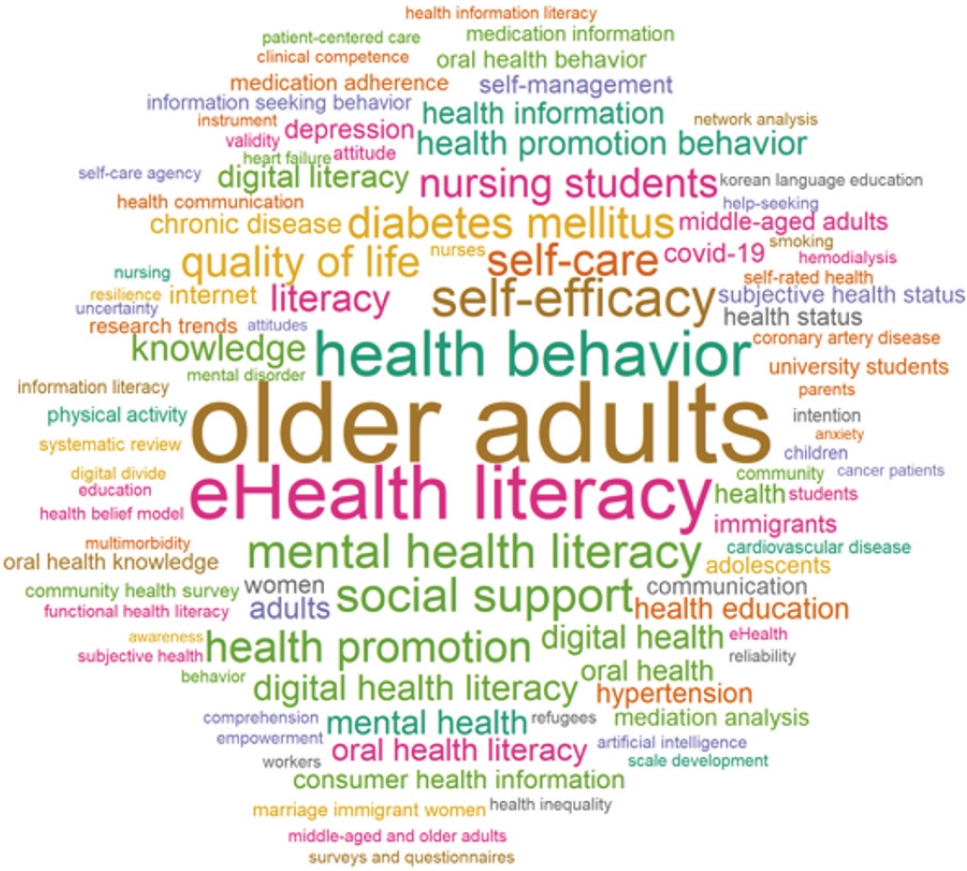
Results Health literacy occupied the most central position in the network, as expected because it was the core search concept. Among the remaining keywords, older adults, eHealth literacy, self-efficacy, health behavior, and self-care had the highest degree centrality. Louvain clustering identified six thematic communities. The five latent Dirichlet allocation topics were Health Literacy Measurement, Mental Health Literacy, Health Information and Communication, Digital Health Literacy, and Disease-Specific Health Literacy. Topic prevalence ranged from 17.1% to 21.4%. Disease-Specific Health Literacy was the largest topic (21.4%, n=136), followed by Digital Health Literacy (21.2%, n=135) and Mental Health Literacy (21.1%, n=134). The sensitivity analysis produced a broadly comparable five-topic structure.
Conclusion This study systematically mapped the knowledge structure of Korean health literacy research. The findings shed light on major research themes and their relationships and may help inform future research priorities.
Purpose This study introduces information value chain analysis by identifying essential information for use in gout care management. Part I reviews the essential concepts of information value chain analysis first introduced by Porter. Part II applies the analysis to determine the information values of patient health information and explores ways in which health information technologies can be best utilized to provide that information to patients with gout.
Methods We combined value chain analysis with natural language processing and machine learning techniques to develop algorithms that can identify patients with gout flares using clinical notes. As one of the first signs that the disease was not being controlled, variables found to be associated with gout flares were considered valuable information for patients with gout.
Results The best performing model, in terms of both gout flare prediction and association identification, was the comprehensive model that not only included concepts from all stages of the value chain but also designated natural language processing concepts from every care stage as surrogate variables. Additionally, all administrative codes traditionally associated with gout and its treatment were included as surrogate outcome variables.
Conclusion This study introduced information value chain analysis and applied it to develop a computer-based method with theoretical underpinnings to identify the concepts associated with gout flares. The findings can be used as a starting point for filtering the vast amounts of information patients must go through and identifying the most valuable information for patient with gout to adequately manage their symptoms.
Purpose Information value is created by providing care for specific medical conditions. To assess the appropriate content and time of delivery, a research framework to examine information values at different stages of the care continuum is needed. This study identified essential information to recommend for different stages of Systemic Lupus Erythematosus (SLE) management. Methods Using Porter's value chain analysis, we conducted a content analysis of the research literature, clinical practice guidelines, and patient education materials in an education-enabled environment regarding patient with SLE. We also used a natural language processing technique to automatically map the essential information identified into authorized concepts in the National Library of Medicine’s Unified Medical Language Systems. Results The essential contents in the diagnosis stage pertained to a general understanding of disease manifestation such as SLE definition, pathophysiology, etiology, prognosis, and progress. The intervening stage highlights information about prominent spheres of therapeutic regimens and administration as well as diverse care providers with relevance to their specific roles. While screening information, such as self-awareness of SLE signs, is valued prior to a clinical visit, the monitoring information follows clinical visits to avoid flaring events. The key concepts identified were "butterfly rash" (C0277942), "anti-inflammatory drugs" (C0003211), "SLE" (C0024141), and "antinuclear antibodies" (C0151480). Conclusion Communication of essential information identified at appropriate care stages can increase patient knowledge and reduce anxiety levels to improve self-care.
Citations
Citations to this article as recorded by
Application of Information Value Chain in Gout Management Maranda Russell, Sujin Kim Korean Journal of Adult Nursing.2022; 34(4): 351. CrossRef



 E-SUBMISSION
 First
First Prev
Prev