Purpose This study aimed to identify predictors of quality of life (QoL), including self-efficacy, social support, illness perceptions, and resilience, among colorectal cancer patients during the first 1 to 6 months after stoma surgery.
Methods A predictive correlational design was used with 142 adult patients who had undergone stoma surgery within the preceding 1 to 6 months. Data were collected using validated instruments measuring QoL, self-efficacy, social support, illness perceptions, and resilience. The data were analyzed using descriptive statistics, the independent t-test, one-way analysis of variance, the Games-Howell post-hoc test, Pearson correlation coefficients, and hierarchical multiple linear regression analysis.
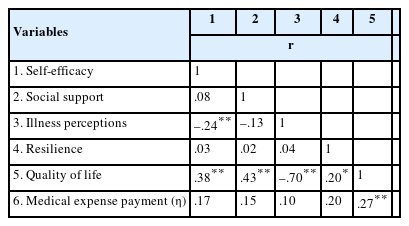
Results The participants had a mean age of 56.15 years (standard deviation, 6.51 years); 67.6% were male, and 57.0% had a temporary stoma. In model 1, the method of paying medical expenses significantly predicted QoL, explaining 6.0% of the variance (adjusted R²=.06, p=.006), with self-financed patients reporting lower QoL than insured patients. In model 2, the addition of psychosocial variables (self-efficacy, social support, illness perceptions, and resilience) substantially improved the model, explaining 70.0% of the variance (adjusted R²=.70, p<.001). In the final model, illness perceptions (β=−.61), social support (β=.32), resilience (β=.20), and self-efficacy (β=.19) were significant predictors (all p<.001), whereas method of paying medical expenses was no longer significant.
Conclusion This study provides evidence to support the development of interventions targeting illness perceptions, social support, resilience, and self-efficacy to improve QoL among stoma patients during the early postoperative period.
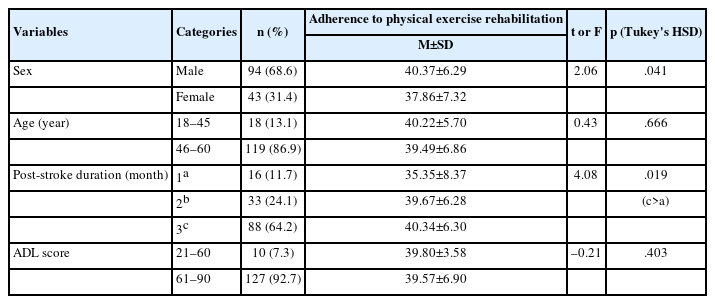
Purpose This study aimed to identify key predictive factors influencing adherence to physical exercise rehabilitation among adults during the first three months following a first-onset ischemic stroke in China. Methods: A cross-sectional descriptive study was conducted among 137 adults who attended clinical follow-up appointments within the first three months after experiencing a first-onset ischemic stroke. Predictors included family support, coping with role transition, depression, self-efficacy, and body image. Hierarchical multiple regression analysis was performed. Results: The mean adherence score for physical exercise rehabilitation was 39.58 (standard deviation=6.71), indicating a moderate adherence level (70.6%). In model 1, male sex (β=.20, p=.017) and post-stroke duration of 2 months (β=.31, p=.015) and 3 months (β=.39, p=.002) were significant predictors of adherence to physical exercise rehabilitation. Adding main predictors in model 2 resulted in a significant increase in explained variance (ΔR²=.418, p<.001), accounting for 51.5% of the total variance (R²=.515, adjusted R²=.484). Male sex (β=.15, p=.017), family support (β=.43, p<.001), self-efficacy (β=.26, p<.001), depression (β=–.24, p=.001), and coping with role transition (β=.16, p=.033) were significant predictors. Body image and post-stroke duration were not significant after adjustment. Conclusion: Efforts to promote adherence to physical exercise rehabilitation should prioritize family support, depressive symptoms, self-efficacy, and coping with role transition. Furthermore, body image may warrant attention when developing sex-specific intervention strategies.
Citations
Citations to this article as recorded by
An Explanatory Model for Rehabilitation Adherence in Patients With Stroke Based on the Capability, Opportunity, Motivation and Behaviour Model Sung Reul Kim, Kyung‐Hee Cho, Hye Young Kim, Yusun Park, Dayeon Chung Journal of Clinical Nursing.2026;[Epub] CrossRef



 E-SUBMISSION
 First
First Prev
Prev