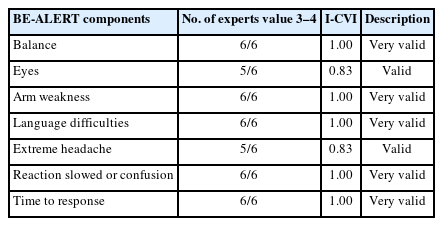
Purpose Stroke is a leading cause of morbidity and mortality worldwide, and rapid early detection is essential. Although screening tools such as FAST (face, arm, speech, and time) are widely used, they may miss posterior strokes, whereas BE-FAST (balance-eyes, face, arm, speech, and time) demonstrates greater sensitivity. However, its implementation in digital formats remains limited. This study aimed to develop, validate, and implement BE-ALERT (balance-eyes-arm weakness-language difficulties-extreme headache-reaction slowed or confusion-time to response) as a community-based early stroke detection application.
Methods This research and development study consisted of development, validation, diagnostic accuracy testing, and community implementation. The development and validation phase included 160 family caregivers of patients with stroke who were aged ≥18 years. The diagnostic accuracy phase included 500 family caregivers who accompanied consecutive patients with suspected stroke in the emergency department. Family caregivers completed the BE-ALERT assessment while accompanying the patients, and their assessment results were compared with neurologist-confirmed diagnoses.
Results Validation showed a content validity index of 0.95 and a Cronbach α reliability coefficient of .82. Community implementation among 160 participants was associated with higher stroke knowledge scores (82.1) and stronger intention to seek immediate treatment (4.5). Receiver operating characteristic curve analysis yielded an area under the curve of 0.836, indicating good diagnostic accuracy. BE-ALERT showed a sensitivity of 85.0%, specificity of 82.1%, negative predictive value of 94.5% and System Usability Scale score of 74.
Conclusion BE-ALERT is a practical, accurate, and well-accepted tool for community-based early stroke detection. It may support stroke screening, public education, and timely treatment-seeking behavior.
Purpose This study investigated factors affecting participation in dementia screening, based on the health belief model. Methods Data from 191 participants that fully answered the distributed questionnaires were analyzed. Data on the following variables were collected: general characteristics with modifying variables, health beliefs, and cue to action for dementia screening. Data were analyzed with descriptive statistics, x2 test, Fisher’s exact test, independent t-test, and logistic regression using SPSS/WIN software version 23.0. Results Factors affecting participation in dementia screening were as follows: For age, those in their 70s were more likely to participate in screening tests for dementia than those in their 60s (Odds Ratio [OR]=0.36, p=.003). For level of education, people with less than elementary school education were more likely to participate in screening tests for dementia than those with more than university education (OR=6.13, p=.020). Presence of spouse (OR=3.65, p=.027), presence of family or friends who underwent dementia screening tests (OR=5.63, p=.002), being exposed to dementia screening advertising (OR=3.94, p=.009), and having showed a lower average score of perceived barrier for dementia screening (OR=0.13, p=.002) were factors that increased the likelihood of participation in dementia screening. Conclusion To increase participation in dementia screening, strategies should be developed taking into account the influencing factors found by this study. In particular, an advertising strategy that emphasizes the importance of participating in dementia screening will be needed.
Citations
Citations to this article as recorded by
Factors Related to the Dementia Prevention Behavior among Community-dwelling Older Adults based on the Health Belief Model: A Cross-sectional Descriptive Study Jin Young Lee, Eun Ko Journal of Korean Academy of Fundamentals of Nursing.2024; 31(3): 263. CrossRef
Factors influencing dementia preventive behaviors of older adults at high risk of dementia: Application of extended health belief model So Hee Jung, Mee Ock Gu Research in Community and Public Health Nursing.2024; 35: 22. CrossRef
Effects of a 6-Week Integrated Dementia Awareness and Prevention Program for Community-Dwelling Older Adults Ji-yeon Kim, Sunghee H. Tak, Hana Ko, SuJung Jung, Jaegyeong Lee, Hyein Choi Sage Open.2022;[Epub] CrossRef
Factors affecting preventive behaviors of Alzheimer’s disease in family members of patients with Alzheimer’s disease JiEun Kim, Min Young Kim, Jung-Ae Kim, Youngeun Lee Medicine.2022; 101(42): e31136. CrossRef
PURPOSE The purpose of this study was to investigate the factors related to Breast cancer Screening using Mammography and CBE of Korean women over 40 years of age. METHODS The participants for this study were 183 Korean women living in 3 urban cities and aged from 40 to 75. The data were collected using structured questionnaires which included sociodemographic factors (11 items), frequency and regularity of mammography and clinical breast examination (7 items), knowledge (16 items), health belief model scale (28 items), and family support (4 items) about breast cancer and breast cancer screening. Frequencies, Chronbach's alpha for reliability, Chi-square, t-test and logistic regression with the SPSS/WIN 12 program were used to analyze the data. RESULTS The percentages of Korean women who had a mammography and CBE for breast cancer screening were 60.1 and 31.1, respectively. Logistic regression analyses demonstrated that regular check ups and perceived barriers were significant predictors of mammography and CBE use for breast cancer screening. CONCLUSION In order to increase the frequency of breast cancer screening practices, educational support and a health care delivery system is needed to improve the chance of regular health check ups.



 E-SUBMISSION
 First
First Prev
Prev