Purpose This study examined sociodemographic, clinical, and symptom-related factors associated with current employment among cancer survivors and described sex-based differences in occupational continuity.
Methods This cross-sectional study used data from the 2019 and 2021 Korea National Health and Nutrition Examination Survey. The sample included cancer survivors aged 19 to 65 years who did not have multiple primary cancers or missing data (n=289). Employment status was categorized as employed or non-employed. Sociodemographic factors (age, sex, education, marital and household characteristics, household income, and private insurance), clinical factors (time since diagnosis, cancer type, current cancer status, and comorbidity), and symptom-related factors (pain, fatigue, depression, memory problems, and sleep difficulties) were evaluated using hierarchical logistic regression. Weighted descriptive analyses were performed to examine sex-based differences in occupational continuity.
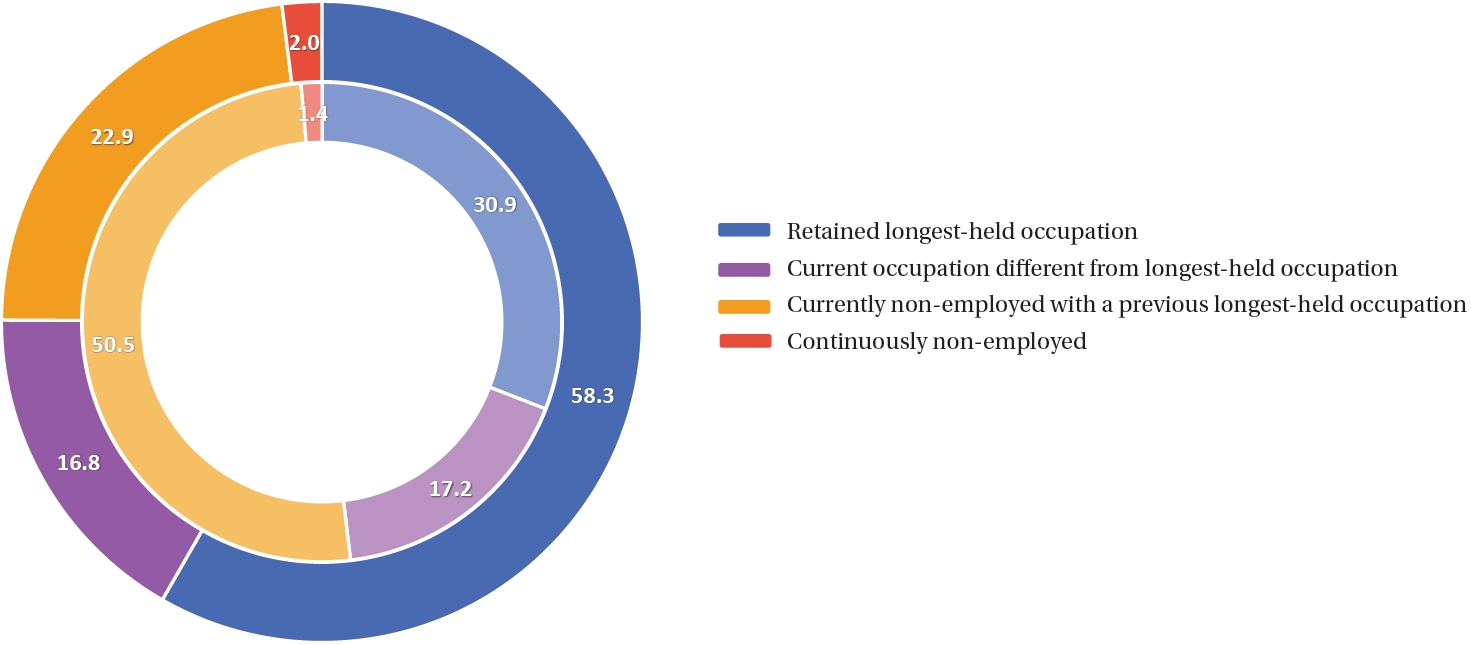
Results Overall, 56.6% of participants were employed. In the final model, male sex was associated with higher odds of employment (odds ratio [OR], 4.69; 95% confidence interval [CI], 2.21–9.94; p<.001), whereas monthly household income below 3 million Korean won was associated with lower odds of employment (OR, 0.41; 95% CI, 0.19–0.88; p<.05). Sleep difficulties were non-significantly associated with lower odds of employment (OR, 0.64; 95% CI, 0.41–1.00; p=.051). No clinical factor was significantly associated with employment. Male participants were more likely than female participants to retain their longest-held occupation (58.3% vs. 30.9%).
Conclusion Employment among cancer survivors was associated with sex and household income, and occupational continuity differed by sex. Although sleep difficulties were not statistically significant in the final model, sleep assessment and sex-sensitive vocational support may be useful components of survivorship nursing care.
Purpose This study aimed to identify socioeconomic clusters of older adults and compare cardiovascular health among the identified clusters.
Methods: A secondary analysis was performed using the data from 3,303 older adults (over 65 years of age; 56.5% women) who participated in the Korean National Health and Nutrition Examination Survey (2016~2017). A two-step cluster analysis was used to identify older adults’ socioeconomic clusters based on 11 factors associated with Socioeconomic Status (SES). Differences in the cardiovascular health outcomes among the identified clusters were analyzed using the x2 test and one-way ANOVA. Results: A three-cluster solution was selected (p<.001) composed of low (n=715), middle (n=1,425), and high-SES clusters (n=1,163). The three clusters differed significantly in the prevalence of diabetes (p<.010), hypertension (p<.001), and metabolic syndrome (p<.001), with greater prevalence in the lower SES clusters. Similarly, systolic blood pressure (p<.001), body mass index (p<.010), and total cholesterol (p<.010) differed significantly among the clusters in the same pattern.
Conclusion: Older adults of lower SES clusters should be a crucial target group for health promotion interventions aimed at the prevention and management of cardiovascular disease risk factors. Tailored interventions can be developed by understanding intersecting SES risk factors in this group.
Citations
Citations to this article as recorded by
The Impact of Clusters With Distinct Social Determinants by a Two-Step Cluster Analysis on Cardiovascular Health Seok Hee Lee, Minsu Ock, Seongmi Moon, Eun Kyeung Song Journal of Cardiovascular Nursing.2026; 41(2): E77. CrossRef
Socioeconomic disparities in hypertension and diabetes among older adults in South Korea: a trend analysis from a national survey, 2011–2023 Bokyoung Choi, Jihee Choi, Jihwan Lee, Eunhee Choi, Soong-nang Jang Social Science & Medicine.2025; 382: 118350. CrossRef
The Contribution of Material, Behavioral, Psychological, and Social-Relational Factors to Income-Related Disparities in Cardiovascular Risk Among Older Adults Chiyoung Lee, Qing Yang, Eun-Ok Im, Eleanor Schildwachter McConnell, Sin-Ho Jung, Hyeoneui Kim Journal of Cardiovascular Nursing.2021; 36(4): E38. CrossRef



 E-SUBMISSION
 First
First Prev
Prev