
• KSAN
  • Contact us
  • E-Submission
ABOUT
BROWSE ARTICLES
EDITORIAL POLICY
FOR CONTRIBUTORS

Articles

Original Article

The Mediating Effect of Grit on the Relationship between Work Environment and Intention to Stay at Work among Regional Trauma Center Nurses: A Cross-Sectional Study

Ji Sun Yang, Myung Jin Jang
Korean J Adult Nurs 2023;35(2):107-116. Published online: May 31, 2023
Charge Nurse, Regional Trauma Center, Gachon University Gil Medical Center, Incheon, Korea JFIFddDuckydqhttp://ns.adobe.com/xap/1.0/ Adobed     ! 1AQa"q 2#w8B36v7XRr$9bCt%u&Ws'(xy4T5fH  !1AQaq"2B Rbr#u67Ѳ3sTt5v8Sc$4ĂCÔ%UӅFV ?_Aנj- H>>,m*>fzp"TrKkr^r.|_&]|*vPuܶvoQ1mwVJUhu-I"=LniAƕ8"۲ k*ҿ[yu:.vUQ+)%F DHyVBk>Hy8jݹ q~9D4KRmzQ)^ʔ.J%k_tVi5NTjg!'ky|5asOȻ)R۸ߩFMԿ3L4j6dڜ#NIwUF]JqB/(FafJRzq3\G՛ ?~\ 6)6W4m[O^L0E&rRMض*C .]Unl-1 1r#Rj/&QɈ׉˩s6Rj=5Tg.y.·Pӡ:JJS:C8-2u]d&vUz;7p9 5VnL֢"y)">iי(IDDd| Yj0; LRfS:ktYK%*N2^m|&dğth":ey)uPQZW)gcC3Pv&MMWd&Ŵ۲mvTRoժM03*F3Yd6\8,\hݻ kߔi<k NTwSԪmljj[>->ptU%'LR>&EBH$MQAUx[$Z6vi&_a.KIQ{hyƒ j"JOC9eFҝfj;˚Ω<[3_m% lQ@4g=5$(J]Yc-OMq<Ǎ wSzڗ)k$7VIP붾ͯnV+卵*t]iЎD31~SA1éC2u)ʼnQn-Uoi3:grI8ؓWm*G zܕ)ZקJ}Y YlGeJ6cB2I NS3Q>k=KTBT]W6+SOXQgGR? telˊ%-Re\hѯ2TF"C/OJΩ6r[N.0{SpljjX1“jOsӥ;ҭhe}xu`Ք&.)yO̒ Fߑ.$Qw;9Iw2o+RVJMSOj[SoҌZ%;`d$blQ{Ro{Imڌ>3egf\O֝Uzx"䢸g+mv%Gʆ:|V[N'&ס-ޝ'kfE|K,G&˳98Juin/\\Qݿ̋v~Ǩ!rtWU d|E߫R4d}.qPw*Ӭv5YEcn~f5c%MTMkb-F>5JT,})QHg%{("ӔȸWMsYyWNRrkkJr0XドnͫT}r-jj,Ŕʍ\Q2Ri>v$5!]"JB2WɅ)]VԜUc8i|.jeRO6^V.¸ Q&#|ܶ-*uOG%JAtRZRr]FFG\۩w+?'zչSѧt jz>KW&ot{7P&2D;&\\>Q2JzܗAKSfeNn[jRrԕf6,q,F1tRfԗ>vֶևj-&R'Zi2=xv~Elbsvm8=ӛ"ū񕜈BȩlWau[]ٷBߨF~J!|Ipr3R̴#Yp)={7:G{+:\W}n|Q#%)7^-h"Ƒq:M*%J&$T軨I333׎g_- ucBwwjp[6i25$̏bU’ٱRv?G\~#Iͪb7<<}Ezt" q_Inw,7-d,G÷%T* Wg1"䥱kq/A.,_KhqŒxwvo u2ۥۧ.bQ}XκA$֣ +K״ZUNmڸII{.v{5z5ѮRme[moyƾd~cRݾK'j.\i&/S6f|b=5: p!6i_ 4j6=.si˧eƾtS^c.Y^RJVS-Vi3,esi08?H$GvZgg?gi䤟2adw릿:"۪lkSN>q-4kI܋ێe̊qۅgDoѨ9; #T.Q;7#~_Ufstb_'w~Xw1Xk,vcOt._}v}8"(4Z\ۘgk?J?bm_c!g{HZV]Fkk%~gEt)b秴vΰB|꽸}mp~E6ݹv;7P٤v+ri*3Ԣ|'O14_~7nP{7ZU\Vű[ +7󖱅o#:ǥŬ\|3r%TJX]V7ez¨Y]lc|O3V! R zbJ'PnGqVJ"19WVeOF埜EaEJωqCN5Z g-9[S<$sUK5b|7sn\7x qmv##FF\ w[=-43$^ooVSiXօv7iB۴yg>]Vf"r$J3""32!Zh[K%7GvNLs+4nB/B{vlsobJaҺJR:0g%&zR\ S3T[&ִor*ⷳc3ʊO[iozW٨%$gn:ܶWwFBԹjHP&z u&F2\f;ipW73 [; '_̽b;vib!oec dC-tS__$Xs]l9&z$2/N>%'[}b{h/{`{Ji׉׏ YJB/X%}.|+{(S:qz]4_Kѵo`^tY_4S#* ^zvݾMr+TrkQ g.8Ͽ^i>ӈǙvix>$o( ^qt*&t1oJVu-ql5U6jCЉmĻ*"?JT=K'O/|=Vo}l0b}}f?X[?/\JSBe,kP8ETJ==?.p5ފgbU9}ǶdNKk—_$8̸͓ۍ8Di\BԿ-1v{FF]|.^ۅ{vl12׏z7-R7wE?\nh\jN/Kձr_oBw"N QMBZqe-m:ӨSn6j4%!hQ;sv'm4kcM=!8\m[M4{SMliۇ%eֽR&N:{2A8)THLK3Zj[jPBx#BگMf:G1\`edcʮ?|w(-̮vXt,bW2;.ιNHRR#YwTM"<;mk\.foIDjmlJ;vxy7o7i\,KQŊ9d^Mmgc L*.T6tLeIuOH3SJQ3=F/ʿ<9\JM6mN6=<{xkP!F1QR[I$6ُimXu2An2yԒMU q f[IB-'䤯jYm52&JG\zд\~vdg QtHGXw&1Lw+nDEdC1w|YJmvP)HZ>i0BPβә?R:QO["]I_Jʏۍ>QKyu^bycBq4lXF~l [\*N>-J6,Gq(Zr5h]CwYӤU~ʶߑ u*SIv%ZfJ7)! FS*s_\|IŸZ)J ]ܜi4"z[+Z,MOZ))}|Ʀ(RUNIII.S'ˍO~˨rn}M)xxӕ0 eyҵ7YMAB]ӣU:/ѭ*6bcwP͵ "+qēVjŹO|GtY4V j[mLV M -m>",B$ GD1~j6O4|LxnNmqATNR3ε|DŽa[fmn-ڭ+FiK7Pcm;r5 l8r{#-]'nrFh2ruycb;pW=njRqRJ(d mnpckNnʹ+6]tz~E=ʕ l ZZ5jSi3#47.Lcfe`9؏v囜.F\-UZ:*0_<Νu9Lӵm&)_3\^ҹ3"1n1v_|uRʞͫr'iȧN_kH׺8xXrj=\МH)V\ˬ.Xʸ oVRC}ySU9/OBY먌5 ٿwޞ)rw8Ӫi5*5ZΗcGƱ !ZۄlmpjJ -l <R̵/JAպZuq\IdUS 48wXJJtcg4cI~aqߓwŷrm-v)G7yS^7H^-\mŌAq|"m9IBnF㏉9[N+mmy/!KKۉ%n +BdddfFF6FQRN-U5;Sv'm4kcM=Mn)\qιqUd9F%",6MGdT%-+~ f%+y֛^3SrF>6lc(֪vۊN;g._0Sѧ]ETWرkQKzGe9ʨsKA"yC y2\[5 rԭ7Gk5Mzw_4sM3hxЊ'oÍ5jsub )ͪ~tR2H]R͍>̋m6=%(˿(Wrr-܅y5(ܔJ޺YunW̹븹NsqK ]/QR#"ZMDfD|43Qw|._ԡSqTZBg??O Ϥ)/E_U|i}2 9Z?¹0:x'3,whǣ?C y-A~=daJј&M?D1_PS+Oi&;a @;Dž7[ zZC"bv:jjMQk$M RԸ3uA\=wI.AwC"^.{?-\NSiˏ"b}T/}q/ o.1M}R%:-ZniʒL$SgrBW*,Mw'N\ɇ{s\j]VryG'8f`}'N<*/`U숻z CwHq18J+vԕKss4R53/&XTt1bZƟo\=%nO)h$rBi-nKĪ^ ջڜlwkYm[̑+/QrZo%TQ;TLs($2C:s.%+eoNttq۰kK7O0m_t_pZ1SsSM7"mevFZ[w -FJ*T*jФQRg BSu|]g:ɵzjqwmltL.e3sRMچkSmjkmWœިm++¦'tILk*բQ D,PB\lI[9{%Gb R6öۍmX-MaʉA931cs..G4CujQտ[9 }G-xwl)IQz j Ó"rqe&=]꾧֎c)<kӳ+0JrRR3'TnXi^xMF Bު*tIL.[h"2"nKzZe'ZV/RrNYz]8죝n]Ķܩ>^Ժ]u-7^\mZjܣ9+Rmn ߑv?oꋘ?&ƪy^N4o=3-ؔ̿*`}V݁ ƒPu8%$ ݗ]wt;\y\>='OjPIp/nJU8{϶FNMsf"ίNqƹ(+ ݮF2Km |jܴZs%zf*eȫ?]4)I۵nR&FX + [jDh(#哑9q9Eծj8noǕZf\J-l&Z˫}`ӎhyrΉn\űn]9pʌӣ"׮Wt?N4_I_~54#/my1Xr*척aS#DT >q ssΛW;3oUaJSRMDgQnt:Ql,/ ܷfRqiM Ȼ>Cob;A>ڦWقM9X~/!'MW.}Vrߔꔵ!5|iB(0-zF=}okڢE$^wW~nokY߮\6՜̌{i-AF*9)\t9IV6۸5ZUF6R$ŨQIq砳YUZ]eyv >hI櫥N )&l JulwE1GDOuFN2| }馥uC1rޫV+^gdb&W[4<^e4YW,d|htͮsUM)۸8:{3d{AѢ)~ \#J=NdƮꮓ90 |1K$v*?мS ]i$J,C,SG?/_՜pMSƯM|mG1V1$~K>CSvkuj=&) -,yLjuFHK{c駗.SOua;BrSqj-ۍZ#'Jys7[g2z/.u4+XV2VQ.ޕ)$"(%)#Z7suZ%j }BǬݕe)Jvz8zJf:hIN|svO1O#IEcۍjݽ:SdὮvu^@:o^5cs>i/VqmVm]ؔܢn6'vޑ̗J4Wn@OlKbX ;n:hgJ9ŻyǑz8f܌q&Y fN0N;[69 rbׅC2/#kE l&2~èMR.*%g=Ft.%؝e8<.e=Uv{~㻏"EˑnvDѭ͜Lu3u0:U֝$[M5<:oi+V4V9 6nXvx&_ q Qqw3W:uϔ2yb/(ɳ|5zQiJ#r|Hw#.W?4aDŲ\ugWG;Cw鐢K|xg)##=O.dF˟jMUvWĻsr.z]kPc9"]R)mkfOd*uYf١RsB Aîh=k]ʳUrrZsq`d#r$/Ը3o^&lRWȍyuW̦Y4QDUMJ65ƒ[+ygk XK_±k#y:8(TJOSQhJt2.DR}"5[) r)6V6u5k:eXZmv𭤔!푊Q[qQ}ҹLE- 8qIZG|UM4j}Mܕ[Vwm{} Naqµ"ԈM zOpKѰ?IAD3Ir0'/q1itoB5{%wkOBn-ۜduqIzYK60{+DʕܞqIt";r1mG/\/ym[6JƫR \L=S=OT@Ix[TMm{>ݾտ֒ݸӉLYIx>+"JVNzx||5rI?C{oz8۹e\R-^\A2F R+N9 vlT]"ۭ d)t֞i #E2jB@׵=#/N+!ĕhx}I!cM`ąZ*ŻɄҒ߮Y.Z}='/oۙ3IpW̮hT7cTSuz9>B}΄&h!>lӵn~j˅IvU.'v'CSZw8QK3G> ,J59ٷ+HSg䧎hJdzvwv-cvxS5[̊n~ؿ%ַX?O0\6ne 6kn9.ϯ} *h 8_QhLݣ7q +=XBҲ5?[[)+F`=4 }B,sNg==u*Nj9k_GJ)+R~GSPBȒZ:(K]heL=vKPӢwq(NrG^ثϣ?#tC?.ͼ[ۅo؞y#%ǛjVyLSw%T*s92JTM%"YkQО.q)gCͲn8cgi6j1MѾ[{9h^vƘǚםidfi.^RHmg&rׇz:}݃}xT$ضk'5s-狶,\vpbPD،=Okf.c#cdz2FK5T!&)|ntD<+OŹU i-G[EE*FDfeaf2QƤM\UG_{ǹm%\yrGy:.\4wjPGUJޕUV7Do\7Vy_13w;[?c]H\$IJ,*L]3b%L{y.JRKG2sq,B6T}(#nW|km+q5] r㪍bJ@y{byz,b踊3ϻJ,'^xd،)JVw#.Vټc''ÝպWtbRؒJz۠8!o9IۄS95E9ؔ-e9JR{dmnッ<[~n${~Њ$W?&ՐY_? #a.ߑv?oꋘ?&ơ|y^N4o=3t=~7!/M3>n8W홎2M`Qx+ z qy8%]7_~540ۦ彷]Wq CѡwkďyF5Dum_}~P(5.(X,K9vᯐ?leB9;Jhm#3{CxGE-S{;@Fz˙]=O'!ɿ]' r`:7'2bЖ>Iy,/eTy/V<.H?UYY{\^#ѣr9^7?xoRȆ7EoS_&??zϾM?(~Q-K&>"~aߨ t7Emsϛ+?;fCr)fY+>z$tIkjn_>vnrֳki-˹l= t;'EyC¥|/BLwBJdgjۛ$s S1|ɍV%JI6KvəhzIlBYɒ|0"Sy0F>eo5W)O+X˻u';v)2vVq۳kۮws?UʑBǴYO漪e2MIjPAک\b1)DDؚKm6ZWΨgȕ۶yjڳ 2ضN[C[|r@9Jfo<_eI7q.|cÊV߷:i.:$ȋ)1%%)ADZCEBxJ0MJۥy(bNsKM9k43IwNt.\%N簤I'.j|ƃ2$grBEٌ\}9:v*!n7M(ɽ]7c@XxƱԨ37īf62cTTfFK]9wntQHͮvٱI/f|j=7}\_V5U^+:uljSȃY(XI.ȱmo1甅jڎIZ2>#\*:gY|4k\8ZwSqtyA!+];бޞKծË¥e)#5ap.QK^8VdU{*ѽL\=qmjnB5>{ Ӟ`v±5 ^k&O~Oshɷ,;6nOW>u6{RqS`)S%jp\ipdEBLfTWy$GIYw~䲭J.1vSY5z.V>^+Ǎvc.I[R{QsNR3ӎfhd>y?UJ*}~[e\i5U^͛E]G_FS(Iɿ]i8:4zj~շsW,ˆsy:%O}iur]iF5~3M:Ӟ#N06)4ߧgdawIotiz:1r5YDZLHBSi;NQc44la=Y kQIT*ըl:tq2(է9VO4뒳܂~2rq'nrVZŦ[t7\oլfb/mlpc.I8콚q^1iE~䰳mi[dۧw֤ICfdFeCsg:i| 6擣׋* 96lust^{%99UNRvaMܽo ammi$em4D6DD\nA%$$#}۷/ݕr99JMն[oT޲E"KTaP+HGkŴj5TM5xƱOS-k`ۛkٝWz;{kS}F;~q|~^_|euwnE'pSupUP)V]vE+t =ZRaVdG6= *.ϼnj9:UɷbېmF_tޫgHjVS'śǕًdkkѻ_]Kv?nT>)^e=Ar1'3ԔILyD?:-^in):{7.؂\.:V }#뺾.3r̸*xbFM aȵz 6SQ:ײj[ 8nn iFMw rR"5M5I旘35f^j='j:nNW.ʭocZvZKV^ɚJ.cM1ZI7E'6rg탸5oZ=[m Z`\hbMUR١Ȗĉ):Jin!_7Dй+f̷eKҷvͨBPR(V`y6tw*MRΝcB.ڭTnc;P$8nFvm4(D(R#R-L -2:FP lxZKQc6I("Km%$E, 78uXIFA$RQI$JbInG]c[ֹ:ZM+n^')JmJMJRu{e)7jQDw~%yQl}BZujSSf۩QZ+Dzhd5o%BIc'GZ?}΍:>Ɵivז-%݌J5MqGWTVʦh݇ܟ~Օ_6 n'{3~mϬj'J11OȻn߃r Qr\3y٘+WӍ'WxEs^O3 o~[|7>]]H9݇ZomT@]?5B:Z߂'`V_+/MSKX߆ޠk3?o7y:4R/7þ] iG߬aBRU&?r&/} cQߥGj2?C5Yśe7hU=?+ x龳f-܈czW^7p%-(\D4h{UK&ӡn^m]Fݢ:`δvj俜F+) y[{{ 7 tu>gvrěOj'5 iRg[ͶFjGe n~qT$ci ۚ0oԹc*jL[sVWqj\ݻ&6"WoK:cnWmrv)o>66(F>=W^bf#c zzʞtپy%mՉPël e}J.\Zk4ttt>oEM=q)hJjI=ͥ(%]脼_88ф;͛gWG;Cw~˘$4=uWdĜTثNDkiQL9U*O"4XP`02,Ge-k5$h>ܼ]3vr6!9RQPIVSnM(ۓ{>;/Qͱv{3&-[rc)ܚI$n{Sv3[j00)-D3z}MRzVQпj,T[uVs0\}Sid;r(ݝJ>æʺL&c[jPK0~d(FKÝW\m]GTcF|Iׁ)I3~#oX%vҦEݑؼ5Żv2qAZTE^..M{ʐfȏ2##.R}*KʛZz^ӞN*lPťLf\G6[WVQquV]XAi)5J!,$iJ6o$tPZc;Kjx_n3`qIelV~vLy{fn匋Ѿn%;zV.n'-ұdd2߽1bZksPe3TI9)$ԩIN9Vơ\=2885N\ p)/a柛w9g_lױo8ݷ iixJV& ғRi{N^_oAŮE6Y7I$Nk$|Q)-*4Z)^¸%4Qm [I%.c-OV+C֧R#%ѨCe3i;w$G+_dy| Fzj$DI(=OA gj%v/]8qԯNIS*֩',Q%\44ZZ%D|Ǧʴ6&vֵI$%8(ԬƾS&#Z. }6z?b/|Jl{ץv&mpx4Z$”ڝ4-H%dGKfM:sKSRWeJAn]>s6应-W9'H]'uȫYvgK^\czp|My\鏩w/ËQ.)]\QiS`8uL뚛̸=J"ܻi\å'-)54Ue]:K\퓡vK xwBqrH\*֕TnzC.mT=t-H]SČ~Nu╏NÅ3f|͡G~B+Xm[Q7U{9"~jgK Zoʰ7"qJ,ekSeNGgϳ] ^.6:s}_,%eRg<5⿨z{ZPun#jRІ.6g T.!]xa c#jN$Zpl̋H WZu8WmMRýsĮ?Mco~sx TU҆Q :KDG4n42.<3/'^?6/ܠڒ^yrrÿr2\D}}B]^E~^T cɛ7϶Y[<֞[7d}2%QPqOLEQR\CIsj1?\}%tJ0e~ *sk"*)&ۓEi#{1J8Hrt|'ܝRr8)=ƔN'RVz:cf]F7bZyZUȘ4x8,#JG̒?.W9XnO]KO]%]ƻ O5Γ/3qÓj؍/r̺rƵ 5\&m6h.xoeX[=<3%< lZ"2h\Z[&jW3ejm?k&[]ųj+{N{66leu_+lj]q* 7g*knأYv= q ەdxЬZ|%GUrQ3jLŒqET]1% qkXYūYc[7Ś]QY\jko\</Lc7+'hMSUc6qXyؙ~6#ѯv.0$BQi5YyIhɍiy=KD!n3Vm[V%W-B%swa97ajۗ m+9~]fKq|Ddaˑ0A]_v޺mM5* F-BYHJ5}q>ʉ.6hyDmpD׬'-_v5;5[8K[viJ.3dR:oYHHh9I7:۽fi+wm^ [)odPѱ52CZUJicSw\&_s0uBȍh32džzQflcd^m|7GѹE!fO5]]H9݇ZomT@]?5B:Z߂'`V_+/MSKX߆ޠk3?o7y:4R/7þ] iG߬aBRU&?r&/} cQߥGj2?C5Yśe7hU=?+ x龳f-܈czW^7p%5|Y:SJE\U-(a_cƣUǽXXKiȞNlmۊڭڄR!**ܤMeȽ$|X5(Ź\rJ~ܮ]>'HB0cp XFr_c?f?7<ukSgov¥iG>>䙗i.+t+bOjIܶ . i^:nm}s}(3>NZ$2Qg([".>i.ƾ)B̋M8+"- >eE6DݥJnJˣt׻ 5.˅nJGwZD~!i۶a,Db3ZQ3O#KO5/֍ozuK'GbRi᝘NV_ҝcvם ZoX}F6z 7e5_e:ۓj=AB+iܔERadMBq*ԯ DwI/Gy*mĥiRKg6skY/#SN4e$-yXM YL?^ĸNNӪ{$r1JJRSLO]Aqm>V/s[~i/j+m>z}eI"Qvp]{ZԼ:{vPAG2=T͡@ڐ#u"E*>C;o$~C#_d/HBq^YRٽzIKbOm\~żjFFGdiQ(*/i*#.FF]©m=BmpQQQSP&Ҫ!T&^>:y)$ˑÐFčI Bӡ-t!bM WҦŶ'UZ=}zvn~oT/\ǒ'nr8 AJIӆz<^uߖ4eFC1i+v!3qNyߕni?4JZlmYFXFۼO0B\m[ tʄU3s"Sr(NJ;SKW72L4̏BVdf^Ҹj\]ȱ۪(ӷm?J-KEmWڽ^4<8qu%9pŹW~877ܾeVгS(յe^C]yX͹! םm4FGȋ\y'Z FX7e)|Gjt߹#gb\ŧq_([R8[qU$Z (ʻezV2V!iQ,i$JE˂٩ a(GK'O{vnBvryRd-RK4=qxZJMl_CuuIz @Rt㮽޳!|68\-l[џ84-2Pu" RJ_^OL>G1~XnBŬw6J0*Uvlږ1N G1q9IUm*'oWu][&UyYZbBZRZNfEJf"+2nF~Eû7n1xv.RUM$6 lAxSQJ&n5ܞwlEói"#>4׿Q.nEq7Oko[1wg8ZQwZYiqtm&~">Bo?w͡ni2峋NCEy Ҕ+%ZJ ʩq*fpˤl,~^Mχk1+:ݕ z&Y`KLӪУDr3[*Z :(SL&ݻ۬Vqsyԭs x|iI߽zZrg.:mp%6ԜvgmpIUt;QbS.Է) ǨKSV,*lڌ|5Jt3#NP.=+OZ~/G سIgbꥹJnl_DUM\iM!֔wVZuԺ,yV.Q>f v:݇WiaŸN5Ҕ[M7SsrvǣrMW= \8ZW-jsnڕ.ZnF2qt ً[ٻޘY۷Zm"Jxr&NAfA-݌to9s359݆mZ+N1-qS$D=17 x׵+%_ ve4ir6Z$FDڗnFtOr'7'{9C˨ꤡaYoace{Refnft RR"4%ʌm:Sj3)OdInTO>X'vxV#jܮw9Fog;5.~Y5\~18YQܹvj4+~t7S ﬕs %^۵ڴDZV69R^Y+rj$ԇoJKR5wB9C>Y:l+EǎS{ʲ{T6Wi* ^^9k/y/Cs\g*qڵgn4T8mERr|Ti+iPe;;.i\EBEJ 丬i9ɧM-ԼsGDrZ>r#R>~X9y4b棇9JwV۔%m(b[Tjvl}۩~nDԺ{Zo-YuK1vx.nWuO+jN [ٮ0%"΢CdTJK-RަH"$I(*ve &҉FzB,_Vpqp9m8werv')E;o&QE׵^d9˦j\_,ڵugZȻ̧8k+jK{wmr@3ӭ2 wFkzFVqs1؛.v'I%$[iT]D5Dl2 nk7qUxԫLS+sا3/ΖeZYK<["%-g/kRs:f3;*E ت wJ%)5&+&rw*霣i|sMҴ|;R+fm䡩.!**dӶ-6s6,]zAXMWjmnz%SJߴm2UXw7MQ%<!tKys#P,W>s;3IYwx<+i_\\\U6 u7P|xbn_k&ӓVOe䦒 VUr,-㘘"-LZeOSҠթrEvq8Kf%5%&K"#%vD/.ZYYŏ+p$nZkvއuW9㓱Z G wYIFyf)?ƎUm5ԉ/'k84{KO:rQI}XRuԪ|*lu)3qZ[mSm5R3".Xcَ5c®ࢫI*۳~wRϿQWޝ(EJrri&ۥ^ʶ齲Im|[yb;mnm֩uiܘq>E+Ikx߄3r33-5𹻖09ϖ9[Tz~mr5NsWl$oPusޛ^{Z;);sڹf\3oٹZmԉ/'k84{NO:rQIBø8Bݱ3n֤DiK4u& ofSȒܩx<˘|N0Fչ]qsp"}! QWw@t4ӭ+cO5%]'*{eM߲DRO1y*q8w++e!c߶ܪlZWّM欼 CQ̼빶lX{vib/V/ ai;x6~]+z]MWB>re-:lgk}պ!#9?%܋V-c[z!W?c7YNm/jRr[HOzԻefճ0q15Zp#rkQQ0tU-AmڵP/cȕ?0cZYj;:0ZM=D6g ?'UN+ձ[K ܖB2'xq9{|۫N0ku 7xaj;n\ 2[VznMlWiKbSk))f..)Km)&bGZ=>OR܍W:j'rM'wYz&/鶧{Sʵb"vջq[I-ՌZH._x*BagC'T(Q:$ͳQcMCKy?3g'ߝqnT);qs #ؤZ}OOI:cfnc8W~qy.;^pVl]Hԓ>^H^@7-AA܃nmL(uWܻS߿ Td95Bdh4t6*dDh!EhI[iŨ\L.&Nc ܮf^;$R)\rip9I|ٺ?#R.ZDZ;/]nݻqs\QE9M&Bd ]N mN*D>tgbK>+ˏ.!23]BȔR1ɝ^j'k2ƮqBQq[$di]icV/e`޵B.FIIJqbi>Ӥ|p; 6${)RU>_e}^dzdfzi %ekRVUS?6'hׂ)5.\+qUgzE2C˷ecŏ^֔ibk shesFWJ#~> Wk~ݨ}ڶ>ơǚ)׽ZƉo~B-ڼrvoE:Ʃ3ۣK7+Y`WirS):{>ڛ}:wԨ(J_";6R%[u&ƫdZ_\'np| RJwNeTW,=rrbnkڄ[M3ܴz)3- R.?:okۼ0TU'w{6&w7j1z3ON'fGoO?)S_bQ_¿R(^ԴԴG.EtMڇ&RUiW uQjU> Kiu1d<ѥIQ'RQ1:O/lŗᏩiʂv&Jc{D5 Tt)1.n[n۶X}RjqnOʽ(~[Ns{ސ⛌uO,kgo֢dRNQȄ .'6W!׌P朼tdZjFGE"]K@'i۪N;sI[{SOzk>`rRR+!σj8&TjlvA̷Q?HyjyLHNտJMjܶT۽lG?SnKN%<‘ nq[N0Sq[Ta(&t(|HGO~gvkݻTR4&Z$#ViOY1r$6YF?e4U/Mvxų:zbU^gQQ+NW_'4jfz^c'#`rvrڡ(IJ/J ݦ6 ]-CW |_{v*_q3^DZ}Ic6Uڌ8p7{crZq5ki`)mU6|-Z5^iEz3P=:Cu7DF'k%}<C-޹ֲ̱#\,(f88%X-N(ck0VLR~} G"-8ӏ/ϰKq?(#nrVTmZ;zióM4 m |UT'C^_1X.gXM{%ʤd 4\ovN":"y-,T)fLQgۢr=/CƹǨJVr[a+!rT|%Y\ٱzsS>jͱ.oOc6f$q% ǒGo;n[];ߎjrk{~\VۓNIGn:iqxo |~t5)Rxעri{Vi&NUOl_ѮMfsޕkЄay.0P{7N((BaIP$ K"U6Gl ݙqJRu+qN$ m#*p<|{:>-Ev=86N*MM긭U*uѾ?/^o7;'u,h4݌xښRM:5.(/ \իU.{F^rmF-Jɷ.>Q"[4xT^OZ~mK}T0ݛ^SAo9u?lX(' qj%=X}"^e4wˠ|rܫ 6I\Ķ;Ӻw!'ڍWg{ i U_9Avhۣƾ+:vs/MK[ɭīe{`Zgb}r[i'GE2J7Nez579wRq+Un ]J.cJ4M:h箽Wxxm^ pc\wcN%'My $$| :$Fqɏ¾^қP9J6Wxvu}ݵP>Z'FFdg"-; [¢cmWkÎT8nG%ݣ7*\խCLRYZͤiD&J#'ehbSyXK|y*ӞpS̍R`[pTr/Eg)K+92{_ n3zwz'oŸۤ+sOj J:`T>Cf*lwd\fYOP"R E֢̔L4ɥ :;.b(B02rJ蠟9>V'9M%)IqnhP<%,r'P/vNSwr#w"ݨaqc(|{kd=^0jTMR2ULNz|.<|^PfY22##!,K~E BEJۜ&jRNsHަޛg\r,v؜.jK3)[EJ2ii{KEiHP^&]Gn8x=K}Wx/KI9-ϵwQ%spܾ[^R}S3$qvq8M[ ozKxcqmJ/ӿ{_}7&ݨ\f6ZSyQz& 7ۉ[8~UNn|nkiTB+4RI8'Nc%tn{!]Ȋo.nEmʱn𵵥J A+wy#+ikǒڂ;՛s85'KmE:Ђu""Iģ5p=БbTY-ͽڔ詻ngL2Q}$de# fs^o{DUUsfwӶ;s1T,ǤtޒQ\෼J=.tKU,7čJ5 N$y3kdSMQU~mO[03 $zAڟsF5^뜞"Կ QHmrR"ӳηer+ҔZ]hE-6Jmt'ޒ=O[sQj)6K}?e4v_KfZheޓ=BV[bY}lݒTTЬ{ȫvO_qpRApVŗ 6ju=*BR)g "O1yhb=tqJ gtm\b3RY+JQ^Ō֍\յ\>+uSi{=x ^w;uӘ#ĸzLn*$anok߷CBӷ}5Yqvdž<( "_OWit5:EZj2 B ρ1̊fi[n!HQF82q1牙nqnEpT(2RMoM4ϳOu ':֧_Xjsg jP^(ڙ{2%E͖j^}ZU[Q$'U) <܂%!s"m R'G5M0<+zM6qYm$ڕ$3ǧH]?o2N<8F1̻r_my[Rf59NjpzBnl7*{.QP 3N&^BLJPjAHCK2Q}$#~YMq8 k(MFMU)8MEqTy+Tʞ-ar5yܕOXw!e;q-Jqܶ䓊Y:LC UE{/t>r"lI9)3KJjϤA 6SEE$d߇3KG*En|P\ԭTn6I-ƍKTj<1H_zwGr19wF N8ݝ+a9ɫM6mhePi%mmD! """"""*1bRKrD"vnrM۫mmĽm]ӡiG~e"˩ lhRTMk^MX["Jݱk7_ޕ*DqĒ&flՒ}`W}~SմZ{ĕ~wm*/{{ѹ_-0ط#P]xlڱ~Tn5wi*lڪ (JxioϏbqKYR|!|KN53 OS222$jzww%i}>N)E+rۥ7c$Ofl/LNث\6H9: FY󡈾I)fB֔JI_ ֣^: 9mY{66㒢7Uj]:.-os[R&gMF3˸#໹kmjq^8W"PΦURjʄWa˧T!͋ lW48JB2ko+ /Nw QwQzQ ے%$ޓ7^YL|r7!v%Trܥ &|M8~ybrn[RV gSn{{*#2#ԽᢏӴHak" ӌcwҜw&RJ07ױ>Ļ =^ BɆ)v32.M1=#6%̠tҤnzqMwԣ~s*%-j|_m*.Yx9Sz=)qE4 3pk+,`=kNRڥ=B=nŔNAx)Q$ԩȧ4z3t#Z2lҮYn$S%y- JzGpu|LBV7ZW#;Wwipܷ%(6jFG5#{$D"uۭ~]֫SrD܃fҎӾ+Tu>-ZTQ& N|$沸ii>eRWݳu'[O̻j8JۻEѩ[]vni= ڒ,[_%kC7I3Nv$4ɎЈeٸoUu:[}Do5|zNq=Tre%ɧ6&~DȍF]ƞG5q m]/w/ \ʲr8=oʔe9U(W"|S]uZd#?Se[W"ֿh][-7Nu:T=)R}.;ml*5Dlf $fF(̏T hiIUU4Szɕ t(%_|2 ~6eM;TƗK[f&]LK^CE2[ȏBOd;Mi|cx,^6;sیGpQ\NuJIFTJ~đArh* B"$H쉩eXPRj?sl"ԥ)su]xpԴY%VESH"ЋJǰ K&5^Ukzׄ8kEgS2h&Se\ Yl]WҶp-ZUvi7QS:4byqOo+[̺腋[6-_Fo.6[7$p&^ _GZԸߍkc.qqoI[9m߸YxOZЦ1uoiSH)P9Uʄjcq= S>֙NeR><;+ڌk%_qT].srNO?s[=vH[]RZHRMtᩗVؾ:/~u)ԍdg%=edVrISb{6vSu=(ܥ)mTv/J}̇8 S3ad:^hBSf؉OɔLhI_1d8,L><_A0y3rXq"'(۱;mFNII.v5_(^q~X>y{3צ I*Vܛv/jW' T'NR'j%ꔩ:mJ3SB}΋!-H-RJBТQoedi9tjENenPpke.%4]#{:>mkEɱdYWl\\\'nRM4&U>?Ќˉk÷!𴪛]]5}UqG~ݏI"O~s6(Ļ)qO~h}uԕd}Q~G,oE!&G&/]_H-O=o{k\̭bkv.Ô܈+;arZx)m?M\3lU$mk-CFXjTv6u' g:Vn_*qk:VC A%'4JV%EY)#BғO4<e׿jQQ]yUr4=wm[K1r׵%Iũ-O}|kC;/VcݩWZ)EHdžTru]8hgĵ-;=>U_ InvTm_jBM+QiF"9*{DI/iuo(=TzϖmPQl_v4z>T*ȴ>YF;ε\t]EH4ꌇ[VrLzef 2T^V>g2~kg5~Nק;{~Z~W}&ŒBӿS2$J?~(Yœ"˲ߩ\O]: J׉ښT{mmIѩn3˧)4LdFZ/zUG>U> n 5& ϴ-KJi2o]uKljvK3$bԔҚV旧iY5.ίfi96v7!v))FJM4{jG~Jt/lUE%pTAFe4qQk\ve۽/u/Im+W')v{\-E|Pms7߮DZRr۞/mu*1ՙaB܆ -xg3#6ۥtRogʌU)׎]ZҞNnŞr}F1Nnޞ;cZ{N}ۿMiuxʉ*3qi'9KHQ$WJxXyرŔe~[v5~/jN9Q4o6rJv FrdxM*iRjMzUinHdн7ᾞS=S'7 } ̽zt7K|_g J=Lq+/Bw_\ۧx\HJUPzQ<hqF[V0x==CsU7q|^ {)Iq38$_A(VgcKu06Ƅ"%i~_ˉk QCܣB8Ku/񋇵u([w}$F|8TՠI.E !;RJ^}MɒD_q2];Ɖ{5}*n7nEInO{Mwv}&q+v [V}Ĝ@%>#dXQ$f;iep.GquixVt x6bj͵mlKقQ[T]zs/&yەnM'W}!Fp_d^Tu N{ɻ'l{խ2.sTu{W^H&;1s)Pӛ6>$mě;Łnj= fLT)>׸+qReɴ[UR\L*P/!$Ӊ3Q 'K=m~6XqW3^W+ųO_[F$rR*u"T%@O +%# ]˽!aܽz{ͷvQh쩎]hGތ5ɇ*DzJDRNLi 4:{~2FmXY-zzĽ^f=]uū{/+&c:Ma{ĝDp2m܍kHș/(--m_vݮK(V{R}.k&yƴ7i^4@3f sK3^Ř˸B=]?gt5KbZB<e;kQLpxuWC}n 5ҴepB##~q= `x]KWF {GfŲ}?G.I9pjWkU]>={7q{kO/^I3==f1ɏ%nnʫ/Zu_yXN<57ۍ'vy/"8넭M2eԷ&Y,в33%IkjMr7xf nmQkX4踼>a-GcIeތw&U=-:qnW)z¥j :WqSZvԒ#j"KrIU)%qrmRoDGQ~SYRsu*V)  ,/x)MFD6O#]z 96[Ui(JRfw'y$GeUީkdMF-ݻ98F2d[o{Rn0n-xsV6Dh|Eb2E:KCOӪv4SJCr"J!!m,hRLD| ZYFm/X~ΧfrN&4Ƒ=Z9Mh.Mܵw/BdrܥniŪ8ɧ|y%œ[M=_tj?F!z5\evM:\ ~F-sg钬OWq“iiȍ<Gi%%n2rqͻllƑ)okw7}\Uk-:&fj솘XerV9yZuʼşdFC=rmo%~ZN78X(N)_7.Εn1MpJ}62jjJdI";R5&iLԸc:jmqiQj$ujp\{;v5B񥍪Xn Ą4qOERjzN(Ga٠䌡)p*v(J7#ZۻZ8O W uONb+^Qipv9GvֽƼϯrYƖKGJQDNPhRJjᡧC"21"9ѓS1;R_O7/WGz)8fE%F2ukmvSov/iZ&/]~KmI[:^~ͤ\kMi稜\ywJt3W7 8Ʒ~ݥeFgѼw"8VVSج\뻆}ݭ/J6Q)d|)zU3>k\L=;ow֯gN3pKѫ|wmkZ$z^2R:E)f>ς нd|#׆?\ǔpV{;\$ƵE%-ͪm0S6[n< kE[}mvE4DDZ^$OZ0*$~XUv҅B@^?]so#%ojw;Y#SxxueBگy v^i-)s)zV jC{7Gt.w3v,ygg8s]aE_,*E tY5k٨h=o"m泏:\6w噓aiL׎n^c\75AGkЯ0Lf46َ`egZ˓p/k;̛]kq!ݸzpԭG"}R9Ve>ˏHUjJ-&7nrnwG*Xv\˱/vN}O)ʼn&CV͍f̵]r\PMB-6Du-#RͰtRN^)mT _}nSȕC*_xBuTkJW[`ɩ`ejvsngP ڻ.-WUtܑqԹQj)t;vN&RNũT+8%IXӃ5fK՛-d9 ]CƑm|nZ-6=Hz,*aEm W3VzRšdY~Xf׀Xx"]s;)5u*ُHB BRGS6bݶؿ 9j[1*jױga7oX CUI%0v#~\-O-Ꙛuɷ쏪&5mY٦M`LJ2qK~HZbr =N'YobI. (^ ׾{_ ?OJ`S`3BN[}5w6:ǵ/iSlt=4F*d&T4y/#. ɵim5Uֲf 眕6Y7 fơ=3dϕq뚩$qTM-%r!$@A? ޾V0c~{[{;򥧅a~ڵ»&ڄv1ek=wb MLkNAԬw-x>~/r=e73VeVN)K%Sښe"+3uXuچrn ֺVzscJ峻m}vb㶓n\YbIUBT%*,0nov=;z꣓S/nSXSpl##k9mXGrZv^Gde!ŷRԠzQyjC]`gToPov{j~KRBMY}i[߶9KL2ԉO0K#m>wB[ٍ+n[[b٦DX ݲpo] [\m5qdT()mo4Oy9Ie b][wղmM~vmi۱~t \}$яimRk(L c Cvk7r9_r1 ;zv|F@KyZ[&jEji/"6$69ml#e]9s\{ScL}Ȣؿ0q/nZ*t,CLoD߉Njǚy=Pgmu6^]l-["çUʖMlʍp-"qmU>۷uFOJ%Ǔkx 'g=睋k[3u,{³WɘݪF]ՍeFX"Oy\,cچ=w/gn Ļ]#2? vqy-gXnR.^}ݺFs{ŝG]}e|#0mjx"ƬWكm?rgU^xVB":Dt>@LRbun~ݭ,w+v⪕;\U(RYa61>#Jm˞Μ9g9XKaG='u8gf}'qy#ɉw J]We.ʲ-<+&q%s?2dњztҼn`cΤmmqMdz O[-ߩӲ&;[tmܝVnr">{x<8U+p:Ig]zjGkt,uzf}dؠoJaکqEq -(:d<պ=eKy[˗^%ZXkX[C2߱\ITTLGzANM￵i]K>UsOGDDD.ZF6* ҃V Zhz{'xp^`wo8r0h ZmJ5"jb[l=yUu7-;7IT%:jFjߖm0tzU'K)څNۧYJ)4IQ}^KWm7kSP>q;ނ#)'n7&׊r?óM{IwR\j2Qn[v pe#/tAF\ϵ225q֒om6z})6҅*oqDsMf CNIN=T S2t,_ѧ}kveMF0J\Rnnݙܹy[rUc-j{yGtkQ%s]5qB.Nw.JN1LvR Ui5J ZESQԙr):MJ+g}χ!2;q([jAud][ljVK3$ײSJI=/|&tl'*n۽f.frܥ jQO8>&Z];.|7T/C}$ڋUmP2Reҭ8hFF\L 3~e v\۫]ݝNmrnB%*]Z«hKc=BTLG :V74$=Ǘy+EX'4tn(I:Ѝ;Df8c,k1%dJ6.j6ź{N~l6&*fœI7 WAlGOu-ҢH,,(ǔe뿋쩨kM܍ZſgRvQ' 9)?n|er˭|I|-fGK.rΛp8XV1%K6mvG+tc+qE&ǸC_Nm:l=_/m5^[dߌڇ.c<%:)tQ$Ow~-aY;UJ>=F)2[nk؆?훐M=l6[4(O.]2#-H^n#->&mp5~Fӛ+|| S,xag%qkEUzUgæBhߕP(7]kFnq?֖CpruZ6*rEڊtS|*tI*E}7R<,nUU֫^I7Q*mSly%rdȓd8hE<9oHhMfNSRj[i7D[Rj݊+kდq{"$$H?p\̅S?㭻;t~R߁)^/>Qj`yt[w ԛ;²~+ߔ_ YW~|o]?x^ᯛ `ʼn;g)T@vWn]>&4lp+$D̢1l|ȨF%-}.9[}w~ ԠLM9hСablfe&QoW!s?wjLK?s7yO>(=C~_nyǜu?v3vyo oI@qV-jeES^[9WoSܝh"l2C1a͔CiJ@3:Pճw=/7ovuk+\V;lDgն<[A+rX~d;m!_s8ݖ׷;;.0llUC+?i#_crʙ1~C.\–q ul8Hܶ2m`ܻM3Tov|Bs rɵ"oLS- DКw=Tv@f'6|YlD͓Y%׵-#Ѯo%:&!3o%\J<02;K87>^vgƓ# ;ݝmz^Y6=PS39U%~ &f# }o!muH;ʲŇ˷yvP+&.7e[3'vR4Yj̗IZ`e˽3o[WU{ m[sUbۋZǾۆl6~9'V*.\S2<Sd*zY[aŶ`]C$n.v^Ʌ dng>ەZ,Mmϑ :n6nϦezWqUJ4! ۇ4R! =>>Fn|Q[{pRO17ƕ~._I''00k=b՛o}Osðc2'o\3}ݭQ^2 . R1yKȣtAݿ-uܾw!`?1Whn|gzUo[ECWwjUIן)^h#1ɭ!/Z np;o;ΗŻkXs."6E`Z1 עӐ9Kl8qd q} 2Stt;#j>;խabONŗ=fwP1j)l6J̶|gV2`y/0E˛6+ԫ1? 6}KW c\KoKͨ2ۅFw–s*TԞLיuDx .kCzWXhy۶gLu|%TnupǺl-S* PRaLnT+c+*xl.v!.U=|; !_L̎뱚U=4hm:ٯ"y)$:>%(n}X'p[ȴ ^˒4kƓmzDx \ 'NqamP7nyN݅=j7%McSڵj%STy qXymvCg{w/w=wSW5r̹u erծˊsOm=DhEҚRb#n)QOxtվQwe]I}wCa'"[ۂ-z}2UuKP$㜉ԧ:mc<Ý>RoL?wu|%ҷ&K y_!y9 ??:tq3(UU-lkS'ɸ@jdzQˬR] EVPW1DJq2n:,c|ǻ̑;y{X,ۂ.u.b˕u.tKBjQ"[S園S`ٮdNبeJ&9Ơ ~0a(Vm٘L+Jr*vڑE( x0+tp˕ n';wm-ޜMOxX>{#2%jgb2M[`K*\5@8l'e=0u+w ֘鳾{y܀:R*Ya]"Ӧ%ktynlۣ65,3gU}{GYrb;ge'TKwǘ.,rpܚV]Tr,!dp /ԺU,xՉ>s׽~W5oTh yx?xrrx?)?ilbT׬,z$Ԏ.UH٠\U1pU:]JwSrGZq8àd驐,N67QYBӢD㏙W!Q25ϸo9ms-7-%3CihO.J鯽-;MZM8ku-7k9S$8]q2E(}bۏI[DKOK}3KUB^u %Y,u.-&f#]'܆o$x`Yu,dzwM;#oKxn;\[d7}Rb+*Y䛂ZuBӱl{j0O̓}LhK;[aֶaGL{Cb#S.T[>߃F]NK"u^LUʐ_ykW?!GRj29͖qa'0[npcDvV)qz9R)PۨM^aJx W] r>];eN3vxdmĘ(5W2K1䪖weF{mE/QP6\u54x5[hۮ-Nk”i[lUgL]J}5 S:EhiUrgHl!ŒJ$pe=q^b͵Q' ?6|R\,JA ڵ"TDꈭ:ymg`B5t%M] <N_zv2_Ortٵ/i/ReӮ*7[qүqEG* m"[I:6e^p"I$jԴęh!m)]GZkcjS!{e^z}+Cѥ9;R|/ֱeiUԏCNu2Zhcٗg$ݭwvr P8*7/Lk~I'Km1+MW%Bk|oOm>-#qj*|Dbѱkn|n{v#jĮqNpMIUm(7Liz;{ҜݞڝVƚVϬ+sO!OstGvxӉ']uӎ4g_ 1^-8ۦ k!)Ύ5O;YSB#2Zzχ;<.ֵOtge~.(RC#wFZeGZٸ6FFJ4e2ˇpJT$[wgV)q6muDGJ56q\I!̗ y/I~RtJ9kJ]Iy*'FN0s.[l!fw'y(7$œ WƫgyΙdMEU JQJv̋vmrۖ.jWR_M֨djYgSj0^\y'EoECjm$ IƩK>Z28J2TiJ2N#}.s cArl嫶nB.FIJ.)۔\ZiM>/hLĸ=C1s[?YMqp|94- 鮝𦔽/k^#NT(Y LS$6˩}{;5 )B۷W$qpN)qqoot}ZDVә;7TiK|6f3h$dԄ}fqݡ>Nb򗉉+ͶO]>ߡ_VtYf79ڰիF sq~prս|QM)g%l0ocJȨHz V;Bb/kLAcfPJ,ԭ{ƍgpjNR6VSI*$!yV足jᇑ.](EܣqM\qJ2eZT).<9UB/(B0j)mtKEj#׿fDI-=rZړj|'Nڤ]k*i$5qt"ݙPM6E4ke^Z8ۏhz$Q(R Ay2zfRñnpnkbkI:=j &ΝșW?׵d{+ύM'??XqeeĽ.[o=UxFS=ӷdZwenՄ]_X=ĭVa* pKs0ބۍfJ3 gz̚i|wnxtjc¼5${(1fXQ65ȼb̶Zkn>%FQMJXӡ{TZEVNᖣimT/37cNJUPnP҂ZOE~"-Rc4^b- FEͧtf5[)S!OZIښݲ͑;tvܡ+N)AR=hCNn;wL16-:特7M$=Tҕ-.R[HٷnXk sn[ҞD-0WS9p9:-Ϸ-jѬNu{ҹfv)[Ľvwfg(ٷfe+0mYj8Q1\ݧg]Eǎvڿc!4#j5̋C2"}BRriFp7=ô\TZ:\BLfj#I22װ<;صZl j 6:l"6]۸ K'6RTѯ^ئOԓV\?$x7s#r:Oh{ց=MmuHԷd{pN /܅:UE#Yy+(SgQ(Щ)RHzw>^Ѿݻ>mK&^ '$Jۻ&w%F|xfz%˳ L~3N?Cy9 v w/{ƿ kz3x> sXv}vP"@WyC z`'톽Dw%-tt yVY\wmuPYQA0iG-2JP,6/gˢ]u.-n!Zw.N7Q]Df}Q0({a\@=i_X7gFǘ8^⻲}G MZ1)WEfO12G+=-B@z\`||w6ċj߬m}UwRox֢I &c~XGP6Qndpvܻul'V7^FJt^{b^B(L~sѣ6@߿^xqU!ڙ5|Vpvef-uӥ^3  FSDɯKD%0r}FF穛r7 +o"V8tv̖NQU!5uFd"bCr^bJ=֤fM#ʳԷP0O-9xRBm\=`r-:;~3Tl(nXtXi%2Vٛ#vwqƴ`L@"H‹qW.j,JM5B[)WܺUeZFqc'V˷1W7V̾-MHФwn8N;HPSdݷC7&2j.W\τGŎ'Vb]c.x+Rx1%C2T{myg[qU|+m:M:շ8҉yWd)ՋWS%%:iqlʹmGwݹ WnNŤѩ5(9hTٵDdGUi-)vSs2 2{OnT$Xck n:¶(lASLeȔBjμPpTb2~N2~%^k[ܗ[Jzs0ӓHBKq[}JَA-$dFQgjxxFv4r/x*Rm% `4J(&iv7SkԲmSH1YWmx 8n.k']:Z˭_W >ڃXЩ. jTq%Aā[E}amc]D:rmHRiu:uӚӢ\p(5-q%e)(۬ҖȽIf<߽pr&ݫVfY91q2ĭEQgYbTGQ&,yL+N$[q*RVۉQ=FuTܻ>f>f㋳8N6$܌n)9&»iˤsX,݅܍ȩv+sRTpO}d?Wn/Inpȸ%O]StQO|v5\}7Zwb.AIVK^:wb{[uݯcytO߶S<{8KSRׁH̏N7ۚ[xkwYy_'ZӵF+>쌛ZUĦreE9F[24De{}@:ExWs-\ǻ7K-\JNvEk%:s˙#κ].oͳ;լ7wB6nwu:$L; DkI#Wz.:Xp(˅v$Sq,wn\qIN-e<5Oe+vuYTpcojUI_ާP8 O 7&VL8z$_B-H-[uh]T{|8=qVRN-:Ij:7PUtXϷmy鉿:RIM~33ӸS2#׳GdŲ5+/Bx{(WzȨ5Y㞎#|˖+ ط.|e<o/rߔX>7s}VE.OVti׽ .5nNJO"95{#q}Ay9do]R"M6z\tnNS-D!@3N_jicWsy*5uٮRcWv/.,j}=S)j5C^> Ie =gu9ӛqjtz]۪TMoߧI!Ǧ¶m:,"[L!{qAv-o 3{"KʼnrIkfٶj2ƙ؄S`7` k6jzޞ?e5G&6uʷ2%ԒRKE*G\Npom F/V |C0.q_eenƣ<5Oh'67ɪn[SĽ{ڔjǘzs;~׌(ۂ`ܢ1ƣ` _l9Va6%UQWh~P~\F^ZHR@:ۧCJ{ôGeBh;~ۧnU J\O+n2 RҠ)ng}Kh{5+S×ܛ.1ZjG)iRȤIN 4%{oΜ/eO[Nffd ĹK?nnԼMqX'܌nZvq<ķbFnͪaQ`5 s,M_լ?-@_{w{ӺձJ}GF[%v\5[ŒGkOw/ΜM9rjË%2+rd~+󲕛C9U۳r[aJǭm|˒LAʨSCq[XMۺoubfp:t+ΤĻo ][ zt-*67kvS7D·MMCQXm;)܎n_h%]4ܙnRk!]ڵsDUF"`R, &#R_*[z*ZqFXɻ]7|۵w+'pFDەs=r./ᐚm3Hשy yD"jHCr':sA65نѮ^o1V/ f;nFr3VM)e*- s D'H݅fӧ\*޷[k<7u<-]֍Q8R h|p=WlW3s%Q %3l}@U-K6f-NϿu|ڴmWN׮[׸F*mW\%r! C78:޳vBG7ŵ.JթԚ2x)ST!řn~9 W:Wpܢ件{xf8ٳwKE ҰWxVB\qBZ 2wMb[lGSnyԚ~z9ZmያvoN2Afnݽjf>)j3 !;gOYʹK" Wftڎ+׭b*2ϻK>ۢӱeyԪXISUm[z+ugX%0lϏnvg!;t{BqPj>PyvR7Cj]O%+ݲ :qiMj6W}3vC/R=4Som]ŗ=ю, TF6U_-\6MyskwMr&Q\wjKܩyMϣUj0*}RZܷSdY3>Zjqj6TgzpA/M`/Cmл,޻feE[/+uk^Vs1W$G(JsW2ٰu*߻q*Y޵.Wi:ur5T),=0uRmho.twܖiYwrWHntvEj8qhf`Ͻpf(R&>Ki%I7$QӖm-2 ~yߗQ-앑/ x[k8nw.c㩵k}]FkbJl:{.(˩n0Hqvαp7 귎.Gupx[N`Yq'+ruU7[ү+>!xrȫoSo]OC# d^Q]\>!ƛGw^Mx"-+%vdX-:M2UR%d>%l ioSu6lsj7D P>XxHz Ukà(n^Q V>5cVtWj SEiJdznyej[lE' 3kuٌNn4JW)gB {4 j6&]' m-(ZMEz8cz>WZ6#7+[,MR-Z!4ܓtCyE|umj1ƽvƷV\;%>Q :#Le(iVz5 4ũۤUWxX ^(ҔsլB2w-V ^R+; ˂M\z+Uwr+RWY⺧~ Q*JcYSNSλUd8in=v K낫k\IRרSUaCFmϿ5̗P|u ZTԕ}>oYѲ1sfP+sQkX8Gb~6r,s>^\,mGL+7[n-E\.Fqḕcl*Jmjb5 ,m]c}NXfeVlǸJ5eˡ$4%g~N p4Y*WwW٧<8v#;qԩTut,m"#Y D\5V`\\Lȋ];LȇiS6ϝZ l>LruR\v=ǘϔDg=ԈdFZ+M{=|,[;0>RiSi4,S5}yxw&(E7&fݙ4UՕ! ~'Id)]ǽu2K-fޭ \08Vڅ쓬=Vy^^ IhyKR-B#Ըr=]mܻӾ'*Umkoy rTqT_i,/8Q^<ݤ|4ԻO(܄"'5N~#m.(Ҿ2i6Uev&I*<}҄$eNtÛzyWJubW^iBW.܅Wڮg]irO6Ve90sgv.+sV޿aޔ[p?3q*FutUo*eL\KM'EG*ZcAFfG5J 5jj=MJ3OK:k˝'NMB7m3uFҕ\-Ywg%PRqMIyZGY9|μvn߻5cWݷa^+X֥vnݘ\v7m>Fgzv"-;Ew֝}1|RjN𿊀7g#֟*GQQ|#/bo]p$>_Un9гUbn9׃ErQBU-^vDmVh'<R[fdHT]*~}3j;nvjc7s-rӳ Y8[n[1pJx kX[Jk9Mn!_Nю6x:iZ˦U |߉^Ԛ݃hYxk &U^bwKk.[jE+P(˞=9j@snCv7%c_7=xǁ<l {t'酚+1F‹l׭:ݻILruǶkL-L(K0L1&>wXB(pm;1fpnlp֓%Skidkt(U +xulo'/ڕeN r=^pZZ:Pnj8Hf"48ijY[ N[yZٻ+=  ø:3 ?^ܷ^Sr#YK[UF?CuhC b]GM')mڏsNrܗI]ljq6VB. W,UK"YX5{c >Iqā> T:n!,5l2VzCl|+I[*SrjnS6٨y+x,@>П.g+!rn9>N|W>OZT_ut Y""v7|sfި;Pclm EùN,{'fNT%U&LfH8~1v>Il}统u6P˗c(WV~H^bMU.o*oOF0N:_:6Smr_.b+|ݶYY غF,mwjv>f*>QM뭱Sd:`N{l/⎱;n-z~"Gze퇎J5S KG9!Gn;N1 ݎ h6m|S?ɂ5'WOÞ 7|7^ao @mxGmi^jϽ>01Mf0լD3-2T. VXR"ɥV Kl J O7|u?bvа;6.eߓ|[1bmRr,eRz`z 6܎-ͨku͹Fː dPhYgZUj}nvX;z=gVեTv_J }\1n7w2J?ޘγc\E 1Aޑzq;\r]]\Y&[nsNei\uURje*Qk2CSl*xJz-xٶlm+|UjUؓ`Ladqiĩ!Gd\W~fz;Tn*PdRM&T4`չSWq5k훶(N"Ӎ% V]֦wb.nUO!u*J&Oӕ2e|Z=eV쫚΅g#+/RW:طnbi*Wyo)p{:ETKؚR(RY+r웓r(IF) VmȵNB:h Q1ғ|u8E]{,'$-TR[j49l*3"I鯴zhd>Q+\BkNF=.$ZR4Nwհ(IpNi.(Gi33#33e$FXK*NdWrud[r{xnk$v2ıh+J1TQ[#JQl[tRO]LHKٮ NӍnF񨔤֞Em'MILB"ԋ%dBŋ+p̿_17jzT~4pc Vo\ƹb9Rq-'1j;8ܗ)hE%DZKS<璸Bu*%*Yw5ڻ9ۣ^z4U; Ñk\U(o~G?VUĎ:?P?_F_Kߤ~ᓾI |pr.Ok\SklRhҪz{­P .}SktZ7UQ4ڌIM8̈eaӊJZ%FFZu,KZvln廐SNFIVtuNi?CM5]+Ph,{jN JSR$IS^tSUVrORYu.9WyP6 [Kiu m!X|]Y79ӄ)\ģ)pbڳr%*&ꑶ_-H*dzk)1 V3')UAϹٶWRxe'պn۫h7AR9 EAJeGLms!%D| A 5]/Q3eb̄vnVn%za\m kZnv([emqrIҕij|""><hjJשvvǕ|Pޟs}V~2&Z?+2N&Z4w@)4iSڪ_>/JN9Hiۏuf8'It[ȲR.hZ$ȋ_Y ~U<UUO*6b)Ovzڜj\R̋.$FsQuҊj^נ䈈y<zZIuP[}Qm=C?zN(Exqu/kn S-FzKZzOסӽjJ\)F3b!r5ٝ|;6 o=-3*λ]αb\abqRi-w޵⦪~b8Kpo)Z=>)ғ"5/GTZLE-輵f7ݘ۹~+&+w/7GFI:l33fg.N~۲\2|*cnermnnM+Fq"ѪIz%j =YW8@~gc/~?N'?)«qȸs➟n=k" X“m֮VreMh2[uݖ] *FܖN)MȐ`f0 g,C9̑o;ddudJ=In13:ݒvvdMUEJLp^,6t-@͐9'{7m{-3,>hnF;ѰM)->>+Ěz!R* :`e--m7nB\u{b U>[8֪]6^ߤLʦ\DFNo$$dͶlgno8OrsQ\l̯hRo8tuNo+ CTxu!2[>ctFpeޓƻֶR"3QrQuOѳgwQr;S~)6HhZw/GgVTmUf_yt7%$];zLWF̰xy2Ʉu!MCmš_0[W6jf#a-KLi+3Q7c^qg%s<1aYIQeZf+}>;S6L0]Yu_h9߻<ƅpmiM$AVvŚ,*#t2.8Y)-Zhshü97/#Oro"u^/uFgWɺ,p:6a,^x%$Yve^3PƗMnTP&yS}OJ '덫MH^:rXԴJۋ/rI;S*,+yz1hv)Qw^ڍJ2oL׊q(\fDj:^T%vOadɂnS}ZO)N*λdaȜkG_PIEO}нa(^iQX᯦-7^)%g'SJx(.S9zVɴZ{E ))ۅi/s7 VIV-|sj0*UBTHIqRf>FP$KqN0 R̻8j\GcC}IUz\i 6F)Q{Gҧ3qSzKj-Az VЛS-zy:8*mNk|D鿓ND2u+0Yŝ7kqm·?8Ib]u>˗^_>(]vӋzv+ݩ){vZrJ2RQ몋C$z [,pp,8mڊbR]Il .f~d/ݓs㓓mͶ{mgjQwn=Oic9ܚm4Q/6ݨ[TƧ?nԶoytf{@AzT{e{[O'ZRZt~AGD?s3􌿂ՉIw'|~U\ w~di:Kޱ)U/sU%njѩ&GSP^ǝd)..!^U` 1wX[aԇSxoFV6_扐)T 2Mfd=ۖͭiZ7KK Bi9%7@<3<ճԻU,},a}FRqɛr i@ONJvK KLN M, ʖv0n-]DwlI-X6ܶ$Jʴh5O+mOI+Ra瞠\ MG7BفjYo1#͖0V`Ѱ2M?c8>-Crt*JkIGS:e#hPKx[鱼>{5m;wcն&>j-M֥^َ) 6yȜl_w{-ō̱r> U=]iw3)r*]:K]6BdCTZ|>gf}LW}[$'Y5 &c -j.z6R 67MԷFMnÌwI7w5E}o޽+K ֵy4܌ȥW"COyR[q5Ӱ͙f[v"_#q{MV6܍3"u9BK(41ӯqˇc${ߝCi6I(OmθzҜ5k^:>Jzw.>qV8{vU[ڶEm|DžBz].KHjI]x;Mɗ{m,qZXr忇2u^RO2Z}ZێS[2Jen!*NDcrBUً4<ǼMҲs1Zw57c3&ĖڻzmP*FuJG1-dN:|OU}ҵgi2t~F^^Z.VxjvŧnNNh<:]^~NN+ge^g.SԔGFe߯'[vn'(ScJ]kܗ7eJOlRrfziݮq̋S"\*U<*W]k$FջV}? 7g#֟*GQQ|#/bo]p$>_Un9;l S VvQU%OLU{οmU6bZ1MTx%!֙Q7, J=!3 ;Q,ڌ;6ͱ݅q^&ߔ·n #WbwӖX.HtG)N&d̵zpI,n cu ޖUj+VXUp[w]N o.J6Z8Ts&utxln;~HPHS/xw`G\ʡ¿rj Z^vt"[L:SD\h0sUwR,}[x^X,R2Vn< ]2YDr[SRKs8tXb̷G?Ps Tv 3be,zVz D[/I.KOEQrm'$7|[J>r S`5յwT#\w1FTz\Ԛ &"ׅhSHrD\'r]~/>p;:Piuu:"9ő=tTaS7V2rӷk7mb[^WmPp*[y.Þ6f]cizJCgRR@UVl큝.WJP1N{/\whZ ػϧӱE7|E֫Sί.x-Y&pi%v''-x6r'Ws*6=DwwUu]=C?MK [yrtܒG$!WGqJ*%SAz ED[^)/tė/g=#Omd.|^n/sl׉g DZqemqowݮRzUܜ=ڽ-o/Iۖ;qVʘgPp|mm;6zGl9.8pwWgsJ2qPbe}}UpNjٯ}7TMQKrؽtEx%v w߾8%|j;~|}pK]ơ/ w߾8%|j;~|}pK]ơ/ w&~e_H 8PL7:%ʭ5Kw&U2vwR_+rm'}C7#rWoO&HoG?M$UR7{FU]u ;# !Wk`|W>׹潇9Vn)6)*ҹ{%qV4q>W1vi#T"Qk&GwxcJBJ- Ϸ^ˁxkU}ԣ/3.;]J=<*)cS)ROK9H=,r zX @)cS)Da^ԽQ gxJI=w֣gf*TRj
Corresponding author:  Myung Jin Jang,
Email: saguri5919@gilhospital.com
  • 4,417 Views
  • 70 Download
  • 3 Crossref
  • 1 Scopus
next

Purpose
According to the Ministry of Health and Welfare, the turnover rate of nurses working at regional trauma centers is 27.6%, which is almost double the turnover rate of 13.8% of all nurses in 2018. The turnover of nurses lowers the morale of the remaining nurses and increases their workload, negatively affecting hospital operation. This study aimed to investigate the mediation effect of grit on the relationship between the working environment and intention to stay at work among regional trauma center nurses, to reduce the turnover rate and improve their intention to stay at work.
Methods
The participants were 185 nurses with more than six months of clinical experience working at 16 regional trauma centers in South Korea. The data were collected using structured questionnaires from July 1, 2022 to July 31, 2022, and analysis was conducted using SPSS/WIN 25.0 programs.
Results
The intention to stay at work among regional trauma center nurses was different depending on age (F=6.32, p=.002), marital status (F=-3.66, p<.001), education level (F=5.29, p=.006), and total clinical experience (F=4.22, p=.007). Grit was found to have a complete mediating effect on the relationship between work environment and intention to stay at work (Z=4.49, p<.001).
Conclusion
To lower the turnover rate of trauma nurses and increase their intention to stay at work, it is necessary to subdivide the intervention program for various ages and clinical career, and to develop a mediation program that can improve nurses' grit by improving the working environment.


Korean J Adult Nurs. 2023 May;35(2):107-116. English.
Published online May 31, 2023.
© 2023 Korean Society of Adult Nursing
Original Article

The Mediating Effect of Grit on the Relationship between Work Environment and Intention to Stay at Work among Regional Trauma Center Nurses: A Cross-Sectional Study

Ji Sun Yang and Myung Jin Jang
    • Charge Nurse, Regional Trauma Center, Gachon University Gil Medical Center, Incheon, Korea.
Received February 24, 2023; Revised April 05, 2023; Accepted May 15, 2023.

This is an open access article distributed under the terms of the Creative Commons Attribution Non-Commercial License (http://creativecommons.org/licenses/by-nc/4.0), which permits unrestricted non-commercial use, distribution, and reproduction in any medium, provided the original work is properly cited.

Abstract

Purpose

According to the Ministry of Health and Welfare, the turnover rate of nurses working at regional trauma centers is 27.6%, which is almost double the turnover rate of 13.8% of all nurses in 2018. The turnover of nurses lowers the morale of the remaining nurses and increases their workload, negatively affecting hospital operation. This study aimed to investigate the mediation effect of grit on the relationship between the working environment and intention to stay at work among regional trauma center nurses, to reduce the turnover rate and improve their intention to stay at work.

Methods

The participants were 185 nurses with more than six months of clinical experience working at 16 regional trauma centers in South Korea. The data were collected using structured questionnaires from July 1, 2022 to July 31, 2022, and analysis was conducted using SPSS/WIN 25.0 programs.

Results

The intention to stay at work among regional trauma center nurses was different depending on age (F=6.32, p=.002), marital status (F=-3.66, p<.001), education level (F=5.29, p=.006), and total clinical experience (F=4.22, p=.007). Grit was found to have a complete mediating effect on the relationship between work environment and intention to stay at work (Z=4.49, p<.001).

Conclusion

To lower the turnover rate of trauma nurses and increase their intention to stay at work, it is necessary to subdivide the intervention program for various ages and clinical career, and to develop a mediation program that can improve nurses' grit by improving the working environment.

Keywords
Environment; Nurses; Personnel turnover; Trauma centers

INTRODUCTION

According to the Ministry of Health and Welfare, the turnover rate of nurses in intensive care units working at regional trauma centers is 27.6%, which is almost twice the turnover rate of all nurses in 2018 (13.8%) [1]. Nurses working at Regional Trauma Centers are contributing toward mediation, treatment, and nursing for smooth treatments performed by various medical staff given the nature of multidisciplinary approaches to treatment such as general surgery, thoracic surgery, neurosurgery, and orthopedic surgery [1, 2]. Moreover, promptness, accuracy, and a high degree of expertise are required because nurses must also identify the needs of the caregivers who may be in a state of confusion following a sudden accident, playing an important role in suggesting future directions [2].

As per past studies, the main reasons for the resignation of nurses at regional trauma centers were the number of severely traumatized patients to be nursed per nurse, severe stress, secondary stress after witnessing severed limbs and damaged organs, and low compensation compared to the work [1, 2]. The high turnover rate of regional trauma center nurses causes a decrease in the morale of the remaining nurses and an increase in workload, and also causes financial losses for the hospital, negatively affecting hospital operations [1, 2, 3]. Previous studies at home and abroad report that it is essential to strengthen the capacity of regional trauma center nurses to provide professional and comprehensive treatment and nursing for severe trauma patients, requiring a multidisciplinary approach [4, 5]. Therefore, based on previous studies [1, 2, 3, 4], finding solutions that take into account various factors such as nursing environment, resilience, traumatic stress, and fatigue in order to maintain and continue the clinical career of regional trauma center nurses, is essential.

The nursing work environment is an organizational characteristic or atmosphere that allows nurses to provide appropriate nursing care. A high-quality nursing work environment is reported to be a positive factor in reducing mortality, shortening the length of hospital stay for patients, and reducing the turnover rate of nurses [5]. However, the nursing work environment in most hospitals is still poor due to irregular working hours caused by three shifts and night shifts, alongside a low level of compensation compared to the heavy workload [6, 7]. In particular, nurses at regional trauma centers care for severe trauma patients who have difficulty moving; thus, the demand for nursing personnel is high. Due to its high severity, dealing with trauma patients is one of the areas that nurses typically avoid, and the turnover rate is high, resulting in a chronic shortage of manpower [1, 2, 7]. In addition, due to the nature of trauma patients, those with head trauma can become violent at any time; in foreign countries where there are many gun and violent accidents, nurses working at trauma centers complain of great mental and physical stress in situations where they are exposed to such violence, leading to an increased intention to move to another organization [8]. As such, due to the poor nursing work environment caused by various factors, the turnover rate of nurses at regional trauma centers is high [2, 8], and proper management is not being provided.

Nurses' intention to stay in a medical institution is a very important indicator in that it can increase the retention of competent nurses; this retention rate is a more important concept than one's current intention to leave because it can lead to a decrease in replacement costs and an increase in organizational efficiency [9, 10, 11]. Through several preceding studies, it has been reported that nurses' intention to stay at work is related to age, length of service, job satisfaction, and working environment [9, 10, 11, 12, 13]. In particular, according to previous studies examining the effect of the working environment on nurses' intention to stay at work, it is reported that autonomy and professional development, alongside a good working environment, are necessary to improve their intention and provide quality nursing care [14]. However, there is still a lack of research on the intention to stay among nurses at general hospitals or larger organizations, and there are no studies that have investigated the intention to stay among regional trauma center nurses. Considering that the turnover rate of nurses working at regional trauma centers is about twice as high as that of all nurses [1], the intention to stay at regional trauma centers and the factors influencing it should be identified; measures to improve the nurses' intention to stay at work should be sought.

Grit is a concept established by Angela Duckworth in 2007 [15], and has received a lot of attention in the fields of psychology, education/sociology, and military. Grit refers to the passion and perseverance to achieve a goal, and refers to the power to maintain continuous effort despite continuous interest, failure, and setbacks [16]. Considering previous studies on grit, in a study by Lee [17], which investigated grit and the nursing work environment for general hospital nurses, it was found that there was a positive correlation between the nursing work environment and grit. In a study by Lee and Kim [18], which investigated general hospital nurses, grit had a positive effect on their intention to stay at work. Similarly, in a study by Park and Cho [19], grit showed a positive correlation with intention to stay at work. A study by Ko and Gu [11], which investigated new nurses, showed a positive correlation between grit and their clinical performance ability and intention to stay at the job. In a study conducted by Jeong et al. [20] on university hospital nurses, it was found that grit had a positive correlation with job commitment and negative correlation with turnover intention. As such, grit is one of the concepts that have been actively studied in the field of nursing recently; it has been reported in many previous studies as a factor influencing nurses' intention to stay at work.

Although there have been studies that have measured mediating effects with grit as a variable in several previous studies, most of the studies have focused on the causal relationship between grit and intention to stay at work. Grit differs by several factors such as age [11, 20], education level [19, 20], job satisfaction [11, 19, 20], type of work [19], clinical experience [20], and annual salary [11]. Considering the preceding studies showing that grit is influenced by factors in the nursing work environment and that grit affects one's intention to stay at work [11, 19, 20], it can be assumed that grit has a mediating effect in the relationship between the nursing work environment and intention to stay. In academic fields other than nursing, grit is used as a parameter to analyze its effect as a buffer against stress and burnout [21]; a number of studies have been conducted to analyze the effect of grit as a parameter between early childhood teachers' teaching efficacy and resilience [22]. In these studies, grit had a partial mediating effect on the relationship between early childhood teachers' occupational well-being and burnout [21]; it also had a partial mediating effect on the relationship between teacher efficacy and resilience lectures [22].

Therefore, in this study, we tried to assess the role that grit plays between the nurses' working environment and their intention to stay, as well as the effect of grit on their intention to stay. We aimed to identify the degree of nursing work environment, grit, and intention to stay for regional trauma center nurses, and assess the mediating effect of grit in the relationship between nursing work environment and nurses' intention to stay at work. Our findings could provide basic data for developing an intervention program to improve nurses' intention to stay at work.

METHODS

1. Study Design

This was a cross-sectional study to assess the influencing factors affecting nurses' intention to stay in regional trauma centers, and to confirm the mediating effect of grit in the relationship between nursing work environment and intention to stay at work.

2. Study Subjects

The subjects of this study were nurses with more than six months of experience working at 17 regional trauma centers nationwide. The number of subjects was calculated using G*power 3.1.9.7 version; in the multiple regression analysis, a significance level of .05, median effect size of 0.25, power of .85, and 16 predictive factors were selected. As a result of the calculation, the sample size required for the multiple regression analysis was calculated to be 157, and the number of subjects considering a dropout rate of about 20% was 188. As a result of data collection, 200 nurses working at 16 out of the 17 regional trauma centers that received the questionnaire, participated. The questionnaire responses were analyzed. Of these subjects, data from 185 nurses working in 16 regional trauma centers were finally analyzed, excluding 15 people who omitted answers to certain questions.

3. Ethical Considerations

This study was conducted after approval from the Research Ethics Committee of G University Hospital located in City I (IRB No. GAIRB2022-116). To prevent the spread of Coronavirus Disease 2019 (COVID-19) and to facilitate access to regional trauma center nurses located across the country, the contents of the study were explained and data were collected through e-mail and mobile phones. The questionnaires included information about the need and purpose of the study, autonomy to participate and discontinuation of the study, time and method for completing the questionnaire, confidentiality of information, and benefits and inconveniences. After obtaining consent, the study was conducted and a small gift was provided to the subjects who completed the questionnaire.

All the information of the subjects used in this study was anonymized through α betical and numeric characters, and the collected research data were stored only on the researcher's personal computer to protect personal information; a secret code was set in the file so that only the researcher could access it. The data of this study will only be used for the purpose of research and will be completely destroyed after the research report is completed and stored for three years.

4. Study Tools

1) Nursing work environment

As a measuring tool for the working environment of nurses, the tool developed by Cho et al. [23] after surveying general hospital nurses was used after obtaining permission from the author. The measurement tool consists of a total of 29 questions under five sub-items, including participation of nurses in hospital operations (nine items); foundation for quality nursing (nine items); nursing manager's ability, leadership, and support (four items); sufficient manpower and material resources (four items); and cooperation between nurses and doctors (three items). The items are rated on a four-point Likert scale from 1 "not at all" to 4 "strongly agree", with higher scores indicating a better working environment. At the time of development of this measurement instrument, the Cronbach's α was .93 [23], and it was .92 in this study.

2) Grit

The grit measurement tool for nurses was developed by Park et al. [24] after surveying clinical nurses in tertiary general hospitals and general hospitals, and it was used after obtaining permission from the author. It consists of a total of 14 questions under three sub-items: persistence to achieve long-term goals (five items), passion to become a nursing professional (five items), and patient-oriented intrinsic motivation (four items). The items are rated on a four-point Likert scale ranging from 1 "not always" to 4 "always"; the higher the score, the higher the grit of the nurse. At the time of development of this measurement instrument, the Cronbach's α of the instrument was .91 [24], and it was .83 in this study.

3) Intention to stay at work

As a tool for measuring nurses' intention to stay at work, the Nurses' Retention Index developed by Cowin [25] was used after receiving a Korean translation from the developer; it was used with permission from both the original developer and the author of the Korean translation. The tool consists of a total of six questions and is measured on an eight-point Likert scale ranging from 1 "not at all" to 8 "strongly agree"; higher scores mean a higher intention to stay. At the time of development, the Cronbach's α of the tool was .97 [25], and it was .91 in this study.

5. Data Collection

The data collection period for this study was from July 1 to July 31, 2022. The data were collected with the help of the Korean Association for Nurses of Trauma (KANT), a domestic trauma nurse organization. The Korean Society of Trauma Nurses is an organization representing trauma nurses in Korea that cares for trauma patients or holds educational programs and academic conferences for nurses who are interested in trauma, striving to promote their rights and interests. The KANT is an organization with about 700 members, and it contributed to the data collection for our study. Data were collected by delivering the questionnaire link to the department members via e-mail or mobile and sharing it with the nursing managers of each regional trauma center. Subjects of the study were provided with information such as the necessity, purpose, data collection details, benefits and risks of the study, encryption of study data and confidentiality of personal information, voluntary participation, and freedom to discontinue the study. Data collection was carried out when the subjects agreed. The collected data were encrypted using α bets and numbers by two researchers and used for analysis.

6. Data Analysis

The collected data were analyzed using the IBM SPSS/WIN 25.0 (IBM Corp. Armonk, NY, USA) program. The general characteristics of the subjects, nursing work environment, grit, and intention to stay at work were analyzed using mean, standard deviation, frequency, and percentage. Nursing work environment, grit, and intention to stay according to general characteristics were analyzed using an independent t-test and one-way ANOVA, and a Scheffé post hoc test was conducted. The mediating effect of grit in the relationship between the subjects' nursing work environment and intention to stay at work was analyzed using simple and multiple regression analysis based on the three-step procedure presented by Baron and Kenny [26]; to verify the significance and size of the mediating effect, the Sobel test was used.

RESULTS

1. Subjects' General Characteristics

A total of 185 subjects were enrolled in this study, and their average age was 31.54±6.00 years. Among the subjects, 86 (46.5%) were aged 29 years or younger, and by gender, there were more women (151 subjects; 81.6%) than men. Among the subjects, 54 (29.2%) were married, and the highest level of education was bachelor's degree (153 subjects; 82.8%). As for the clinical experience, 59 nurses (31.9%) had more than five and less than 10 years of experience. In departments within regional trauma centers, nurses working in the trauma intensive care unit accounted for the most, with 71 nurses (38.4%), followed by the trauma ward (22.2%) and the trauma emergency room (20.0%). There were 36 nurses (19.5%) working in other departments such as the operating room, dedicated nursing, and coordinator, and 84 (45.4%) of the nurses stated that their reasons for working at the regional trauma center included voluntary work (Table 1).
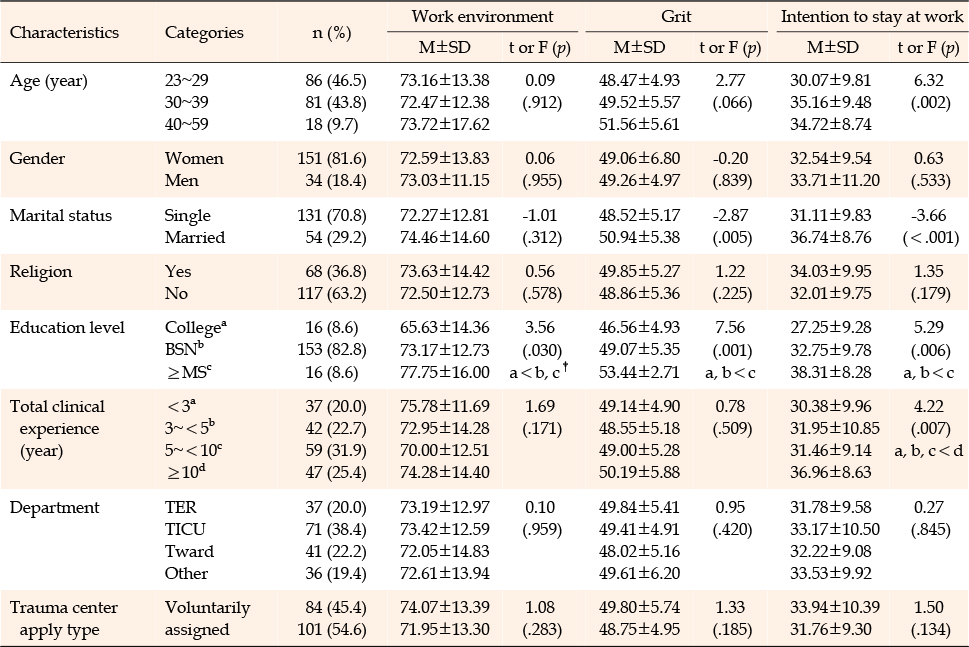
Table 1
Work Environment, Grit, and Intention to Stay at Work according to General Characteristics of Patients (N=185)

2. Differences in Nursing Work Environment, Grit, and Intention to Stay at Work According to Subjects' General Characteristics

Regarding the differences in nursing work environment, grit, and intention to stay at work according to the general characteristics of the subjects, there was a difference in the environment according to the level of education (F=3.56, p=.030). As a result of the post-hoc analysis, subjects with a bachelor's degree or higher had higher nursing work environment scores than did those with a professional bachelor's degree. Grit scores according to the general characteristics of the subjects showed differences in marital status (F=-2.87, p=.005) and education level (F=7.56, p=.001). As a result of the post-hoc analysis, it was found that married subjects had higher grit scores than unmarried subjects, and those with a master's degree or higher had higher grit scores than did subjects with a bachelor's degree or less.

The scores of intention to stay at work showed differences according to age (F=6.32, p=.002), marital status (F=-3.66, p<.001), education level (F=5.29, p=.006), and total clinical experience (F=4.22, p=.007). As a result of the post-hoc analysis, it was found that subjects with a master's degree or higher had a higher intention to stay at work than did subjects with a bachelor's degree or less, and those with more than 10 years of clinical experience had higher intentions to stay at work than did those with less than 10 years of experience (Table 1).

3. Nursing Work Environment, Grit, and Degree of Intention to Work for the Subjects

In this study, the nursing work environment of the subjects scored an average of 2.51±0.46 points out of 4. The average scores of the sub-items were 2.35±0.56 points for nurse participation in hospital operation, 2.68±0.48 points for the foundation for quality nursing, 2.64±0.64 points for ability and leadership and support of nursing managers, 2.20±0.66 points for sufficient manpower and material resources, and 2.76±0.58 points for the cooperative relationship between nurses and doctors. The grit score of the subjects was an average of 49.23±5.33 (3.52±0.38 out of 4 points) out of 56 points. The average score of the sub-items was 15.55±3.29 for persistence to achieve long-term goals, 18.91±1.69 for the passion to become a nursing professional, and 14.77±1.49 for patient-oriented intrinsic motivation. The intention of the subjects to stay at work was 32.75±9.85 (5.46±1.64 out of 8 points) on average out of a total of 48 points (Table 2).
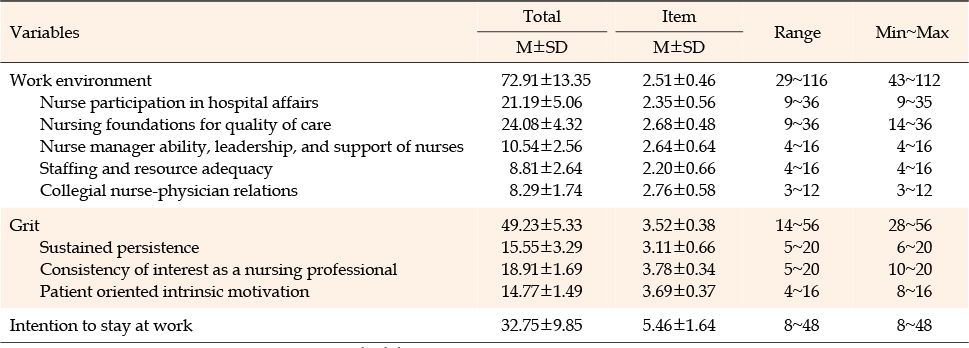
Table 2
The Level of Work Environment, Grit, and Retention Intention (N=185)

4. The Mediating Effect of Grit in the Relationship between the Nursing Work Environment and Intention to Work for Subjects

In order to verify the mediating effect of grit in the relationship between the subjects' nursing work environment and intention to stay at work, a regression analysis was conducted using the three-step procedure of Baron and Kenny [26]. After regression analysis, the Sobel test was conducted to verify the significance of mediating effects between variables (Table 3, Figure 1).
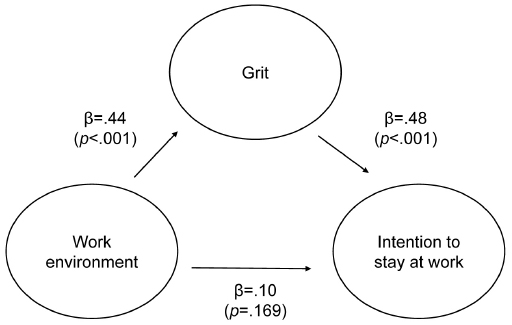
Figure 1
Model for the mediating effect.
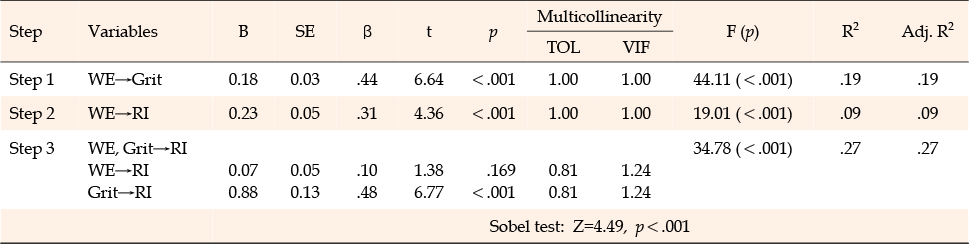
Table 3
Mediating Effect of Grit in the Relationship between Work Environment and Intention to Stay at Work (N=185)

In step 1, the independent variable, the nursing work environment, was found to have a significant effect on the parameter, grit (β=.44, p<.001). In the second stage, the independent variable, nursing work environment, was found to have a significant effect on the dependent variable, intention to stay at work (β=.31, p<.001). The explanatory power was 9.4% in the second stage, which was lower than that in the first stage (19.0%). In the last stage, the independent variable, nursing work environment, did not appear to have a significant effect on intention to stay at work (β=.10, p=.169). However, grit was found to have a significant effect on retention intention (β=.48, p<.001) and the explanatory power increased to 27.7%. In step 3, nursing work environment did not have a significant effect on the intention to stay, but grit did have a significant effect. Grit was found to completely mediate the relationship between nursing work environment and intention to stay at work. As a result of the Sobel test, the mediating effect was found to be significant (Z=4.49, p<.001).

DISCUSSION

This study was conducted to assess the nursing work environment, grit, and intention to stay at work of nurses working in regional trauma centers, and to confirm the mediating effect of grit in the relationship between nursing work environment and intention to stay at work. The average score of the nursing work environment of the subjects in this study was 2.51 points, which was similar to 2.62 points in the study of Kim and Seo [5] that investigated the nursing work environment for clinical nurses working in tertiary general hospitals, 2.49 points in the study by Lee and Seomun [6], and 2.58 points in the study by Cho et al. [23].

According to a previous study by Cho et al. [23], who developed the nursing work environment measurement tool for this study, the tool is based on an average score of 2.50; if it is higher than this, it is judged that the nursing work environment perceived by nurses is good. At the time of development, the average score was 2.58, showing a slightly higher score than the average, and in this study, the score slightly exceeded 2.50. These results can be interpreted as the nursing work environment perceived by nurses being good on average; on the other hand, it is also possible to interpret that there is no significant difference in the current nursing work environment 10 years after the tool development. Therefore, in order to clarify these results, it is necessary to compare and evaluate the nursing work environment through a multicenter study using various tools. According to a study by Lake [27], the nursing work environment scores of 16 magnet-accredited hospitals in the US were higher than those of eight non-magnet-accredited hospitals. This means that the nursing work environment should be improved not simply for hospital evaluation, but through improving the quality of nursing care and treatment. Organizational and policy efforts are needed for this purpose.

Among the sub-items of the nursing work environment, "sufficient manpower and material resources" showed the lowest score, being consistent with the results of several previous studies [5, 6, 23]. In previous studies, the cause for the low score was attributed to a shortage of nurses [5, 23]. A study by Kang [28], which investigated nurses in seven small and medium-sized hospitals in Korea, also showed the lowest score in this sub-item. It can be inferred that the shortage of domestic nurses is a factor that deteriorates the working environment of nurses in both tertiary general hospitals and small and medium-sized hospitals. Therefore, it is necessary to prepare a fundamental solution to solve the shortage of nurses in regional trauma centers.

In this study, the average grit of the subjects scored 3.52 points, which was higher than 3.05 points in the study of Park and Cho [19] and 2.98 points in the study of Shin and Choi [29], which investigated general hospital nurses as subjects. This means that there is a difference in grit between nurses working in general medical institutions and those in regional trauma center nurses. It is difficult to establish the exact causal relationship of these differences as there are not many previous studies that have investigated grit in nurses. Nevertheless, it is believed that the passion and perseverance generated in this situation-taking responsibility for the life-threatening trauma patients till the end and performing treatment and nursing-result in this difference. Therefore, it is necessary to analyze various factors that affect the grit of regional trauma center nurses and further research is needed to specifically identify these differences with nurses working in general medical institutions.

Prior studies conducted abroad report that grit will help healthcare workers, including nurses, treat patients with enthusiasm in clinical practice, and improve their passion for their work, job commitment, and intention to stay at work [30, 31]. Therefore, it is necessary to seek ways to improve the grit of nurses working at regional trauma centers. Further research is needed to analyze various factors that affect grit and develop an intervention program to improve it.

The intention to stay at work for the subjects of this study was 5.46 on average, which was higher than that in previous studies [9, 18, 19, 32]. According to a systematic literature review that analyzed the influencing factors of domestic nurses' intention to stay at work, 32 variables were reported to be related to the intention to stay at work. Among them, organizational commitment, professional self-concept, job satisfaction, resilience, nursing performance, burnout, and job stress were significantly related to the intention to stay at work [33]. Regional trauma center nurses are considered to have high professional self-concept and job satisfaction while performing trauma-related tasks, similar to the previous difference in grit [1]. The difference in intention to work between general medical institutions and regional trauma center nurses is interpreted as a result derived from various factors rather than simply the medical institution where they work.

Regarding the difference in intention to stay according to the general characteristics of regional trauma center nurses, it was found that there was a difference in intention to stay according to age, marital status, education level, and clinical experience. This is consistent with the results of several previous studies, which showed differences in intention to stay at work according to age [9, 10, 19, 34], marital status [9, 10, 11, 12, 19], education level [19], and clinical experience [9, 11, 12, 19]. The more the age and longer the clinical experience, the higher the job proficiency, and the higher the position and salary.

Contrary to the above, it was found that nurses with short clinical careers had a low intention to stay. In previous studies, as ways to improve nurses' intention to stay at the job, time for psychological exchange regarding motives for joining the company, interest and encouragement from senior nurses, opportunities to participate in education, mentoring by senior nurses who can adapt to new field work, and work motivation have been suggested [10, 19, 32]. Not only medical institutions, but also various academic societies and associations should make efforts to increase the intention to stay for new nurses and nurses with short clinical experience through follow-up intervention studies applying various measures suggested in previous studies.

According to the results of this study, the grit of regional trauma center nurses had a complete mediating effect on the relationship between nursing work environment and intention to stay. This study confirmed that grit directly affects retention intention in the relationship between the three variables; nursing work environment indirectly affects retention intention through grit as a medium. When seeking ways to increase the intention to stay at work for nurses at regional trauma centers, an effective intervention method would be to create and apply a program to increase grit by improving the nursing work environment, which would ultimately lead to an increase in intention to stay at work.

According to previous studies, in order to improve grit, it is essential to provide an environment in which new and junior nurses can set individual goals and achieve them in the long term, alongside various educational opportunities to provide continuous interest and motivation for the goals; support and encouragement from senior nurses and nursing managers are also required [35].

There are limitations in comparing the results of this study from various perspectives since there is a lack of research on the effect of grit on retention intention [11, 18, 19]; moreover, there are no previous studies that have measured the mediating effect of grit on the relationship between nursing work environment and retention intention. Therefore, it is necessary to analyze the effect of grit in various nursing work environments through follow-up studies to confirm the effect on the improvement in intention to stay at work; based on this, a suitable intervention program to improve grit can be developed.

The significance of the study can be found in verifying that grit had a complete mediating effect on the relationship between nursing work environment and the intention to stay among regional trauma center nurses. Basic data for the development of interventions that can increase the intention to stay at work for nurses at regional trauma centers are presented. However, this study was conducted in a situation where face-to-face investigation was limited due to the COVID-19 pandemic. Although nurses from 16 regional trauma centers participated, the proportion of nurses participating in each regional trauma center showed a large difference; the difference in size of regional trauma centers according to the number of hospital beds was not considered. Therefore, caution is required in generalizing the results of this study to all regional trauma center nurses due to these limitations.

CONCLUSION

This study was conducted to provide basic data for the development of an intervention program to improve intention to stay at work by confirming the mediating effect of grit in the relationship between nursing work environment and intention to stay at work among regional trauma center nurses. It was confirmed that grit had a complete mediating effect on the relationship between nursing work environment and intention to stay. Therefore, in order to improve the intention to stay among regional trauma center nurses, it is necessary to establish long-term goals for new nurses and nurses with short clinical careers and prepare an intervention plan that can improve their grit.

Through the results of this study, we would like to suggest the following: First, a follow-up study will be needed to develop a grit intervention program to improve the intention to stay at work for nurses at regional trauma centers and to verify its effectiveness. Second, the difference in intention to stay at work according to the hospital size of the regional trauma center, including the nursing work environment variables of regional trauma center nurses, should be confirmed and expanded to a multi-center follow-up study, including all regional trauma centers operating in South Korea. Third, it will be necessary to conduct a qualitative study that can deeply and empirically explore the phenomenon of intention to stay for the regional trauma center nurses.

Notes

CONFLICTS OF INTEREST:The authors declared no conflict of interest.

AUTHORSHIP:

  • Study conception and design acquisition - YJS and JMJ.

  • Data collection - YJS and JMJ.

  • Analysis and interpretation of the data - YJS and JMJ.

  • Drafting and critical revision of the manuscript - YJS and JMJ.

ACKNOWLEDGEMENT

Thank you to the Korean Association for Nurses of Trauma (KANT), a Korean trauma nurses society who helped to collect data.

References

    1. Ministry of Health and Welfare. Policy for improving severe trauma care system to save the lives of the people [Internet]. National Agenda Checking and Adjustment Conference; 2018 [cited 2023 January 22].
    1. Woo MJ, Kim DH. Factors associated with secondary traumatic stress among nurses in regional trauma centers in South Korea: a descriptive correlational study. Journal of Emergency Nursing 2021;47(3):400–411. [doi: 10.1016/j.jen.2020.08.006]
    1. Wijdenes KL, Badger TA, Sheppard KG. Assessing compassion fatigue risk among nurses in a large urban trauma center. Journal of Nursing Administration 2019;49(1):19–23. [doi: 10.1097/NNA.0000000000000702]
    1. Van VD, Aungsuroch Y, Navicharern R. A study of trauma nursing core competency among staff nurses in Vietnamese general hospitals. Journal of Health Research 2015;29(2):143–151.
    1. Kim SU, Seo MJ. The mediating effect of resilience on the relationship between nurse practice environment and organizational commitment in clinical nurses. Journal of Digital Convergence 2020;18(12):435–444. [doi: 10.14400/JDC.2020.18.12.435]
    1. Lee YJ, Seomun GA. Impact of unit-level nurse practice environment on nurse turnover intention. Journal of Digital Convergence 2016;14(6):355–362. [doi: 10.14400/JDC.2016.14.6.355]
    1. Freeman L, Fothergill-Bourbonnais F, Rashotte J. The experience of being a trauma nurse: a phenomenological study. Intensive and Critical Care Nursing 2014;30(1):6–12. [doi: 10.1016/j.iccn.2013.06.004]
    1. Lee HJ, Lee SK. Effects of job embeddedness and nursing working environment on turnover intention among trauma center nurses: a cross-sectional study. Journal of Nursing Management 2022;30(7):2915–2926. [doi: 10.1111/jonm.13666]
    1. Kim YM, Seo MJ. Factors influencing the retention intention of nurses in general hospital nurses. Journal of Digital Convergence 2020;18(12):377–387. [doi: 10.14400/JDC.2020.18.12.377]
    1. Lee MH, Kwon SH. Mediating effect of organizational commitment on the relationship between nurses' clinical characters and retention intention of the small and medium-sized hospital nurses. Journal of Korean Academy of Nursing Administration 2022;28(2):110–120. [doi: 10.11111/jkana.2022.28.2.110]
    1. Ko JH, Gu MO. Convergence study on mediating effect of clinical competence on the relationship between grit and retention intention among new graduate nurses. Journal of the Korea Convergence Society 2020;11(4):369–380. [doi: 10.15207/JKCS.2020.11.4.369]
    1. Yu M, Kang KJ, Yu SJ, Park MS. Factors affecting retention intention of male nurses working health care institution in Korea. Journal of Korean Academy of Nursing Administration 2017;23(3):280–289. [doi: 10.11111/jkana.2017.23.3.280]
    1. Hussein R, Salamonson Y, Hu W, Everett B. Clinical supervision and ward orientation predict new graduate nurses' intention to work in critical care: findings from a prospective observational study. Australian Critical Care 2019;32(5):397–402. [doi: 10.1016/j.aucc.2018.09.003]
    1. Twigg D, McCullough K. Nurse retention: a review of strategies to create and enhance positive practice environments in clinical settings. International Journal of Nursing Studies 2014;51(1):85–92. [doi: 10.1016/j.ijnurstu.2013.05.015]
    1. Duckworth AL, Peterson C, Matthews MD, Kelly DR. Grit: perseverance and passion for long-term goals. Journal of Personality and Social Psychology 2007;92(6):1087–1101. [doi: 10.1037/0022-3514.92.6.1087]
    1. He C, Wu D, Yang L, Yang L, Yue Y. Psychometric properties of the Grit-S in Chinese nurses. Frontiers in Psychology 2021;12:5057–5065. [doi: 10.3389/fpsyg.2021.766055]
    1. Lee CJ. In: The influence of grit, nursing practice environment on turnover intention of general hospital nurses [master's thesis]. Busan: Catholic University of Pusan; 2023.
    1. Lee DY, Kim SY. The influences of grit, emotional labor and organizational intimacy on nurses' intention to stay in comprehensive nursing care service units. Korean Journal of Rehabilitation Nursing 2020;23(2):149–157. [doi: 10.7587/kjrehn.2020.149]
    1. Park MH, Cho SH. Relationships among grit, job satisfaction, and the intention to stay of clinical nurses in Korea. Journal of Korean Clinical Nursing Research 2019;25(3):285–293. [doi: 10.22650/JKCNR.2019.25.3.285]
    1. Jeong JY, Seo YS, Choi JH, Kim SH, Lee MS, Hong SH, et al. The influence of grit on turnover intention of university hospital nurses: the mediating effect of job involvement. Journal of Korean Academy of Nursing 2019;49(2):181–190. [doi: 10.4040/jkan.2019.49.2.181]
    1. Kang HM, Seo HA. The meditating effect of grit on the relationship between occupational well-being and burnout in early childhood teachers. Journal of Children's Literature and Education 2019;20(2):121–139. [doi: 10.22154/JCLE.20.2.6]
    1. Han MR, Kim GS. The mediating effect of grit on the relationship between teacher efficacy and resilience of early childhood teachers. Korean Journal of Early Childhood Education 2018;38(4):237–257. [doi: 10.18023/kjece.2018.38.4.010]
    1. Cho EH, Choi MN, Kim EY, Yoo IY, Lee NJ. Construct validity and reliability of the Korean version of the practice environment scale of nursing work index for Korean nurses. Journal of Korean Academy of Nursing 2011;41(3):325–332. [doi: 10.4040/jkan.2011.41.3.325]
    1. Park HS, Lee KM, Shin NY. Development and validation of the clinical nurses grit scale (CN-GRIT). Journal of Korean Academy of Nursing Administration 2020;26(1):55–64. [doi: 10.11111/jkana.2020.26.1.55]
    1. Cowin L. The effects of nurses' job satisfaction on retention: an Australian perspective. The Journal of Nursing Administration 2002;32(5):283–291. [doi: 10.1097/00005110-200205000-00008]
    1. Baron RM, Kenny DA. The moderator-mediator variable distinction in social psychological research: conceptual, strategic, and statistical considerations. Journal of Personality and Social Psychology 1986;51(6):1173–1182. [doi: 10.1037//0022-3514.51.6.1173]
    1. Lake ET. Development of the practice environment scale of the nursing work index. Research in Nursing & Health 2002;25(3):176–188. [doi: 10.1002/nur.10032]
    1. Kang KN. In: Nurses' practice environment, nursing professionalism, career commitment, and turnover intention in the small-medium sized hospital [master's thesis]. Seoul: Ewha Womans University; 2010.
    1. Shin HK, Choi HR. The influences of hospital nurses' grit and positive psychological capital on job engagement. Journal of Digital Convergence 2022;20(3):497–505. [doi: 10.14400/JDC.2022.20.3.497]
    1. Schimschal SE, Visentin D, Kornhaber R, Cleary M. Grit: a concept analysis. Issues in Mental Health Nursing 2021;42(5):495–505. [doi: 10.1080/01612840.2020.1814913]
    1. Munro CL, Hope AA. Grit makes us unstoppable. American Journal of Critical Care 2019;28(5):334–336. [doi: 10.4037/ajcc2019871]
    1. Yom YH, Yang IS, Han JH. Effects of workplace bullying, job stress, self-esteem, and burnout on the intention of university hospital nurses to keep nursing job. Journal of Korean Academy of Nursing Administration 2017;23(3):259–269. [doi: 10.11111/jkana.2017.23.3.259]
    1. Lim JY, Shin JA, Kim SK, Lee EM, Kim SH. Influencing factors on nurse's intention to stay: systematic review and meta correlation analysis. Journal of Korean Academic Society of Home Health Care Nursing 2019;26(3):265–277. [doi: 10.22705/jkashcn.2019.26.3.265]
    1. Wright C, McCartt P, Raines D, Oermann MH. Implementation and evaluation of self-scheduling in a hospital system. Journal for Nurses in Professional Development 2017;33(1):19–24. [doi: 10.1097/NND.0000000000000324]
    1. Tyer-Viola LA. Grit: the essential trait of nurses during a disaster. The Journal of Perinatal & Neonatal Nursing 2019;33(3):201–204. [doi: 10.1097/JPN.0000000000000416]

Download Citation

Download a citation file in RIS format that can be imported by all major citation management software, including EndNote, ProCite, RefWorks, and Reference Manager.

Format:

Include:

The Mediating Effect of Grit on the Relationship between Work Environment and Intention to Stay at Work among Regional Trauma Center Nurses: A Cross-Sectional Study
Korean J Adult Nurs. 2023;35(2):107-116.   Published online May 31, 2023
Download Citation
Download a citation file in RIS format that can be imported by all major citation management software, including EndNote, ProCite, RefWorks, and Reference Manager.

Format:
  • RIS — For EndNote, ProCite, RefWorks, and most other reference management software
  • BibTeX — For JabRef, BibDesk, and other BibTeX-specific software
Include:
  • Citation for the content below
The Mediating Effect of Grit on the Relationship between Work Environment and Intention to Stay at Work among Regional Trauma Center Nurses: A Cross-Sectional Study
Korean J Adult Nurs. 2023;35(2):107-116.   Published online May 31, 2023
Close
TOP