

| Hyun-E Yeom | 1 Article |
Purpose
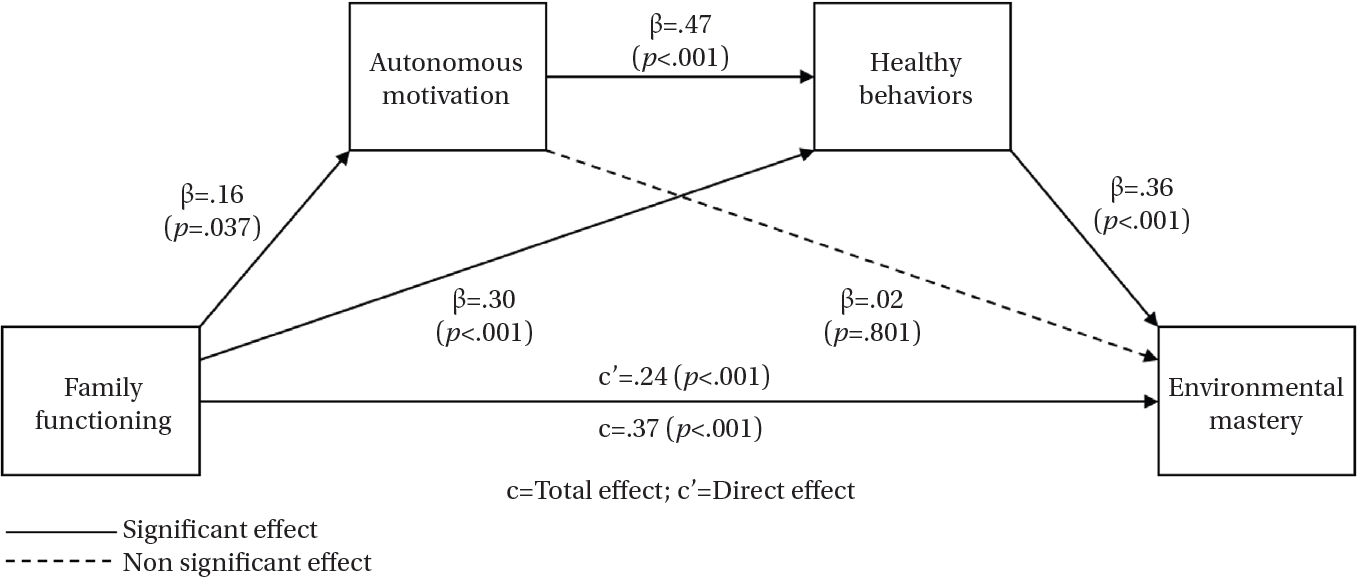
This study examined the association between family functioning and environmental mastery among breast cancer survivors. Specifically, it tested a serial mediation model involving autonomous motivation and healthy behaviors and compared this pathway with the potential role of controlled motivation. Methods A cross-sectional survey was conducted with 192 community-dwelling Korean breast cancer survivors recruited from an outpatient breast clinic. Participants completed a structured self-administered questionnaire assessing family functioning, autonomous and controlled motivation for self-management, engagement in healthy behaviors, and environmental mastery. Serial mediation was tested using a regression-based bootstrapping approach implemented with Hayes’ PROCESS macro. Results Family functioning was positively associated with both healthy behaviors and environmental mastery. The serial indirect effect through autonomous motivation and healthy behaviors was significant (standardized indirect effect, 0.03; 95% bootstrapped confidence interval [BootCI], 0.00–0.06). In addition, healthy behaviors independently mediated the association between family functioning and environmental mastery (standardized indirect effect, 0.11; 95% BootCI, 0.05–0.17). Controlled motivation was not significantly associated with family functioning and did not contribute to indirect effects. Conclusion Supportive family functioning may enhance environmental mastery primarily through greater engagement in healthy behaviors, including a significant sequential pathway involving autonomous motivation. These findings support family-centered, autonomy-supportive approaches that strengthen healthy behaviors to promote psychological adjustment during breast cancer survivorship.
|
|
 E-SUBMISSION