Purpose This review presents a comprehensive overview of the utilization of educational technology for formative assessment in nursing education and proposes directions for its future application.
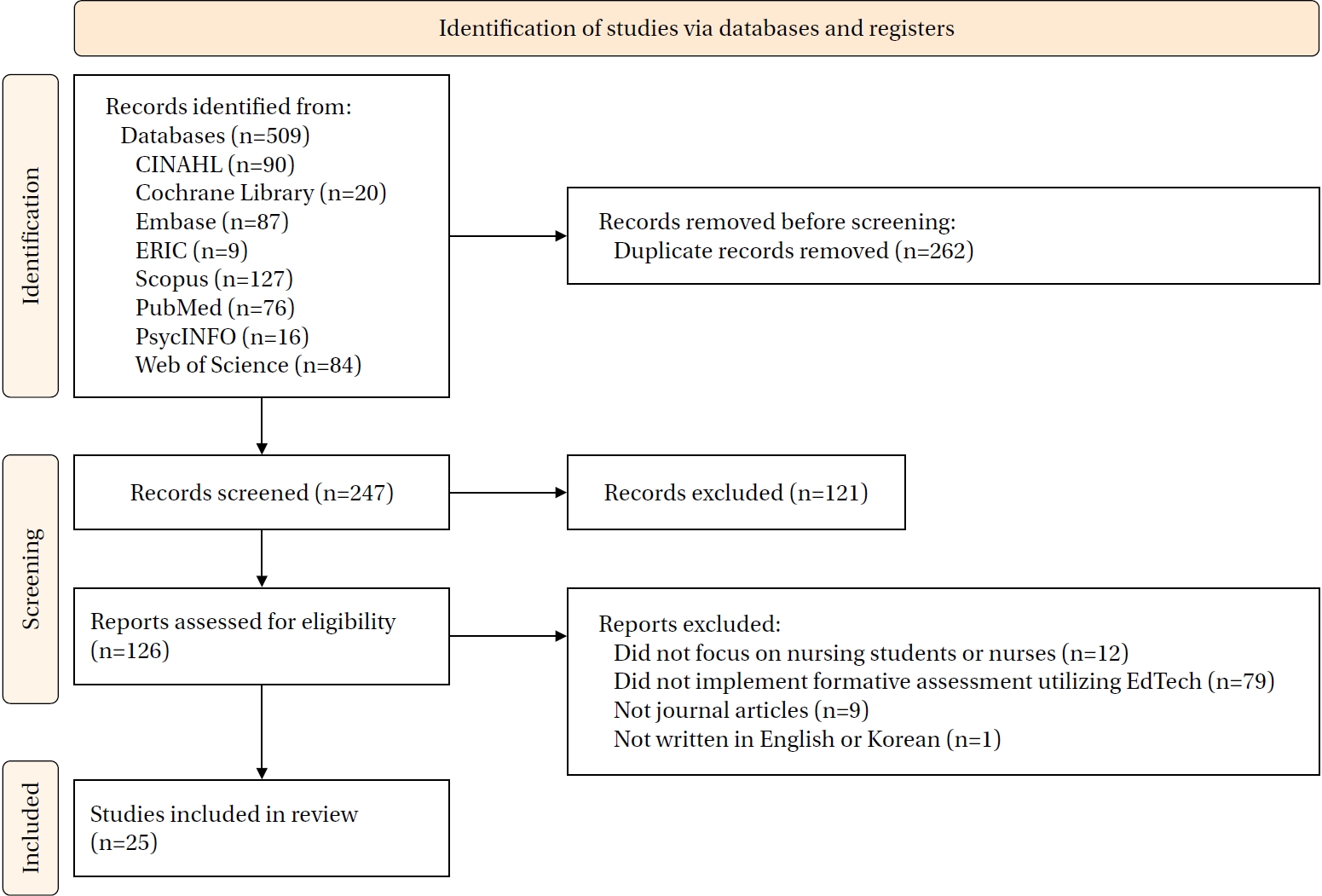
Methods Arksey and O'Malley’s scoping review design was adopted. A total of 509 articles were retrieved in February 2025 from the Cumulative Index to Nursing and Allied Health Literature, the Cochrane Library, Embase, Education Resources Information Center, Scopus, PubMed, PsycINFO, and Web of Science databases.
Results Twenty-five articles that conducted formative assessments utilizing educational technology among nursing students and nurses were analyzed. The analysis identified three key themes: educational technology, formative assessment, and educational feedback. Online platforms were the most frequently employed educational technology, while mobile applications have gained prominence since 2020. Formative assessment primarily evaluated knowledge in theoretical courses but has increasingly been used to evaluate skills in practicum settings since 2020. Immediate constructive feedback was provided by educators, peer learners, and non-human agents. Since 2020, feedback delivery has increasingly been automated through non-human agents, including artificial intelligence-based non-human agents.
Conclusion This review, which focused on the implementation of educational technology-based formative assessment in nursing education, highlights the increasing adoption of non-human agents for delivering educational feedback in practicum courses. To strengthen educators’ competency in providing immediate and constructive educational feedback, sustained support from policymakers and educational institutions is required.
Citations
Citations to this article as recorded by
Academic Performance in Nursing Education Through Digital Competencies and AI Integration: A Systematic Review Lorena Espina-Romero, Jorge Izaguirre Olmedo, Angélica Ochoa-Díaz, Omar El Kadi Janbeih, Karla Rojas Jimenez, Hugo Benzaquen Hinope Encyclopedia.2026; 6(7): 143. CrossRef
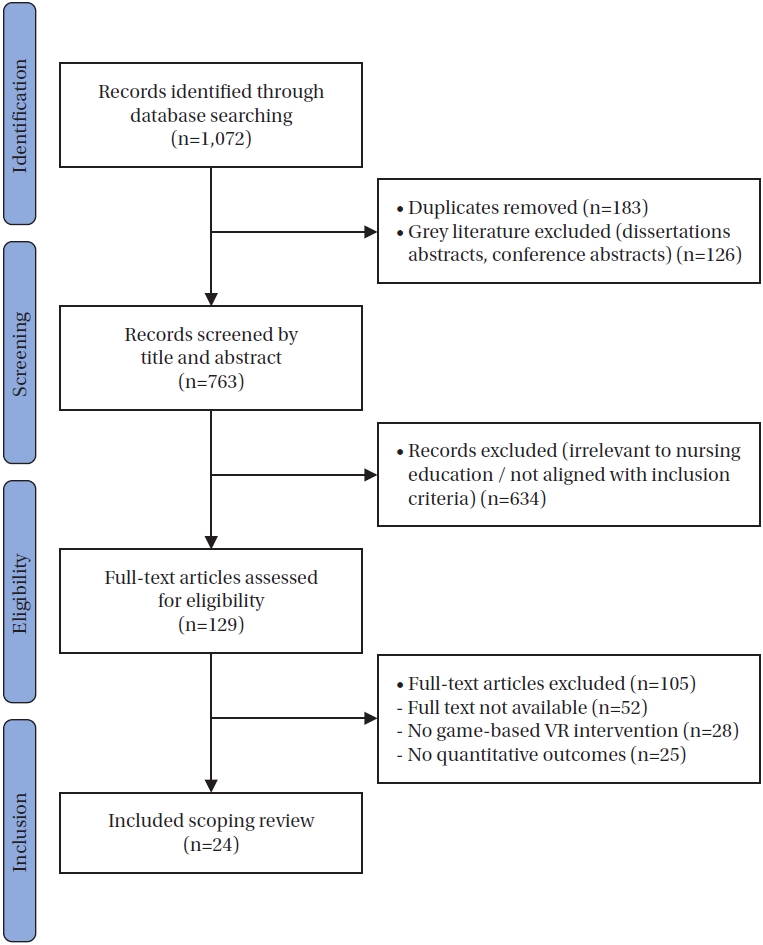
Purpose This scoping review aimed to explore the characteristics and educational effects of game-based virtual reality (VR) programs used in nursing education, providing foundational insights for future instructional design and research. Methods: Following the Joanna Briggs Institute guidelines and the Preferred Reporting Items for Systematic Reviews and Meta-Analyses extension for Scoping Reviews checklist, a comprehensive literature search was conducted across eight databases for studies published between April 2014 and March 2025. Studies were screened and selected using the population, concept, context framework. Twenty-four studies met the inclusion criteria and were analyzed. Results: Most of the 24 included studies targeted nursing students, with some involving practicing nurses. Interventions primarily employed immersive VR head-mounted displays and incorporated diverse game elements such as mission-based scenarios, challenges, feedback loops, and virtual patient interactions. Educational effects were categorized into cognitive, affective, and psychomotor domains. Improvements in knowledge acquisition, self-efficacy, learning motivation, and skill performance were consistently reported. Additionally, most studies reported enhanced learner satisfaction, engagement, and emotional immersion. However, limited evidence was found regarding teamwork and communication skills. Conclusion: Game-based VR programs show substantial potential as effective instructional strategies in nursing education. Their design features—including immediate feedback, repeatable immersive scenarios, and engaging game mechanics—support learner-centered and self-directed learning. Nevertheless, the current evidence base largely focuses on nursing students and short-term outcomes. Future studies should encompass diverse nursing populations and assess long-term effects and real-world applicability, particularly in team-based and clinical practice contexts.
Citations
Citations to this article as recorded by
Design and usability of an immersive virtual reality simulation in orthopaedic nursing education: A pilot study Carla Sílvia Fernandes, Ana Galvão, Cris Renata Grou Volpe, Marta Campos Ferreira International Journal of Orthopaedic and Trauma Nursing.2026; 61: 101286. CrossRef
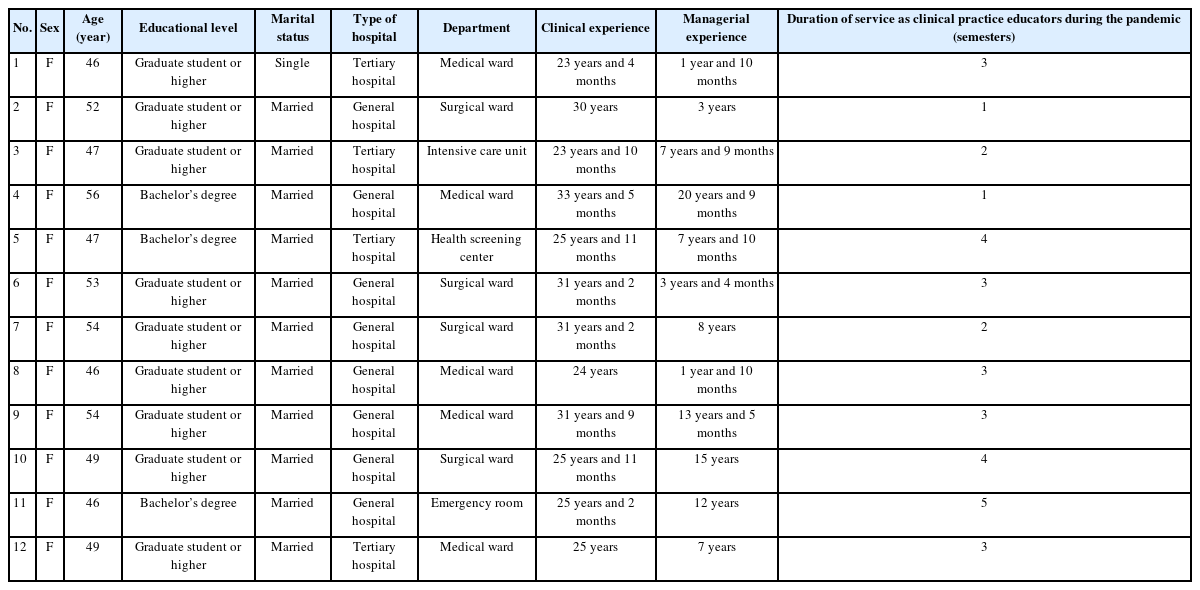
Purpose The purpose of this study was to examine the experiences of nurse managers in clinical nursing education during an emerging infectious disease outbreak. Methods: Individual semi-structured interviews were conducted with 12 nurse managers from seven general or tertiary hospitals, each with 300 or more beds, in South Korea. Data were collected between February 17 and June 10, 2023, and analyzed using qualitative content analysis. Results: Four themes and 11 subthemes were identified. Nurse managers faced significant challenges in departmental management during the infectious disease outbreak, encountered a wide range of student attitudes toward learning, adapted their teaching methods flexibly in response to changing infectious disease conditions, and ultimately found meaning in the irreplaceable value of clinical practice education. Conclusion: During the emerging infectious disease outbreak, nurse managers not only encountered substantial difficulties but also experienced professional growth as clinical nursing educators. To enhance clinical nursing education in such challenging environments, it is essential to minimize uncertainty caused by infectious diseases and foster positive perceptions among nursing students regarding clinical practice education under restrictive circumstances. Institutional support is also necessary to reduce the work burden on nurse managers.
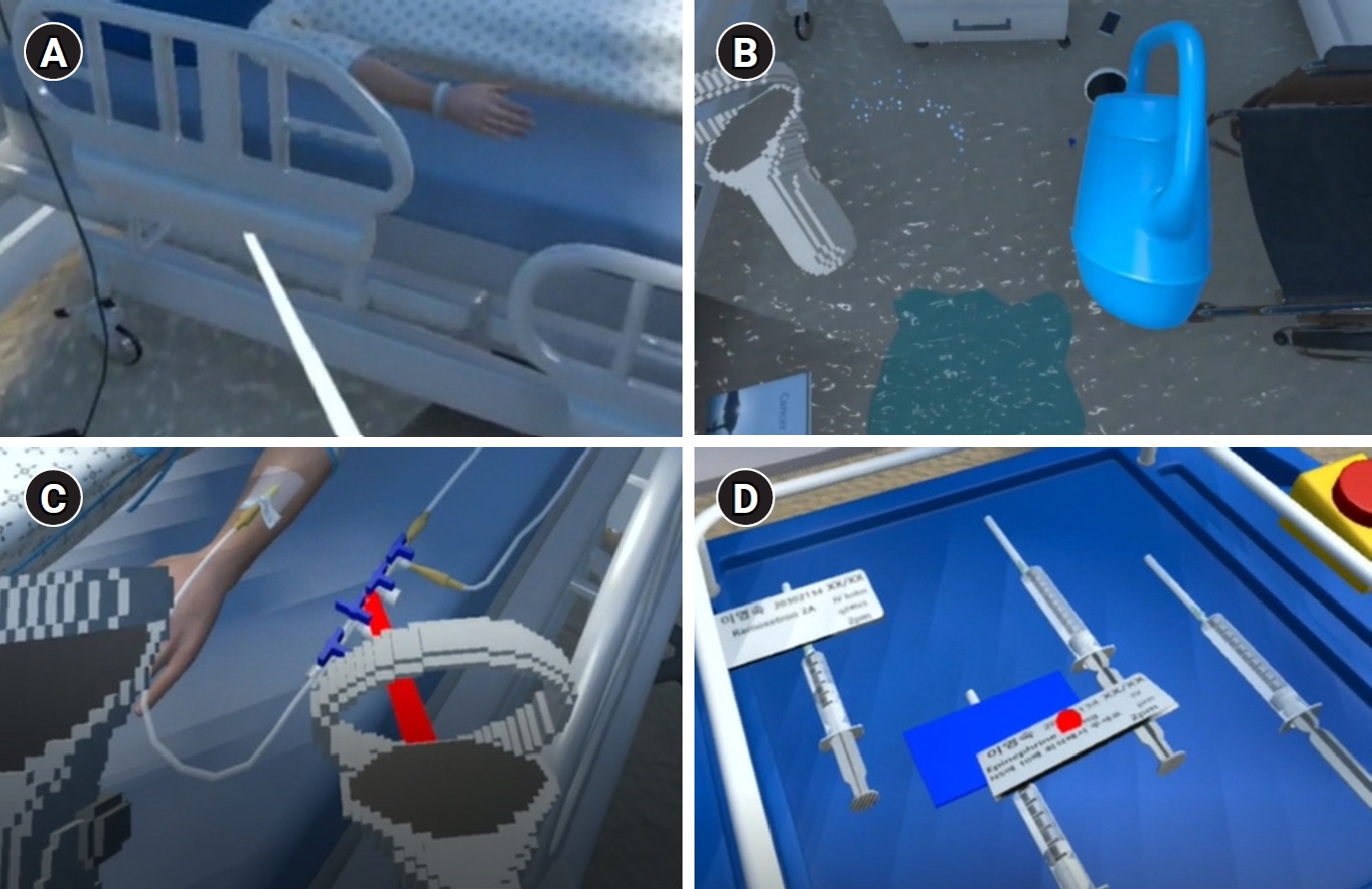
Purpose Falls and medication errors are the most common patient safety incidents globally. Kolb’s experiential learning theory supports the application of cognitive learning in clinical settings. This study examined the effectiveness of Experiential Learning–Based Fall and Medication Error Prevention Education (EFMPE), utilizing virtual reality and room of errors.
Methods A randomized controlled trial was conducted with 28 fourth-year nursing students (15 experimental, 13 control). The experimental group participated in EFMPE from February 1 to 6, 2024, comprising six sessions of 2 hours each. The control group received traditional lectures. Safety control confidence and course interest were measured before and immediately after the intervention; safety control confidence was reassessed 6 weeks later.
Results Both groups showed immediate improvement; however, only the experimental group sustained increased safety control confidence after 6 weeks (Wald χ²=13.21, p<.001). Course interest was significantly higher in the experimental group post-intervention (Wald χ²=10.64, p=.001).
Conclusion These preliminary findings suggest that EFMPE potentially supports the prevention of falls and medication errors in clinical practice.
Citations
Citations to this article as recorded by
Safety-centered simulation education using the 360-degree video room of errors: A mixed-methods study Jiyoung Kim, Yeji Kim, Hyunji Park, Jiyeong Won, Jiwon Yun, Yuran Lee Clinical Simulation in Nursing.2026; 111: 101899. CrossRef
Effects of different technology-based simulation on nursing students' self-confidence and critical thinking: A systematic review and network meta-analysis Huijie Wang, Shuwei Zhang, Yi Feng, Yiming Lu, Zhenzhen Wang, Mingyue Jia, Cui Hou, Guozeng Zhang Nurse Education Today.2026; 165: 107166. CrossRef
Purpose This study was a scoping review aimed at evaluating Simulation-Based Education for recognizing and responding to deteriorating patients within Korean nursing school curricula, and at developing educational strategies for these competencies. Methods A literature search was conducted from April 1 to April 30, 2024. The review followed the scoping review framework by Arksey and O’Malley and the manual by the Joanna Briggs Institute. Relevant studies were identified through databases such as the Korean Medical Database, Korean Studies Information Service System, DataBase Periodical Information Academic, Research Information Sharing Service, ScienceOn, and the Cumulative Index to Nursing and Allied Health Literature. Results Eleven studies published from 2010 to 2019 were reviewed. The simulations typically included several lectures and practice sessions on advanced cardiopulmonary life support before the simulation exercises, which were then repeated.
Cardiac arrest was frequently used as a scenario subject. The learning outcomes focused on the cognitive and psychomotor domains, as well as self-efficacy. Conclusion Although simulation for recognizing and responding to deteriorating patients was available in Korean nursing school curricula, it was infrequently incorporated as a regular part of the training. Future initiatives should include adding educational content to enhance nursing students' competencies in recognizing and responding to deteriorating patient simulations. Subsequent studies should assess the effectiveness of these educational methods.
Citations
Citations to this article as recorded by
Utilization of advanced resuscitation skills among doctors and nurses in Uganda Peter Kavuma, Mary Ellen Lyon, Doreen Okong Alaleit, Jonathan Byasi, Janat Tumukunde, Daniel Obua African Journal of Emergency Medicine.2026; 16(2): 100969. CrossRef



 E-SUBMISSION
 First
First Prev
Prev